
Pawpaw
Papaw, American custard-apple; asiminier of the French colonists; Asimina triloba of Dunal, Annona triloba of Linnaeus, Uvaria triloba, Porcelia triloba; not the papaya, Carica papaya, which has borrowed the name
- Known today as
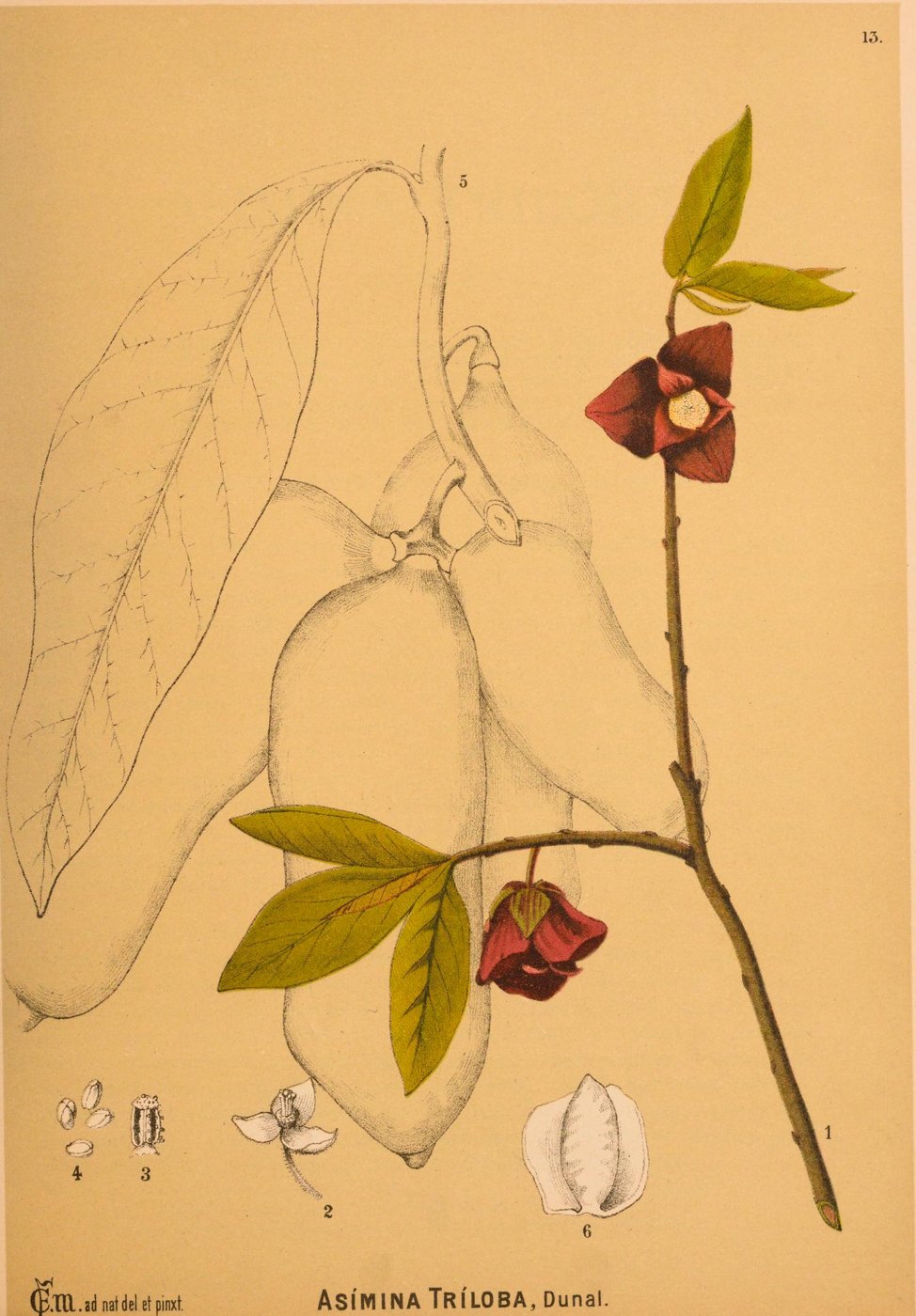
- Asimina triloba, the one temperate tree of the custard-apple family: ten to thirty feet high, with long thin leaves, dull purple flowers that open with or before the leaves, and oblong pulpy fruits like short bananas, native to the central belt of the United States from western New York to the Mississippi and southward, along streams where the soil is rich and the frosts come late.
- Kind
- Plant, in 3 older authorities
- Constituents
- annonaceous acetogenins, annonacin
- Earliest authority here
- C. S. Rafinesque
- In other databases
- Plants of the World Online search · GBIF search · Wikidata search
Caution. The ripe pulp has been eaten in the Ohio valley for as long as there are records of it, and the seeds and bark were known to be emetic and bitter. The acetogenins measured in the pulp in 2012 are toxic to nerve cells in culture, and their risk in long use has not been studied; twig extracts sold as cancer remedies carry the same compounds in greater strength.
Pawpaw: what was it used for?
A fruit more than a medicine. Rafinesque found the pulp, sweet, luscious, and yellow like a custard when ripe after frost, to be “sedative, laxative and healthy,” and a clear wine made of it useful for the mouth-sores of children; the Indians, he says, made strong ropes of the bark. Millspaugh, who thought the former medical uses of little or no importance, records that a tincture of the seed proves emetic and that the bitter bark was taken for a tonic; the fruit, greatly prized by the aborigines, was in his day occasionally sold in city markets, and “only fit to eat after having been touched by frost,” when it turns from yellowish-green to black and becomes inside of the colour and consistence of custard.
Pawpaw: foraging it in the Midwest
- Part
- Fruit
- When
- September and October, after frost
Along streams in rich soil through the Ohio valley and the central belt from western New York to the Mississippi, Millspaugh says; the fruit is fit to eat only when frost has turned it from yellowish-green to black and custard within. The seeds and bark are not eaten.
After Millspaugh; Rafinesque. All the foragables of the Midwest. Historical record, not a field guide: identify before you gather, and read the whole entry.
Pawpaw: what does modern science say?
The pawpaw holds annonaceous acetogenins, the compounds of its tropical relatives, in twigs, unripe fruit, seeds, roots, and bark, and, a 2009 study found, in the ripe pulp too, where asimicin, bullatacin, and bullatalicin were identified and the pulp extract was as active in a brine-shrimp assay as the twig extract. In 2012 annonacin, a mitochondrial complex I inhibitor, was measured in the fruit pulp at about 0.07 milligrams a gram, and both it and the crude extract killed half of cultured rat cortical neurons in two days; the authors called for studies of the risk of chronic exposure, since related compounds in soursop and its leaf tea have been linked to atypical Parkinsonism. Twig extracts are sold as an anticancer alternative medicine; in cells they block the hypoxia signal that drives tumour blood supply, by the same inhibition of complex I.
Pawpaw: is it poisonous?
Yes, in some form or dose. The ripe pulp has been eaten in the Ohio valley for as long as there are records of it, and the seeds and bark were known to be emetic and bitter. The acetogenins measured in the pulp in 2012 are toxic to nerve cells in culture, and their risk in long use has not been studied; twig extracts sold as cancer remedies carry the same compounds in greater strength. Historical description, not medical advice; in a poisoning, call a poison centre.
Pharmacognosy & Toxicology
- Constituents
- annonaceous acetogeninsasimicin, bullatacin, and bullatalicin identified in the ripe pulp; in twigs, unripe fruit, seeds, roots, and bark besides
- annonacina complex I inhibitor measured at about 0.07 milligrams a gram of fruit pulp, toxic to cultured cortical neurons
- Mechanism
- The acetogenins inhibit mitochondrial complex I; in tumour cells this blocks the hypoxia-inducible factor HIF-1 and the VEGF it drives, which is the proposed anticancer mechanism of the twig-extract products, and in cultured neurons the same inhibition kills, which is the proposed hazard.
- Toxic dose
- A fruit, eaten ripe; Millspaugh’s tincture of the ripe seeds was an emetic. No dose of the acetogenins is established for people.
- Standing
- A regional fruit crop and a cancer alternative medicine, with the same compounds behind both; the question of long-term neurotoxicity from the fruit was raised in 2012 and has not been answered in any study read here.
- Potts, L. F., Luzzio, F. A., Smith, S. C., Hetman, M., Champy, P., & Litvan, I. (2012). Annonacin in Asimina triloba fruit: implication for neurotoxicity. Neurotoxicology 33: 53–58. doi:10.1016/j.neuro.2011.10.009 Verified against its record · PMID 22130466
- Pomper, K. W., Lowe, J. D., Crabtree, S. B., & Keller, W. (2009). Identification of annonaceous acetogenins in the ripe fruit of the North American pawpaw (Asimina triloba). Journal of Agricultural and Food Chemistry 57: 8339–8343. doi:10.1021/jf9018239 Verified against its record · PMID 19711911
- Coothankandaswamy, V., et al. (2010). The alternative medicine pawpaw and its acetogenin constituents suppress tumor angiogenesis via the HIF-1/VEGF pathway. Journal of Natural Products 73: 956–961. doi:10.1021/np100228d Verified against its record · PMID 20423107
The abstract of each source, beneath its citation. For Club members. About the Club or sign in.
Constituent names open the compound’s record at PubChem, and “ChEMBL” beside a name opens its record at ChEMBL, the European Bioinformatics Institute’s database of bioactive molecules. Where a mechanism line was checked against ChEMBL (ChEMBL 37, read 1 October 2026), the check is shown with the measured value and its source paper, or says plainly that nothing has been measured. Doses are as the references give them, for description only; this is not medical advice. Each source carries the result of its check against Crossref, PubMed, or the authority’s page: see Verification.
Pawpaw: what lore surrounds it?
A tree of two names and two smells: the custard that gives it its common name is what the frost makes of a fruit that, green, smells to Rafinesque like the thorn-apple, and the pawpaw and the papaya have been confused in every herbal since the French of Louisiana called it asiminier. Millspaugh, who could find no analysis of it, hoped that a preparation of the seeds, bark, and green fruit might prove of use; a century later the chemists found the whole tree, pulp included, full of the acetogenins of its tropical cousins.
Pawpaw: what did the older authorities say?
- C. S. Rafinesque
- “Fruit with a bad smell, but when ripe after frost, the pulp is sweet, luscious, yellow, similar to Custards. It is sedative, laxative and healthy. A wine is made of it, quite clear and good, useful for aphthas of children. The skin of the fruit and the seeds are fetid, smell similar to Datura.” All these shrubs, he adds, deserve cultivation.
- Charles F. Millspaugh
- A native especially of the Ohio valley, flowering from March to May, grown in a protected place in Central Park but not hardy north of Cincinnati. The ripe fruit is “soft, sweet, and insipid, having a taste somewhat between that of the May-apple and the banana”; green, it has a very unpleasant odour. “The chemical properties and physiological action have never been—to my knowledge—determined.” His tincture is of the ripe seeds.
- Mrs. M. Grieve
- Her Papaw is the tropical Carica papaya, the source of papain, and she warns that it “must not be confounded with the custard apple, which is often called Papaw and botanically known as Uvaria triloba”: this tree.
Sources
- Millspaugh, C. F. (1887). American Medicinal Plants, vol. 1, no. 13, “Asimina triloba,” and Plate 13. Internet Archive, americanmedicina01mill_0. Primary text
- Rafinesque, C. S. (1830). Medical Flora, or Manual of the Medical Botany of the United States of North America, vol. 2, “Asimina,” p. 194. Internet Archive, b21468710_0002. Primary text
- Grieve, M. A Modern Herbal, “Papaw.” As published on botanical.com. Standard reference work
Verification
- Checked
- October 1, 2026
- Passes
- Every sentence read against its sources, in the pass over the remaining 343 entries
- The Standing line checked against the authority it names (EMA, WHO, FDA, CITES, Commission E)
- Every dated or regulatory claim checked by category across the database
- Sources
- 6 cited: 3 verified against its record, 2 primary text, 1 standard reference work. 3 with the abstract on file.
- Corrections
- None were needed.
What was checked, how, and what was found is set out on the Verification page. A checked source is one whose record was found; it does not make the entry medical advice.
Cite This Entry
Version 1 · first published October 4, 2026
- Chicago
“Pawpaw.” In Materia Medica, edited by B. C. P. Statema. Version 1. The Thinking Press, 2026–. Last modified October 4, 2026. https://thethinkingpress.org/materia-medica/pawpaw.
- MLA
“Pawpaw.” Materia Medica, edited by B. C. P. Statema, version 1, The Thinking Press, 4 Oct. 2026, thethinkingpress.org/materia-medica/pawpaw. Accessed 8 Oct. 2026.
- APA
Pawpaw. (2026, October 4). In B. C. P. Statema (Ed.), Materia medica (Version 1). The Thinking Press. Retrieved October 8, 2026, from https://thethinkingpress.org/materia-medica/pawpaw
Club members keep entries on a shelf with private notes, print the plates as cards, and receive an entry by email each week. Create a free account before January 1, 2027 and all of it is yours for good. About the Club
See Also
Also in M. Grieve
Pokeweed in M. Grieve · Mayapple in M. Grieve · Rosemary rice water in M. Grieve · Ground cherry in M. Grieve · everything M. Grieve names →
Drawing on the same sources: Millspaugh, Rafinesque, Grieve
Milkweed · Sumac · Jewelweed · Pennyroyal · Oxymel, and oxymel of squill · Periwinkle · the bibliography →
Nearby in the alphabet
Pearls, prepared (Pearls ground to a fine powder) · Passarino’s white powder (a man skilled in the spagyric (chemical) art (note XXXIX)) · Penicillin mould (fruit, and damp) · Paschal candle · Parsley (Petroselinum crispum) · Peony (the kind formerly grown for its medicinal root) · Paregoric (camphor, benzoic acid, and anise oil in spirit)
Historical description, not medical advice.