
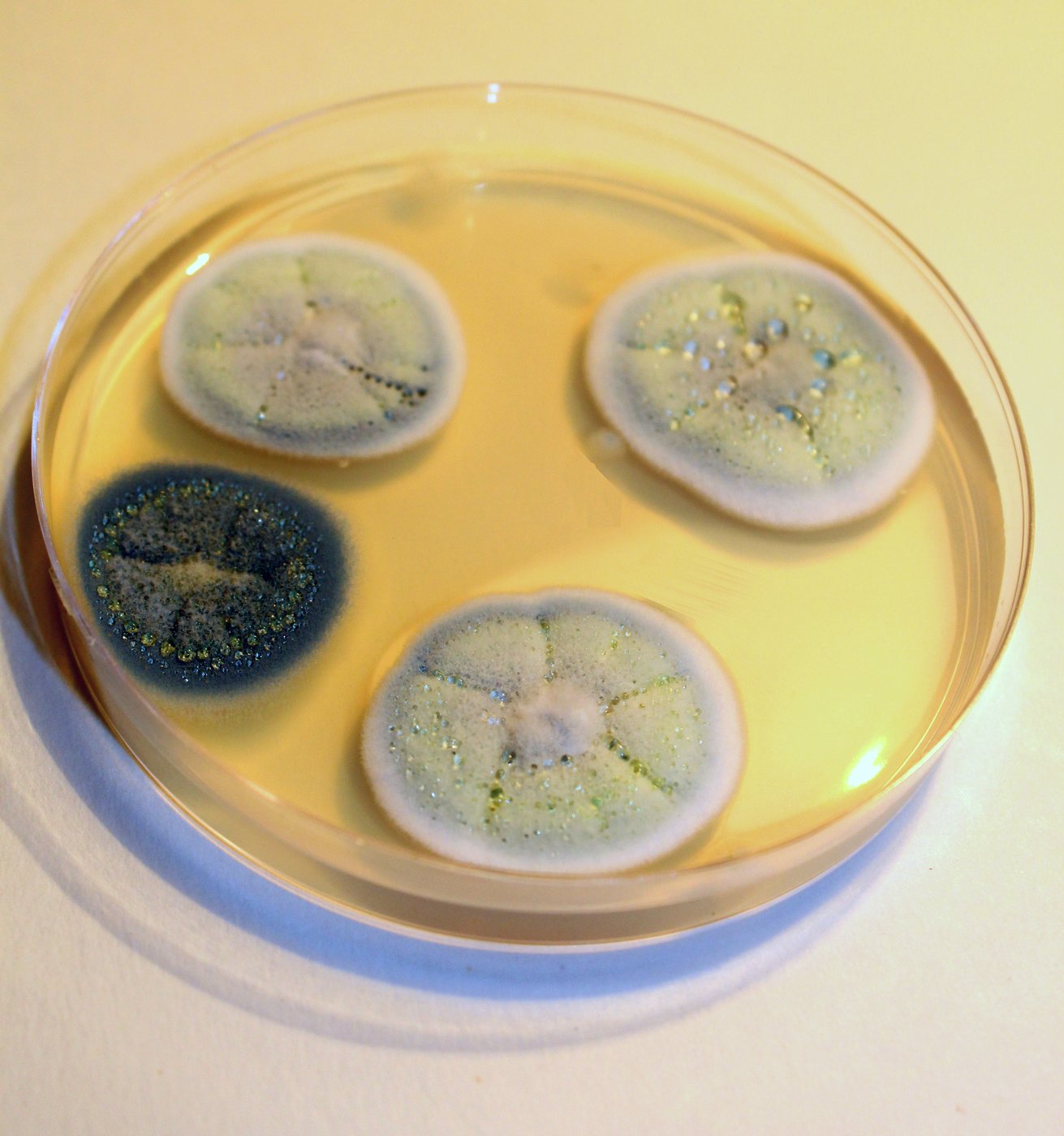
Penicillin mould
Penicillium rubens (Fleming’s “P. notatum”)
- Known today as
- A blue-green mould of bread, fruit, and damp.
- Kind
- Fungus
- Constituents
- penicillin G, 6-aminopenicillanic acid
- In other databases
- GBIF search · Wikidata search
Penicillin mould: what was it used for?
Folk healers laid mouldy bread on wounds long before anyone knew why.
Penicillin mould: what does modern science say?
The first antibiotic, and one of the most important medicines in history.
Pharmacognosy & Toxicology
- Constituents
- penicillin G ChEMBLbenzylpenicillin
- 6-aminopenicillanic acid ChEMBLthe core of the semi-synthetic penicillins
- Mechanism
- Penicillin binds the enzymes that cross-link the bacterial cell wall, so the dividing bacterium bursts; it has no target in the human cell, which is why it is so safe.
- Checked against ChEMBL
- penicillin G: ChEMBL’s curated mechanism: inhibitor Bacterial penicillin-binding protein.
- Toxic dose
- Allergy, in up to a tenth of those who report it, is the only common harm; anaphylaxis is rare.
- Standing
- Benzylpenicillin is on the WHO list of essential medicines; Fleming’s observation of 1928 and the Oxford work of Florey, Chain, and Heatley gave the drug by 1941.
- Fleming, A. (1929). “On the antibacterial action of cultures of a Penicillium.” British Journal of Experimental Pathology 10. Verified against its record · doi:10.1093/clinids/2.1.129
- Chain, E., et al. (1940). “Penicillin as a chemotherapeutic agent.” Lancet 236. Verified against its record · doi:10.1016/s0140-6736(01)08728-1
Constituent names open the compound’s record at PubChem, and “ChEMBL” beside a name opens its record at ChEMBL, the European Bioinformatics Institute’s database of bioactive molecules. Where a mechanism line was checked against ChEMBL (ChEMBL 37, read 1 October 2026), the check is shown with the measured value and its source paper, or says plainly that nothing has been measured. Doses are as the references give them, for description only; this is not medical advice. Each source carries the result of its check against Crossref, PubMed, or the authority’s page: see Verification.
Penicillin mould: what lore surrounds it?
In 1928 Alexander Fleming noticed that a stray mould had killed the bacteria around it on a culture plate. Howard Florey and Ernst Chain made penicillin a medicine in the 1940s, and the three shared the Nobel Prize in 1945.
In Their Own Words
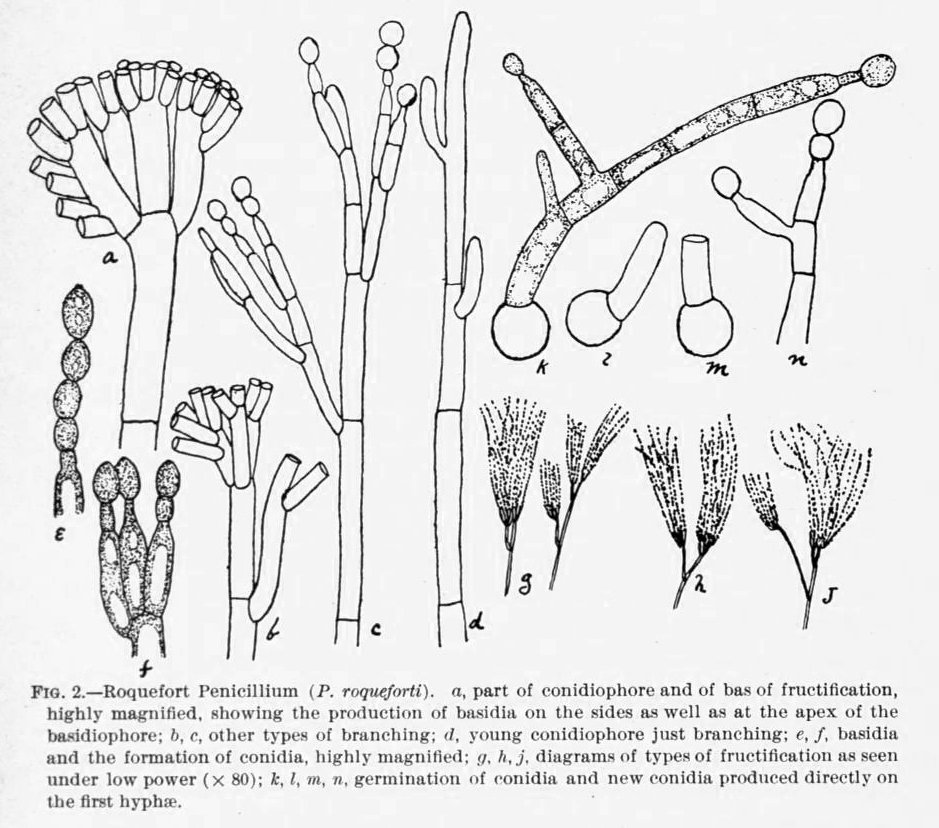
The 1911 Britannica names Penicillium and Aspergillus as the chief moulds, calling the blue-green mould P. crustaceum extraordinarily widespread and found on almost any food left exposed to the air.
“The Perisporiaceae are saprophytic forms, the two chief genera being Aspergillus and Penicillium. The blue-green mould P. crustaceum and the green mould A. herbariorium (= Eurotium herbariorum) are extraordinarily widely distributed, moulds being found on almost any food-material which is exposed to the air.”
Encyclopædia Britannica, eleventh edition: Fungi, “Fungi”: the Perisporiaceae. The 1911 Encyclopædia Britannica, as transcribed on Wikisource. The text, read in part
Each passage is quoted from the text named, which the press fetched and read, and was checked word for word against a fresh copy of it; the link opens that copy. Passages are given as printed, without the editors’ footnote numbers, and with words broken across lines joined.
Sources
- Fleming, A. (1929). On the antibacterial action of cultures of a Penicillium. British Journal of Experimental Pathology 10: 226–236. Verified against its record · doi:10.1093/clinids/2.1.129
Verification
- Checked
- October 1, 2026
- Passes
- Every sentence read against its sources, in the pass over the remaining 343 entries
- The Standing line checked against the authority it names (EMA, WHO, FDA, CITES, Commission E)
- Every dated or regulatory claim checked by category across the database
- The mechanism read against ChEMBL (ChEMBL 37): curated mechanisms and measured activity
- Sources
- 3 cited: 3 verified against its record.
- Corrections
- None were needed.
What was checked, how, and what was found is set out on the Verification page. A checked source is one whose record was found; it does not make the entry medical advice.
Cite This Entry
Version 1 · first published September 25, 2026
- Chicago
“Penicillin mould.” In Materia Medica, edited by B. C. P. Statema. Version 1. The Thinking Press, 2026–. Last modified September 25, 2026. https://thethinkingpress.org/materia-medica/penicillium.
- MLA
“Penicillin mould.” Materia Medica, edited by B. C. P. Statema, version 1, The Thinking Press, 25 Sept. 2026, thethinkingpress.org/materia-medica/penicillium. Accessed 8 Oct. 2026.
- APA
Penicillin mould. (2026, September 25). In B. C. P. Statema (Ed.), Materia medica (Version 1). The Thinking Press. Retrieved October 8, 2026, from https://thethinkingpress.org/materia-medica/penicillium
Club members keep entries on a shelf with private notes, print the plates as cards, and receive an entry by email each week. Create a free account before January 1, 2027 and all of it is yours for good. About the Club
See Also
Nearby in the alphabet
Pennyroyal (Mentha pulegium) · Pearls, prepared (Pearls ground to a fine powder) · Peony (the kind formerly grown for its medicinal root) · Pawpaw (the one temperate tree of the custard-apple family) · Periwinkle (the lesser periwinkle, a trailing evergreen with blue flowers) · Passarino’s white powder (a man skilled in the spagyric (chemical) art (note XXXIX)) · Pilewort · Paschal candle

Historical description, not medical advice.