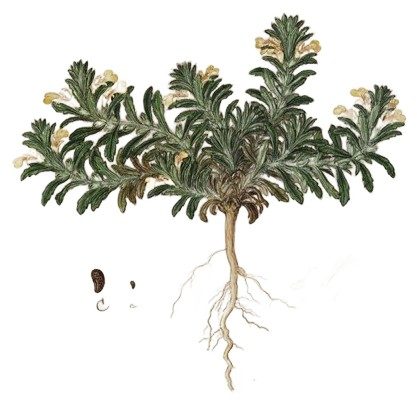
Iva
Iua
- Known today as
- Ajuga iva; see Arthritica.
- Kind
- Plant, in 2 older authorities
- Constituents
- 20-hydroxyecdysone, apigenin, carvacrol
- In other databases
- Plants of the World Online · GBIF · Wikidata
- In the Canale glossary
- On the Manner of Discerning and Healing the Bewitched, Appendix A: Part Three, Chapter 9: Anointings
Revised October 17, 2026: Tradition, lore, modern assessment, and sources extended. Checked against its sources, each read in full, in part, or in its abstract. Version 1, first published September 25, 2026.
Iva: what did Canale use it for?
In the oil for the bewitched (ch. 9).
Iva: what does modern science say?
Some anti-inflammatory activity has been reported in the laboratory; no established effect. Its extracts have shown antidiabetic, antioxidant, cholesterol-lowering, and pain-relieving effects in laboratory and animal studies, which still await clinical validation.
The toxic dose and the poisoning
- Toxic dose
- Its safety has not been established: toxicological validation is still called for.
The references for these lines are listed under Pharmacognosy, in Science. Doses are as the references give them, for description only; this is not medical advice. In a poisoning, call a poison centre.
Iva: what did the older authorities say?
- Dioscoridesc. AD 40–90
- Gives chamaipitys, the ground pine, for jaundice and hip pains and as a pessary for the womb; of his second and third kinds, among which the translator suggests Ajuga iva, he says that they too smell of pine and act alike, but less strongly.
- North African folk medicine
- Uses iva especially against diabetes and diseases of the immune system, according to the review by Bouyahya and colleagues.
Iva: what lore surrounds it?
In North African folk medicine iva is used above all against diabetes, and also for rheumatism, allergies, and disorders of the kidneys, digestion, and breathing; like Dioscorides’ ground pine, it smells of pine.
Pharmacognosy
- Constituents
- 20-hydroxyecdysonea phytoecdysteroid, with cyasterone and ajugasterone
- apigenin ChEMBLa flavonoid, with apigenin dihexoside
- carvacrol ChEMBLa terpenoid
- Mechanism
- Canale’s iva is taken to be Ajuga iva, the musky bugle; in North African folk medicine it is used against diabetes, and its extracts are antidiabetic in experimental studies that still await clinical validation.
- Standing
- Laboratory and animal data only; clinical and toxicological studies are still needed.
- Bouyahya, A., et al. (2020). “Ethnomedicinal use, phytochemistry, pharmacology, and toxicology of Ajuga iva.” Journal of Ethnopharmacology 258. Abstract read · the text read
The abstract of each source, beneath its citation. For Club members. About the Club or sign in.
Constituent names open the compound’s record at PubChem, and “ChEMBL” beside a name opens its record at ChEMBL, the European Bioinformatics Institute’s database of bioactive molecules. Where a mechanism line was checked against ChEMBL (ChEMBL 37, read 1 October 2026), the check is shown with the measured value and its source paper, or says plainly that nothing has been measured. Doses are as the references give them, for description only; this is not medical advice. Each source carries the result of its check against Crossref, PubMed, or the authority’s page: see Verification.
Sources
- [13] Bouyahya, A., El Omari, N., Elmenyiy, N., Guaouguaou, F.-E., Balahbib, A., El-Shazly, M., & Chamkhi, I. (2020). Ethnomedicinal use, phytochemistry, pharmacology, and toxicology of Ajuga iva (L.) Schreb. Journal of Ethnopharmacology 258: 112875. doi:10.1016/j.jep.2020.112875 Abstract read · the text read
- Dioscorides, De materia medica III. Read in part · the text read
Verification
- Checked
- October 1, 2026, October 17, 2026
- Passes
- Read against its sources in the pass over the remaining 343 entries
- Every dated or regulatory claim checked by category across the database
- Every source read, in full, in part, or in its abstract, and every sentence checked against what was read (October 17, 2026)
- Sources
- 3 cited: 1 read in part, 2 abstract read. 2 with the abstract on file.
- Corrections
- None recorded.
What was checked, how, and what was found is set out on the Verification page. A checked source is one whose record was found; it does not make the entry medical advice.
Club members can point at a technical term in this entry, such as a constituent, an action, or a word of Jung’s, to read its definition from the source. The Club.
Cite This Entry
Version 1 · first published September 25, 2026 · last revised October 17, 2026
- Chicago
“Iva.” In Materia Medica, edited by B. C. P. Statema. Version 1. The Thinking Press, 2026–. Last modified October 17, 2026. https://thethinkingpress.org/materia-medica/iva.
- MLA
“Iva.” Materia Medica, edited by B. C. P. Statema, version 1, The Thinking Press, 17 Oct. 2026, thethinkingpress.org/materia-medica/iva. Accessed 22 Nov. 2026.
- APA
Iva. (2026, October 17). In B. C. P. Statema (Ed.), Materia medica (Version 1). The Thinking Press. Retrieved November 22, 2026, from https://thethinkingpress.org/materia-medica/iva
See Also
Sharing 20-hydroxyecdysone, apigenin, carvacrol
Ajuga iva · Pilosella officinarum · Matricaria chamomilla · Passiflora incarnata · Origanum vulgare · Origanum dictamnus · Thymus vulgaris · Nepeta cataria
Also in Dioscorides
Knotgrass in Dioscorides · Isinglass in Dioscorides · Lavender in Dioscorides · Horsetail in Dioscorides · everything Dioscorides names →
Drawing on the same sources: Dioscorides, Bouyahya
Nearby in the alphabet
Ivy leaf · Jack-o’-lantern · Iron and steel (given as filings in wine, as its rust, or in chalybeate spring waters) · Jalap · Ipecacuanha (The root of Psychotria ipecacuanha (Cephaelis ipecacuanha) of Brazil) · James’s powder (secret in its making) · INRI
Historical description, not medical advice.
