
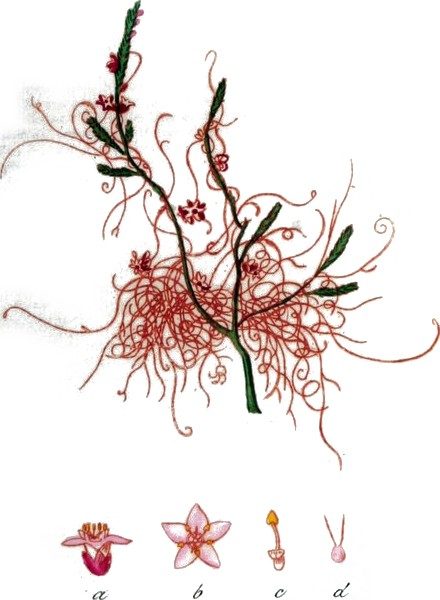
Epithymum
Epitimo
- Known today as
- Dodder growing on thyme, Cuscuta epithymum, a parasitic plant.
- Kind
- Plant, in 1 older authority
- Constituents
- kaempferol and quercetin glycosides, cuscutin, the host’s compounds
- Earliest authority here
- Pliny (AD 23/24–79)
- In other databases
- Plants of the World Online search · GBIF search · Wikidata search
- In the Canale glossary
- On the Manner of Discerning and Healing the Bewitched, Appendix A: Treatise One, Part Three, Chapters 2–3: Purgative and Preparative Medicines
Revised October 1, 2026: An older authority added from a text read in full. Version 1, first published September 25, 2026.
Epithymum: what did Canale use it for?
One of the first purges, for melancholy (ch. 2; see note XXIX).
Epithymum: what does modern science say?
Dodder was traditionally used as a purge and for urinary complaints, but modern studies have not confirmed a laxative action; its reputation as a purger of “black bile” belongs to humoral medicine.
Pharmacognosy & Toxicology
- Constituents
- kaempferol and quercetin glycosides
- cuscutin ChEMBL
- the host’s compoundsdodder takes up the thyme it grows on
- Mechanism
- Epithymum is the dodder (Cuscuta epithymum) parasitic on thyme, which the Arabs and Galenists made the specific purge of black bile; it is a mild laxative at best, and the melancholy it purged does not exist as a humour. The Chinese dodder seed (C. chinensis, tu si zi) is a tonic in that pharmacopoeia.
- Toxic dose
- No toxicity recorded.
- Standing
- No monograph; obsolete in Europe since the eighteenth century.
- Donnapee, S., et al. (2014). “Cuscuta chinensis Lam.: a systematic review on ethnopharmacology, phytochemistry and pharmacology.” Journal of Ethnopharmacology 157. Verified against its record · doi:10.1016/j.jep.2014.09.032
The abstract of each source, beneath its citation. For Club members. About the Club or sign in.
Constituent names open the compound’s record at PubChem, and “ChEMBL” beside a name opens its record at ChEMBL, the European Bioinformatics Institute’s database of bioactive molecules. Where a mechanism line was checked against ChEMBL (ChEMBL 37, read 1 October 2026), the check is shown with the measured value and its source paper, or says plainly that nothing has been measured. Doses are as the references give them, for description only; this is not medical advice. Each source carries the result of its check against Crossref, PubMed, or the authority’s page: see Verification.
What Medicine Makes of It
- Melancholy and the DemonThe black bile, the devil’s bath, and depression.
Epithymum: what lore surrounds it?
Dodder carries a rich folklore of its own. Its folk names in English and American tradition include love vine, angel hair, witches’ shoelaces, devil’s-gut, and strangle-weed. In the Missouri River country and the old South, a young woman would toss a strand over her shoulder onto a neighboring plant: if it took hold and grew within a few days, her suitor was judged faithful, a test held more reliable than pulling petals. Medieval Byzantine farming texts, oddly, associated the plant with lions.
Epithymum: what did the older authorities say?
- Pliny
- Gives juice of epithymum, with cotyledon, axle-grease, and leaves of batrachion, for chilblains, and epithymum “used as a liniment, with vinegar” for pains and indurations of the sinews.
Sources
- [23] Chabra, A., Monadi, T., Azadbakht, M., & Haerizadeh, S. I. (2019). Ethnopharmacology of Cuscuta epithymum: a comprehensive review on ethnobotany, phytochemistry, pharmacology and toxicity. Journal of Ethnopharmacology 231: 555–569. doi:10.1016/j.jep.2018.10.016 Verified against its record · doi:10.1016/j.jep.2018.10.016
- [28] Culpeper, N. (1653). Pharmacopœia Londinensis, or, The London Dispensatory [the Royal College of Physicians’ pharmacopoeia in English, with Culpeper’s commentary]. London: Peter Cole. Text Creation Partnership edition A35381. Read in part · the text read
- Native Plant Society of Texas, on dodder. Book, not indexed
- Pliny the Elder, Natural History 26.66, 26.81, trans. J. Bostock & H. T. Riley (1855), Perseus Digital Library. Primary text
Verification
- Checked
- October 1, 2026
- Passes
- Every sentence read against its sources, in the pass over the remaining 343 entries
- The Standing line checked against the authority it names (EMA, WHO, FDA, CITES, Commission E)
- Every dated or regulatory claim checked by category across the database
- Each quotation from the older authorities checked word for word against the text, read in full
- Sources
- 5 cited: 1 read in part, 2 verified against its record, 1 primary text, 1 book, not indexed. 1 with the abstract on file.
- Corrections
- None were needed.
What was checked, how, and what was found is set out on the Verification page. A checked source is one whose record was found; it does not make the entry medical advice.
Cite This Entry
Version 1 · first published September 25, 2026 · last revised October 1, 2026
- Chicago
“Epithymum.” In Materia Medica, edited by B. C. P. Statema. Version 1. The Thinking Press, 2026–. Last modified October 1, 2026. https://thethinkingpress.org/materia-medica/epithymum.
- MLA
“Epithymum.” Materia Medica, edited by B. C. P. Statema, version 1, The Thinking Press, 1 Oct. 2026, thethinkingpress.org/materia-medica/epithymum. Accessed 8 Oct. 2026.
- APA
Epithymum. (2026, October 1). In B. C. P. Statema (Ed.), Materia medica (Version 1). The Thinking Press. Retrieved October 8, 2026, from https://thethinkingpress.org/materia-medica/epithymum
Club members keep entries on a shelf with private notes, print the plates as cards, and receive an entry by email each week. Create a free account before January 1, 2027 and all of it is yours for good. About the Club
See Also
Also in Pliny the Elder
Eryngo in Pliny the Elder · Endive in Pliny the Elder · Fennel in Pliny the Elder · Elf-shot in Pliny the Elder · everything Pliny the Elder names →
Nearby in the alphabet
Epsom salt (first boiled from the waters of a spring on Epsom Common in Surrey) · Epiphany water (in the East as the Great Blessing of the Waters at Theophany) · Ergot · Epiphany chalk · The exorcists’ manuals (above all those of the Franciscan Girolamo Menghi)
Historical description, not medical advice.