
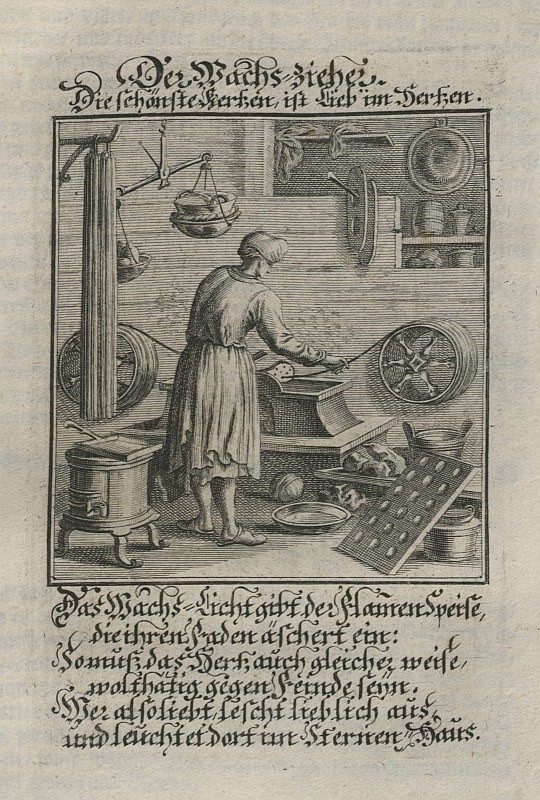
Wax
Cera
- Known today as
- Beeswax; in the final oil, wax of the Paschal candle.
- Kind
- Animal, in 1 older authority
- Constituents
- triacontanyl palmitate, cerotic acid, hydrocarbons
- Earliest authority here
- Pliny (AD 23/24–79)
- In the Canale glossary
- On the Manner of Discerning and Healing the Bewitched, Appendix A: Part Three, Chapter 9: Anointings
Revised October 3, 2026: An older authority added from a text read in full. Checked against its sources, each read in full, in part, or in its abstract. Version 1, first published September 25, 2026.
Wax: what did Canale use it for?
Fresh wax in the oil for hexes; Paschal wax to set the oil for the bewitched and, in Treatise Two, in amulet packets and pouches for the house (ch. 9; Treatise Two).
Wax: what does modern science say?
Paschal wax carried the blessing given the candle in the Easter rite of Holy Saturday, which was its whole purpose here; at Rome the Agnus Deis were made from what remained of the paschal candles.
Pharmacognosy & Toxicology
- Constituents
- triacontanyl palmitatethe chief ester of beeswax
- cerotic acid ChEMBL
- hydrocarbons
- Mechanism
- Beeswax is a water-repellent base that stiffens an ointment and forms an occlusive barrier on the skin, giving anything from soft creams to firm ointments and cerates; eaten, its wax esters are poorly digested. The Paschal wax of the amulet packets is the same wax with a blessing.
- Toxic dose
- Edible, of negligible toxicity, like the plant waxes.
- Standing
- A pharmacopoeial excipient (cera alba, cera flava) and a food additive (E901).
Constituent names open the compound’s record at PubChem, and “ChEMBL” beside a name opens its record at ChEMBL, the European Bioinformatics Institute’s database of bioactive molecules. Where a mechanism line was checked against ChEMBL (ChEMBL 37, read 1 October 2026), the check is shown with the measured value and its source paper, or says plainly that nothing has been measured. Doses are as the references give them, for description only; this is not medical advice. Each source carries the result of its check against Crossref, PubMed, or the authority’s page: see Verification.
Wax: what did the older authorities say?
- Pliny
- Records that before paper, private memoranda “were impressed upon linen cloths, or else engraved on tablets of wax,” which Homer shows in use before the Trojan war; that the books of Numa lay on a stone “bound on every side with cords enveloped in wax,” which was thought to have kept them from rotting; and that balsam adulterated with Cyprian wax betrays itself on hot coals.
Sources
- [21] Herbermann, C. G., et al. (eds.) (1907–1912). The Catholic Encyclopedia. New York: Robert Appleton Company. Online at newadvent.org. Articles: Agnus Dei (H. Thurston); Amulet (M. Hassett); Ash Wednesday (H. Thurston); Bells (H. Thurston); Holy Oils (H. Leclercq); Paschal Candle (H. Thurston); Scapular (J. Hilgers). Read in part · the text read
- Pliny the Elder, Natural History 13.21, 13.27, 12.54, trans. J. Bostock & H. T. Riley (1855), Perseus Digital Library. Read in part · the text read
- Wikipedia, “Beeswax.” Read in full · the text read
- Huanbutta, K., et al. (2026). Beeswax in pharmaceutical sciences: a comprehensive review of its chemical composition, functional applications, types, and formulation roles. International Journal of Molecular Sciences. Read in full · the text read
Verification
- Checked
- October 1, 2026, and October 3, 2026
- Passes
- Every sentence read against its sources, in the pass over the remaining 343 entries
- The Standing line checked against the authority it names (EMA, WHO, FDA, CITES, Commission E)
- Every dated or regulatory claim checked by category across the database
- Each quotation from the older authorities checked word for word against the text, read in full
- Every source read, in full, in part, or in its abstract, and every sentence checked against what was read (October 3, 2026)
- Sources
- 4 cited: 2 read in full, 2 read in part.
- Corrections
- None were needed.
What was checked, how, and what was found is set out on the Verification page. A checked source is one whose record was found; it does not make the entry medical advice.
Cite This Entry
Version 1 · first published September 25, 2026 · last revised October 3, 2026
- Chicago
“Wax.” In Materia Medica, edited by B. C. P. Statema. Version 1. The Thinking Press, 2026–. Last modified October 3, 2026. https://thethinkingpress.org/materia-medica/wax.
- MLA
“Wax.” Materia Medica, edited by B. C. P. Statema, version 1, The Thinking Press, 3 Oct. 2026, thethinkingpress.org/materia-medica/wax. Accessed 8 Oct. 2026.
- APA
Wax. (2026, October 3). In B. C. P. Statema (Ed.), Materia medica (Version 1). The Thinking Press. Retrieved October 8, 2026, from https://thethinkingpress.org/materia-medica/wax
Club members keep entries on a shelf with private notes, print the plates as cards, and receive an entry by email each week. Create a free account before January 1, 2027 and all of it is yours for good. About the Club
See Also
Also in Pliny the Elder
Wild carrot, seed of in Pliny the Elder · Water germander in Pliny the Elder · Wild garlic in Pliny the Elder · Walnut, middle bark of in Pliny the Elder · everything Pliny the Elder names →
Drawing on the same sources: Wikipedia
Nearby in the alphabet
Wax ex-votos · Weapon-salve · White arsenic (Arsenic trioxide) · Vitriol (blue vitriol (copper sulfate), and white vitriol (zinc sulfate)) · White hellebore
Historical description, not medical advice.