
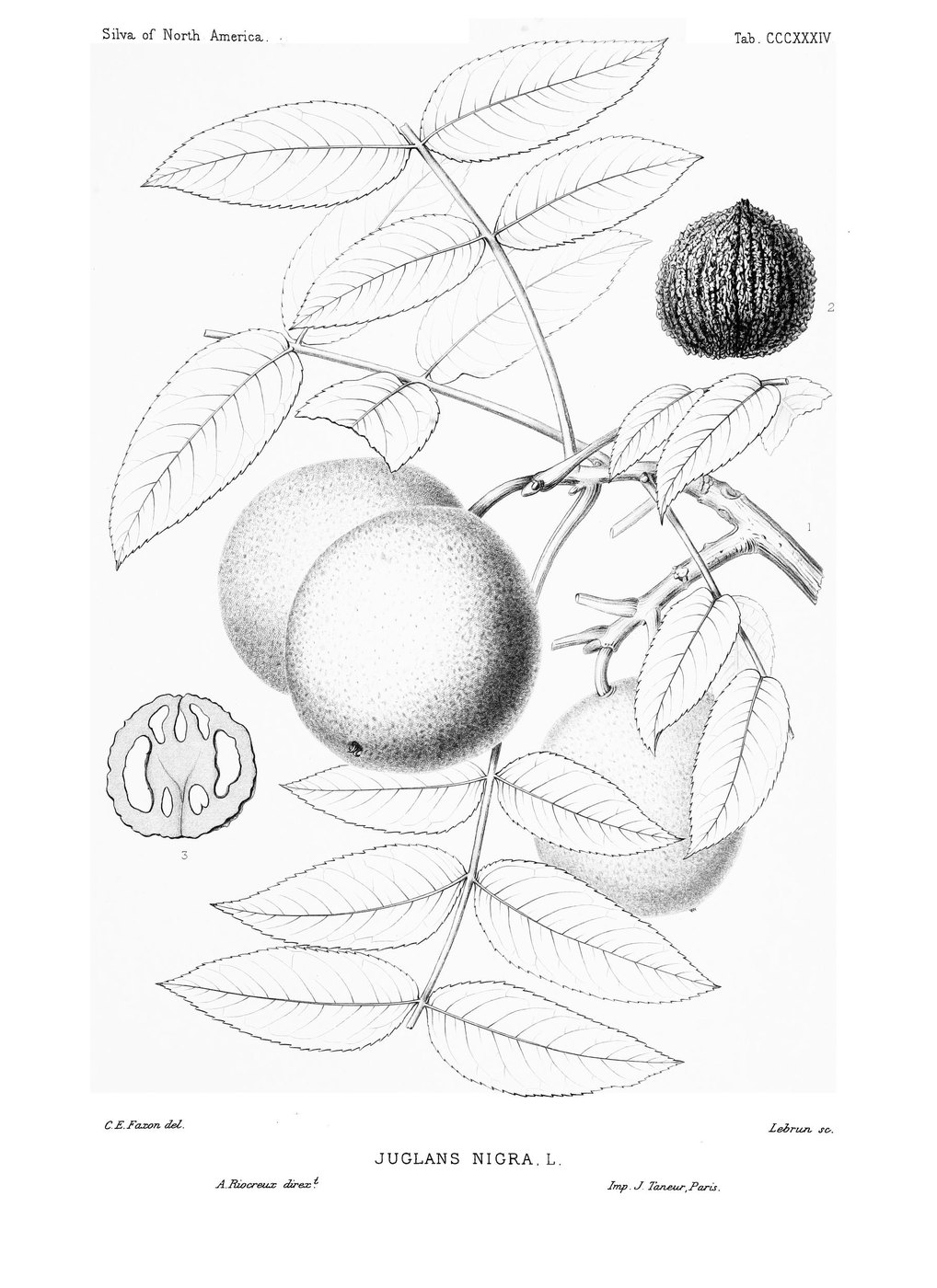
Black walnut
Juglans nigra of Linnaeus; Wallia nigra of Alefeld; the Ojibwe and Potawatomi knew the butternut, Juglans cinerea, their baganak, and not this tree
- Known today as
- Juglans nigra, the great walnut of the rich bottom-lands and fertile hillsides of the Mississippi basin: a tree often a hundred feet high and sometimes a hundred and fifty, with a straight trunk clear of branches for fifty or sixty feet, leaves of fifteen to twenty-three leaflets, and a globose green husked fruit an inch and a half to two inches across, holding a deeply ridged nut with a sweet kernel. It ranges from western Massachusetts to southern Ontario, through southern Michigan and Minnesota to Nebraska and Kansas, and south to Florida and Texas.
- Kind
- Plant, in 3 older authorities
- Constituents
- juglone, tannin of the rind
- Earliest authority here
- Charles Sprague Sargent
- In other databases
- Plants of the World Online search · GBIF search · Wikidata search
Caution. An extract of the wood brings on laminitis in horses within hours, and the shavings are kept out of their bedding on that account. The husks stain whatever they touch. The nuts are a food.
Black walnut: what was it used for?
Sargent records that the nuts were valued by the Indians of the Mississippi Basin and in his day were still gathered for domestic use and sold in the markets of western and southern cities, though the kernel, sweet and pleasant while fresh, soon goes rancid; the husks dyed, and the wood, hard, dark brown, and durable in the ground, was shipped to England from Virginia as early as 1610 and furnished the gunstocks of the Civil War. Rafinesque: the bark and the rind of the nuts dye wool brown boiled alone and black with vitriol; the green rind rubbed on tetters and ringworms dispels them, and its decoction is a vermifuge; the vernal sap is sweet and might give sugar; the young green nuts are pickled. Le Page du Pratz, whom Sargent quotes, watched the natives of Louisiana crush the nuts, stir the flour in great vessels of water, and work it with their hands until the shell and the abundant oil rose and the cleaned meat sank, to make a bread.
Black walnut: foraging it in the Midwest
- Part
- Nuts
- When
- Autumn
Rich bottom-lands and fertile hillsides from southern Michigan and Minnesota to Kansas and south; the nuts were valued by the Indians of the Mississippi Basin and gathered for domestic use, the sweet kernel going rancid soon. In Wisconsin the tree reaches only the southern half of the state; the north has the butternut.
After Sargent; Smith. All the foragables of the Midwest. Historical record, not a field guide: identify before you gather, and read the whole entry.
Black walnut: what does modern science say?
The tree’s notorious effect on what grows beneath it is laid to juglone, a naphthoquinone it makes in its roots by a branch of the phylloquinone pathway, as a 2018 study of its genes and labelled feeding showed; the same study notes the interest in juglone as a natural herbicide. Black walnut is a poison to horses: twelve geldings given an aqueous extract of the wood by stomach tube developed laminitis within eight to twelve hours, four of them severe, with a fall and then a rise in their neutrophils, which has made the extract a standard model of that disease.
Black walnut: is it poisonous?
Yes, in some form or dose. An extract of the wood brings on laminitis in horses within hours, and the shavings are kept out of their bedding on that account. The husks stain whatever they touch. The nuts are a food. Historical description, not medical advice; in a poisoning, call a poison centre.
Pharmacognosy & Toxicology
- Constituents
- juglone ChEMBLthe 1,4-naphthoquinone of the roots and husks that poisons the ground beneath the tree, made in the roots from an intermediate of the phylloquinone pathway
- tannin of the rindthe brown dye of bark and husk, black with iron, by Rafinesque
- Mechanism
- Juglone is allelopathic, suppressing other plants, and the aqueous extract of the wood brings on laminitis in horses within eight to twelve hours, with a fall and then a rise in neutrophils and necrosis of the laminae of the hoof; the horse model is used to study that disease.
- Toxic dose
- Nuts, eaten; the green rind rubbed on ringworm and its decoction as a vermifuge, by Rafinesque. No human dose of juglone is established.
- Standing
- A timber and nut tree whose chemistry is studied for a natural herbicide and for the harm its shavings do to horses; nothing read for this entry is a trial in people.
- McCoy, R. M., Utturkar, S. M., Crook, J. W., Thimmapuram, J., & Widhalm, J. R. (2018). The origin and biosynthesis of the naphthalenoid moiety of juglone in black walnut. Horticulture Research 5: 67. doi:10.1038/s41438-018-0067-5 Verified against its record · PMID 2061431
- Galey, F. D., et al. (1991). Black walnut (Juglans nigra) toxicosis: a model for equine laminitis. Journal of Comparative Pathology 104: 313–326. doi:10.1016/s0021-9975(08)80043-6 Verified against its record · PMID 30393541
The abstract of each source, beneath its citation. For Club members. About the Club or sign in.
Constituent names open the compound’s record at PubChem, and “ChEMBL” beside a name opens its record at ChEMBL, the European Bioinformatics Institute’s database of bioactive molecules. Where a mechanism line was checked against ChEMBL (ChEMBL 37, read 1 October 2026), the check is shown with the measured value and its source paper, or says plainly that nothing has been measured. Doses are as the references give them, for description only; this is not medical advice. Each source carries the result of its check against Crossref, PubMed, or the authority’s page: see Verification.
Black walnut: what lore surrounds it?
William Strachey wrote in 1610 of a Virginia walnut “of a delicate grayne and cullour like ebonie, and not subject to the worme,” already shipped home yearly to make wainscot tables, cupboards, chairs, and stools; and Josselyn in New England of a black walnut “of precious use for Tables, Cabinets, and the like.” The younger Tradescant carried it to Europe about the middle of the seventeenth century, Parkinson first described it, and a tree in the Bishop of London’s garden bore fruit before 1687. Rafinesque’s note that the scented leaves were said to shelter from the thunder is the tree’s one piece of weather-lore in these books.
Black walnut: what did the older authorities say?
- Charles Sprague Sargent
- Large black walnuts “practically no longer exist in the American forests”: many were cut and burnt or split into fence-rails when the bottom-lands were cleared, the demand for gunstocks in the War of Secession took more, and for twenty years the agents of lumber-dealers had bought up singly, often at nominal prices, every tree of marketable size. Trees measured near Mount Carmel, Illinois, averaged a hundred and six feet, and one stood a hundred and thirty-one. The nuts, valued by the Indians of the Mississippi Basin, are still gathered and sometimes sold.
- C. S. Rafinesque
- Of the three walnuts, “J. nigra has the finest wood, hard and brown, bark and rind of the nuts dye wool brown boiled alone, and black with vitriol. Leaves scented, said to shelter from the thunder. Vernal sap sweet, may give sugar. Young green nuts pickled in vinegar, styptic, unwholesome? The green rind rubbed on tetters and ringworms dispels them: their decoction vermifuge and sudorific.”
- Huron H. Smith
- Among the Ojibwe the butternut is plentiful in the north “while the Black Walnut is not to be found”; they used the butternuts for food and the hulls for a brown dye they could get at any time of year. Among the Forest Potawatomi the black walnut “only reaches the central part of Wisconsin” and “has not been known to Wisconsin Indians for medicine.”
Sources
- Sargent, C. S. (1895). The Silva of North America, vol. 7, “Juglans nigra. Black Walnut,” pp. 121–124 and Plate CCCXXXIV. Internet Archive, mobot31753000329273. Primary text
- Rafinesque, C. S. (1830). Medical Flora, or Manual of the Medical Botany of the United States of North America, vol. 2, “Juglans,” p. 233. Internet Archive, b21468710_0002. Primary text
- Smith, H. H. (1932). Ethnobotany of the Ojibwe Indians, Bulletin of the Public Museum of the City of Milwaukee 4(3), “Butternut.” Project Gutenberg, 49527. Primary text
- Smith, H. H. (1933). Ethnobotany of the Forest Potawatomi Indians, Bulletin of the Public Museum of the City of Milwaukee 7(1), “Butternut.” Internet Archive, ethnobotany-of-the-forest-potawatomi-indians-by-huron-h.-smith-1933. Primary text
Verification
- Checked
- October 1, 2026
- Passes
- Every sentence read against its sources, in the pass over the remaining 343 entries
- The Standing line checked against the authority it names (EMA, WHO, FDA, CITES, Commission E)
- Every dated or regulatory claim checked by category across the database
- Sources
- 6 cited: 2 verified against its record, 4 primary text. 2 with the abstract on file.
- Corrections
- None were needed.
What was checked, how, and what was found is set out on the Verification page. A checked source is one whose record was found; it does not make the entry medical advice.
Cite This Entry
Version 1 · first published October 4, 2026
- Chicago
“Black walnut.” In Materia Medica, edited by B. C. P. Statema. Version 1. The Thinking Press, 2026–. Last modified October 4, 2026. https://thethinkingpress.org/materia-medica/black-walnut.
- MLA
“Black walnut.” Materia Medica, edited by B. C. P. Statema, version 1, The Thinking Press, 4 Oct. 2026, thethinkingpress.org/materia-medica/black-walnut. Accessed 8 Oct. 2026.
- APA
Black walnut. (2026, October 4). In B. C. P. Statema (Ed.), Materia medica (Version 1). The Thinking Press. Retrieved October 8, 2026, from https://thethinkingpress.org/materia-medica/black-walnut
Club members keep entries on a shelf with private notes, print the plates as cards, and receive an entry by email each week. Create a free account before January 1, 2027 and all of it is yours for good. About the Club
See Also
Sharing juglone
Drawing on the same sources: Sargent, Rafinesque, Smith
Chokecherry · Juneberry · Bloodroot · Wild ginger · Burdock · the bibliography →
Nearby in the alphabet
Blackthorn (Prunus spinosa) · Black pepper (The dried fruit of Piper nigrum) · Bladderwrack (a brown seaweed of rocky shores, buoyed by paired air bladders) · Black hellebore (Helleborus niger) · Blessed ashes (blessed on Ash Wednesday) · Bitter aloes (A) · Blessed bread (distinct from the Eucharist) · Bistort (snakeweed)
Historical description, not medical advice.