
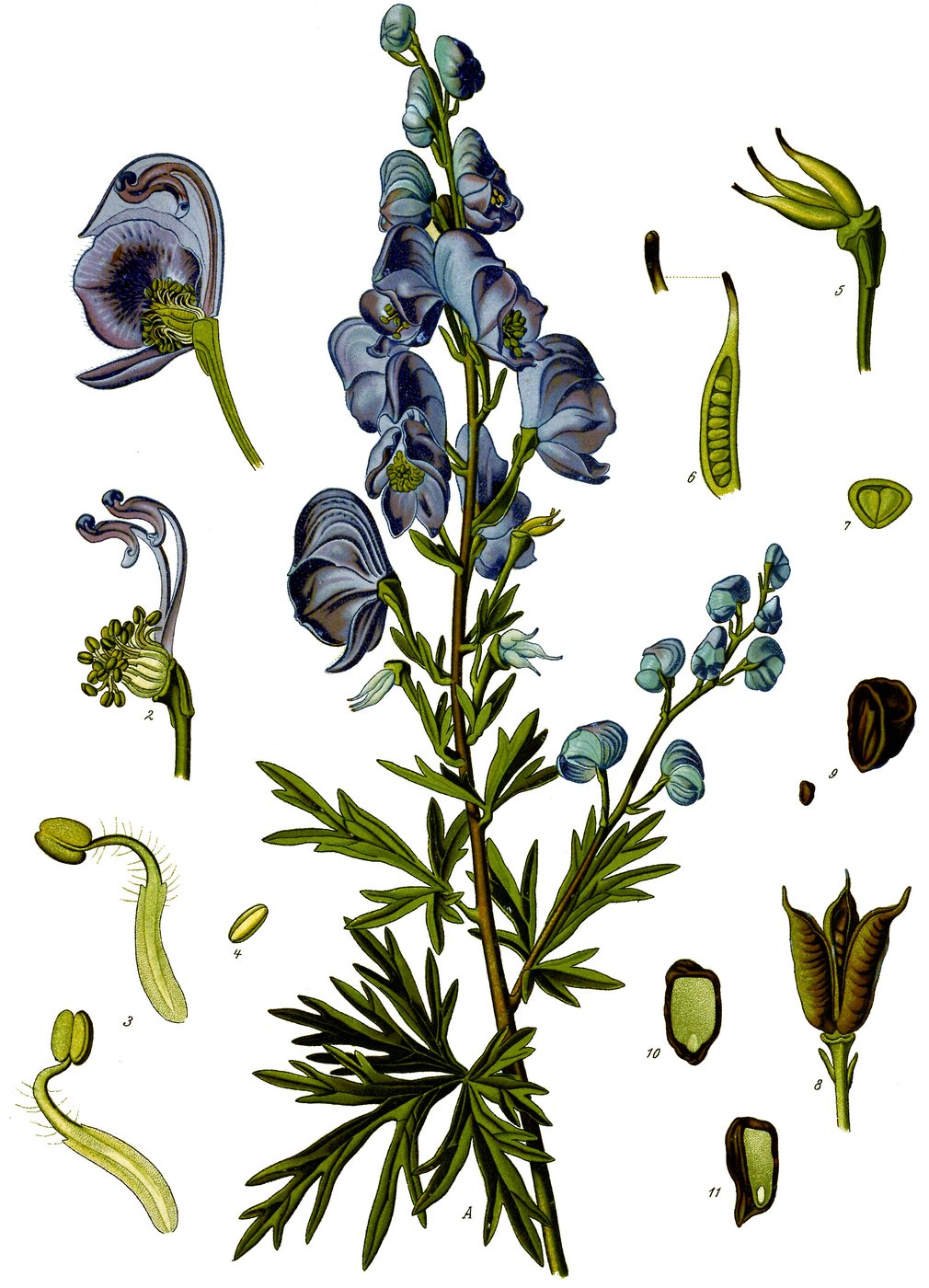
Aconite
Wolfsbane, monkshood; Greek akoniton
- Known today as
- Aconitum napellus and its relatives, of the buttercup family.
- Kind
- Plant, in 2 older authorities
- Constituents
- aconitine, mesaconitine, hypaconitine
- Poisoning
- Aconitine poisoning
- Earliest authority here
- Ovid (43 BC–AD 17/18)
- In other databases
- Plants of the World Online search · GBIF search · Wikidata search
Caution. Among the deadliest plants of Europe. Do not handle without gloves.
Aconite: what does modern science say?
Aconitine disturbs the nerves and the rhythm of the heart; a few milligrams can kill, and it can pass through the skin.
Aconite: is it poisonous?
Yes, in some form or dose. Among the deadliest plants of Europe. Do not handle without gloves. Its poisoning is aconitine poisoning: Minutes to two hours, through the skin too. Historical description, not medical advice; in a poisoning, call a poison centre.
Pharmacognosy & Toxicology
- Constituents
- aconitine ChEMBLa diterpenoid alkaloid
- mesaconitine ChEMBL
- hypaconitine ChEMBL
- Mechanism
- Aconitine holds open the voltage-gated sodium channels of nerve and heart muscle.
- Checked against ChEMBL
- aconitine: No measurement in ChEMBL for “holds open the voltage-gated sodium channels” (487 activities recorded, none against the target named); the line rests on its references.
- Toxic dose
- About 2 mg of aconitine, or a gram of the root; absorbed through the skin.
- Syndrome
- Aconitine poisoning
- Standing
- No Western medicinal use. Processed aconite (fuzi) remains in Chinese medicine, with poisonings each year.
- Chan, T. Y. K. (2009). Clinical Toxicology 47. Book, not indexed
Constituent names open the compound’s record at PubChem, and “ChEMBL” beside a name opens its record at ChEMBL, the European Bioinformatics Institute’s database of bioactive molecules. Where a mechanism line was checked against ChEMBL (ChEMBL 37, read 1 October 2026), the check is shown with the measured value and its source paper, or says plainly that nothing has been measured. Doses are as the references give them, for description only; this is not medical advice. Each source carries the result of its check against Crossref, PubMed, or the authority’s page: see Verification.
What Medicine Makes of It
- The Witches’ OintmentNightshades on the skin, and what they do.
- LycanthropyThe werewolf confessions, and the clinical lycanthropy of the wards.
Aconite: what lore surrounds it?
The poison of sorceresses in the classical imagination, and, in the witches’ ointments of later writers, a companion to the nightshades.
Aconite was said to have sprung from the saliva of Cerberus where it dripped on the hill of Aconitus as Hercules dragged the hound up from the underworld, and Hecate, goddess of witchcraft and the crossroads, gathered it there, binding the plant to her cult for good. Later folklore held that it could turn a man into a werewolf and, in other tellings, cure him of it. It appears in recorded witches’ ointment recipes beside soot, fern, and wild celery.
Aconite: what did the older authorities say?
- Ovid
- In the Metamorphoses aconite springs from the foam of Cerberus, dragged up from the underworld by Hercules, and Medea mixes it in the cup for Theseus.
- Its names
- Wolfsbane, for its use to poison baits for wolves; monkshood, for the shape of its flower.
Sources
- Ovid, Metamorphoses VII. Book, seen in reviews
- Theophrastus, Enquiry into Plants. Verified against its record · doi:10.4159/dlcl.theophrastus-enquiry_plants.1916
- Icy Sedgwick, on the folklore of aconite. Book, not indexed
Verification
- Checked
- October 1, 2026
- Passes
- Every sentence read against its sources, in the pass over the remaining 343 entries
- The Standing line checked against the authority it names (EMA, WHO, FDA, CITES, Commission E)
- Every dated or regulatory claim checked by category across the database
- The mechanism read against ChEMBL (ChEMBL 37): curated mechanisms and measured activity
- Sources
- 4 cited: 1 verified against its record, 1 book, seen in reviews, 2 book, not indexed.
- Corrections
- None were needed.
What was checked, how, and what was found is set out on the Verification page. A checked source is one whose record was found; it does not make the entry medical advice.
Cite This Entry
Version 1 · first published September 25, 2026
- Chicago
“Aconite.” In Materia Medica, edited by B. C. P. Statema. Version 1. The Thinking Press, 2026–. Last modified September 25, 2026. https://thethinkingpress.org/materia-medica/aconite.
- MLA
“Aconite.” Materia Medica, edited by B. C. P. Statema, version 1, The Thinking Press, 25 Sept. 2026, thethinkingpress.org/materia-medica/aconite. Accessed 8 Oct. 2026.
- APA
Aconite. (2026, September 25). In B. C. P. Statema (Ed.), Materia medica (Version 1). The Thinking Press. Retrieved October 8, 2026, from https://thethinkingpress.org/materia-medica/aconite
Club members keep entries on a shelf with private notes, print the plates as cards, and receive an entry by email each week. Create a free account before January 1, 2027 and all of it is yours for good. About the Club
See Also
Poisoned alike: aconitine poisoning
Also in Ovid
Coral, red in Ovid · Laurel in Ovid · Cypress in Ovid · everything Ovid names →
Drawing on the same sources: Ovid, Theophrastus, Icy Sedgwick, Chan
Cinnabar · White lead · Gum arabic · Greater celandine · Thyme · Saffron · Burdock · the bibliography →
Nearby in the alphabet
Adder’s-tongue fern (Ophioglossum vulgatum) · Abracadabra (one letter shorter each time, into a narrowing triangle) · Aflatoxin mould · Zedoary (of the ginger family, a bitter, camphor-scented root from India) · Agarwood (oud) · Yew (Taxus baccata) · AGLA · Yellow stainer

Historical description, not medical advice.