
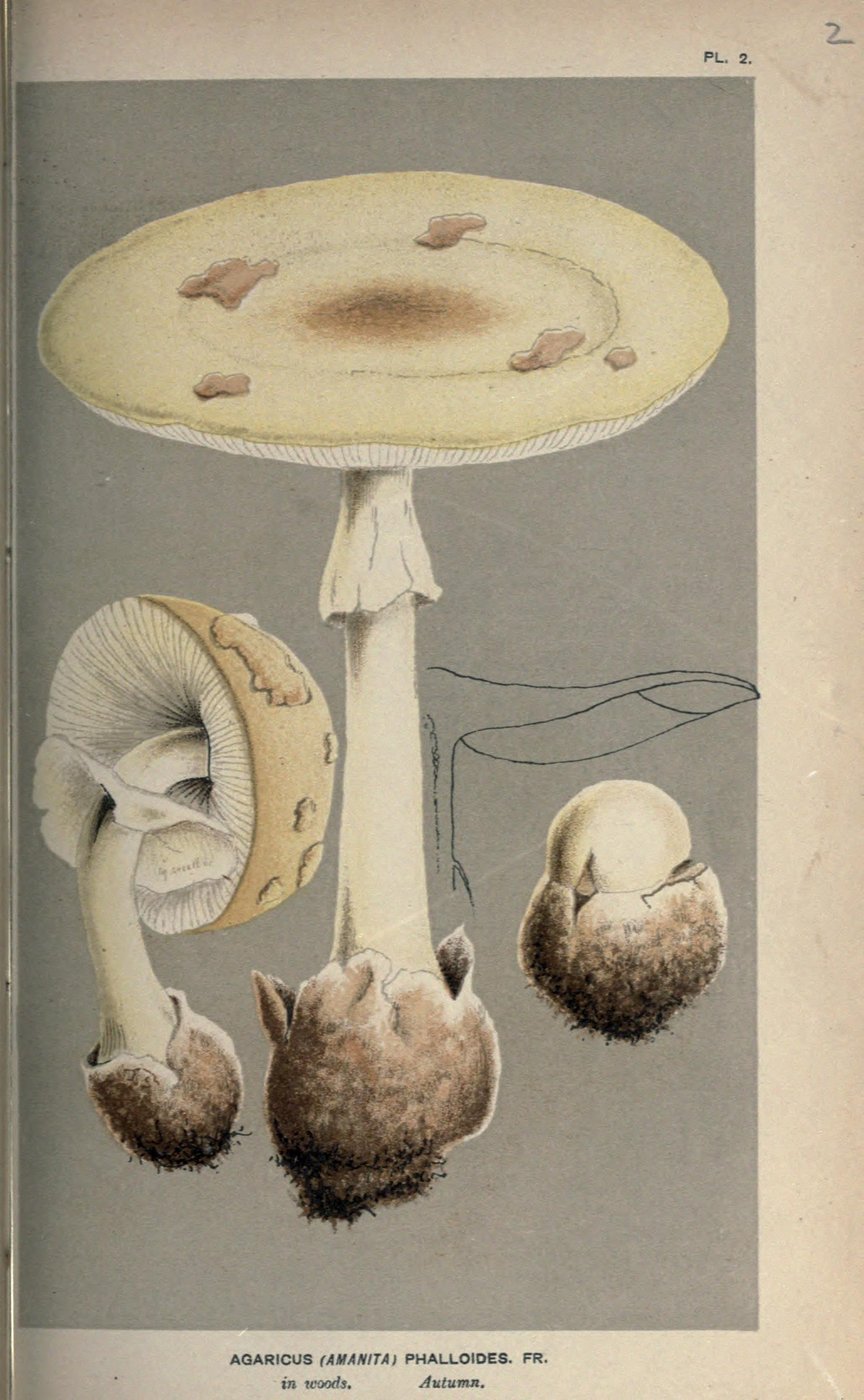
Death cap
Amanita phalloides
- Known today as
- A greenish, white-gilled mushroom of oak and beech woods, now spread worldwide.
- Kind
- Fungus
- Constituents
- alpha-amanitin, beta-amanitin, phalloidin
- Poisoning
- Amatoxin poisoning
- In other databases
- GBIF search · Wikidata search
Revised October 3, 2026: Checked against its sources, each read in full, in part, or in its abstract. Version 1, first published September 25, 2026.
Deadly. Half a cap can kill an adult; cooking does not destroy the toxin.
Death cap: what was it used for?
None, though its alpha-amanitin is now on trial in drugs against cancer.
Death cap: what does modern science say?
Its amatoxins stop the liver’s cells from making proteins. Symptoms are delayed six to twelve hours, then seem to pass before the liver fails. It causes most of the world’s mushroom deaths. Silibinin, from milk thistle, is among the treatments.
Death cap: is it poisonous?
Yes, and it can kill. Half a cap can kill an adult; cooking does not destroy the toxin. Its poisoning is amatoxin poisoning: 6 to 24 hours, usually 10 to 12, with no symptoms before: the long latency is the mark of it. Historical description, not medical advice; in a poisoning, call a poison centre.
Pharmacognosy & Toxicology
- Constituents
- alpha-amanitin ChEMBL
- beta-amanitin ChEMBL
- phalloidinnot absorbed from the gut
- Mechanism
- Inhibition of RNA polymerase II.
- Checked against ChEMBL
- alpha-amanitin: No measurement in ChEMBL for “inhibition of RNA polymerase II” (3 activities recorded, none against the target named); the line rests on its references.
- Toxic dose
- Under 0.1 mg of α-amanitin per kilogram: half a cap.
- Syndrome
- Amatoxin poisoning
- Standing
- None. The cause of nine-tenths of fatal mushroom poisonings.
Constituent names open the compound’s record at PubChem, and “ChEMBL” beside a name opens its record at ChEMBL, the European Bioinformatics Institute’s database of bioactive molecules. Where a mechanism line was checked against ChEMBL (ChEMBL 37, read 1 October 2026), the check is shown with the measured value and its source paper, or says plainly that nothing has been measured. Doses are as the references give them, for description only; this is not medical advice. Each source carries the result of its check against Crossref, PubMed, or the authority’s page: see Verification.
Death cap: what lore surrounds it?
Tacitus and Suetonius report that the emperor Claudius was poisoned in a dish of mushrooms, a favourite of his; he died in AD 54, and Gordon Wasson suspected the death cap. The emperor Charles VI is said to have died in 1740 after a meal of mushrooms, of which Voltaire remarked that it changed the destiny of Europe.
In Their Own Words
McIlvaine calls Amanita phalloides an exceedingly poisonous, dangerous and seductive species, responsible for most deaths from toadstool eating, because its white form is mistaken for the common mushroom.
“An exceedingly poisonous, dangerous, seductive species, responsible for most of the deaths from toadstool eating; because in its white form it is mistaken for the common mushroom—Agaricus campester.”
Charles McIlvaine and Robert K. Macadam, Toadstools, Mushrooms, Fungi, Edible and Poisonous; One Thousand American Fungi, Amanita phalloides, species entry. Revised edition; Indianapolis: The Bowen-Merrill Company, copyright 1900, 1902 (Project Gutenberg eBook #51393). The text, read in part
Badham counts Amanita phalloides and A. verna among the most deadly funguses, noting that their flesh does not change colour when cut and is of a tempting whiteness.
“…the Amanita verna, the Am. phalloides, the Ag. semiglobatus, dryophilus, and muscarius, though amongst the most deadly of this class of plants, do not change colour on being cut; the flesh of the first two is, moreover, of a tempting whiteness”
Charles David Badham, M.D.; edited by Frederick Currey, A Treatise on the Esculent Funguses of England, Footnote 88. London: Lovell Reeve & Co., Henrietta Street, Covent Garden, 1863 (second edition; Project Gutenberg eBook #58853). The text, read in part
Atkinson warns that the white form of the deadly amanita sometimes has a faint pink tinge in the gills, which might lead a novice to take it for the common mushroom.
“Furthermore, sometimes the white form of the deadly amanita possesses a faint tinge of pink in the gills, which might lead the novice to mistake it for the common mushroom.”
George Francis Atkinson, Studies of American Fungi. Mushrooms, Edible, Poisonous, etc., Chapter VI (The White-Spored Agarics), Amanita phalloides. Second edition; New York: Henry Holt and Company, 1903 (Project Gutenberg eBook #26492). The text, read in part
Each passage is quoted from the text named, which the press fetched and read, and was checked word for word against a fresh copy of it; the link opens that copy. Passages are given as printed, without the editors’ footnote numbers, and with words broken across lines joined.
Sources
- Tacitus, Annals XII. Read in part · the text read
- Suetonius, Life of Claudius. Read in part · the text read
- Wikipedia, “Amanita phalloides,” en.wikipedia.org (read 2 October 2026). Read in full · the text read
- Wikipedia, “Amanita bisporigera,” en.wikipedia.org (read 2 October 2026). Read in full · the text read
Verification
- Checked
- October 1, 2026, and October 3, 2026
- Passes
- Every sentence read against its sources, in the pass over the remaining 343 entries
- The Standing line checked against the authority it names (EMA, WHO, FDA, CITES, Commission E)
- Every dated or regulatory claim checked by category across the database
- The mechanism read against ChEMBL (ChEMBL 37): curated mechanisms and measured activity
- Every source read, in full, in part, or in its abstract, and every sentence checked against what was read (October 3, 2026)
- Sources
- 4 cited: 2 read in full, 2 read in part.
- Corrections
- None were needed.
What was checked, how, and what was found is set out on the Verification page. A checked source is one whose record was found; it does not make the entry medical advice.
Cite This Entry
Version 1 · first published September 25, 2026 · last revised October 3, 2026
- Chicago
“Death cap.” In Materia Medica, edited by B. C. P. Statema. Version 1. The Thinking Press, 2026–. Last modified October 3, 2026. https://thethinkingpress.org/materia-medica/death-cap.
- MLA
“Death cap.” Materia Medica, edited by B. C. P. Statema, version 1, The Thinking Press, 3 Oct. 2026, thethinkingpress.org/materia-medica/death-cap. Accessed 8 Oct. 2026.
- APA
Death cap. (2026, October 3). In B. C. P. Statema (Ed.), Materia medica (Version 1). The Thinking Press. Retrieved October 8, 2026, from https://thethinkingpress.org/materia-medica/death-cap
Club members keep entries on a shelf with private notes, print the plates as cards, and receive an entry by email each week. Create a free account before January 1, 2027 and all of it is yours for good. About the Club
See Also
Poisoned alike: amatoxin poisoning
Destroying angel · Funeral bell · the syndrome, with all of them →
Drawing on the same sources: Suetonius, Wikipedia
Laurel · Caesar’s mushroom · Deadly webcap · Devil’s-bit scabious · the bibliography →
Nearby in the alphabet
Deadly nightshade (of the nightshade family) · Diacatholicon (based on senna, rhubarb, cassia, and tamarind with various seeds) · Deadly fibrecap (of spring and summer woods) · Diamoschu, sweet (aloeswood, coral, pearls, and spices) · Dandelion (of the daisy family)
,_to_serve_as_an_atlas_to_the_%22Handbook_of_British_Fungi%22_(Pl._2)_(8163891626).jpg)
Historical description, not medical advice.