
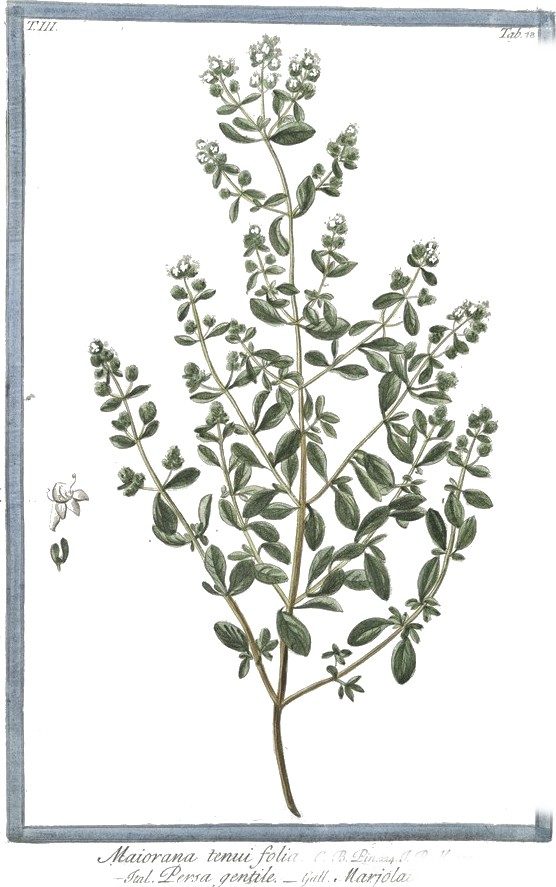
Marjoram and jasmine
Maggiorana; gelsomini
- Known today as
- Sweet marjoram, Origanum majorana; jasmine, Jasminum officinale.
- Kind
- Plant, in 2 older authorities
- Constituents
- terpinen-4-ol, cis-sabinene hydrate, benzyl acetate, and 1 more
- Earliest authority quoted here
- Dioscorides (c. AD 40–90)
- In other databases
- Plants of the World Online search · GBIF search · Wikidata search
- In the Canale glossary
- On the Manner of Discerning and Healing the Bewitched, Appendix A: Part Three, Chapter 9: Anointings
Revised October 17, 2026: Tradition, lore, modern assessment, and sources extended. Checked against its sources, each read in full, in part, or in its abstract. Version 1, first published September 25, 2026.
Marjoram and jasmine: what did Canale use it for?
Their oils for anointing, the jasmine “with crow’s gall” (ch. 9).
Marjoram and jasmine: what does modern science say?
Aromatic oils. Marjoram is antimicrobial in the laboratory; jasmine is one of the flowers most valued by perfumers, its blossoms picked after sunrise, since the dew would spoil their scent, and its distilled oil too dear to be much used.
The toxic dose and the poisoning
- Toxic dose
- The EU monograph knows no undesirable effects of marjoram, but bars it to those allergic to the mint family; the fruit of the white jasmine poisoned a child in 1861, in a case Grieve cites.
The references for these lines are listed under Pharmacognosy, in Science. Doses are as the references give them, for description only; this is not medical advice. In a poisoning, call a poison centre.
Marjoram and jasmine: what did the older authorities say?
- Dioscoridesc. AD 40–90
- Calls sampsuchon, marjoram, “very fragrant and heating,” plaited into wreaths for the head, and gives a decoction of it for beginning dropsy and painful urination; its oil, warming, goes into poultices for tetanus and other convulsions.
- Persian medicine
- Gave jasmine its name, from the Persian yasmin, Grieve says; its physicians rubbed oil of jasmine, as of lily, marjoram and chamomile, on headaches of the cold kind, a modern review of their texts reports.
Marjoram and jasmine: what lore surrounds it?
Venus first raised sweet marjoram, in Rapin’s verse, and the Greeks and Romans crowned young married couples with it, Folkard says; the jasmine is a native of northern India and Persia, and Pomet tells how the perfumers kept its scent in the odourless oil of ben to make their sweet essences.
Pharmacognosy
- Constituents
- terpinen-4-ol ChEMBLin the marjoram oil
- cis-sabinene hydrate ChEMBL
- benzyl acetate ChEMBLin the natural oil of jasmine
- indole and methyl anthranilatein the essential oil of J. grandiflorum
- Mechanism
- Marjoram is a traditional remedy for bloating and wind and is antimicrobial in the laboratory, though no direct study supports its use on irritated skin; jasmine oil rubbed on the skin of the abdomen made forty volunteers more alert and raised their breathing rate and blood pressure in one trial.
- Standing
- An EU herbal monograph (2016) accepts marjoram as a traditional remedy for mild spasmodic digestive complaints and for irritated skin around the nostrils, after traditional-use registrations in Poland; jasmine is a perfumery material.
- Hongratanaworakit, T. (2010). “Stimulating effect of aromatherapy massage with jasmine oil.” Natural Product Communications 5. Abstract read · the text read
The abstract of each source, beneath its citation. For Club members. About the Club or sign in.
Constituent names open the compound’s record at PubChem, and “ChEMBL” beside a name opens its record at ChEMBL, the European Bioinformatics Institute’s database of bioactive molecules. Where a mechanism line was checked against ChEMBL (ChEMBL 37, read 1 October 2026), the check is shown with the measured value and its source paper, or says plainly that nothing has been measured. Doses are as the references give them, for description only; this is not medical advice. Each source carries the result of its check against Crossref, PubMed, or the authority’s page: see Verification.
Sources
- Dioscorides, De materia medica III. Read in part · the text read
- Pomet, P. (1694). Histoire générale des drogues. Read in part · the text read
- Canale, F. (1622). Del modo di conoscer et sanare i maleficiati, et dell'antichissimo, et ottimo uso del benedire: trattati due. Brescia: Bartolomeo Fontana. Read in part · the text read
- Dioscorides. De materia medica, trans. T. A. Osbaldeston (2000). Johannesburg: Ibidis Press. Read in part · the text read
- Folkard, R. (1884). Plant Lore, Legends, and Lyrics. London: Sampson Low. Project Gutenberg #44638. Read in part · the text read
- Grieve, M. (1931). A Modern Herbal, “Jasmines.” botanical.com/botanical/mgmh/j/jasmin06.html Read in full · the text read
- EMA/HMPC (2016). European Union herbal monograph on Origanum majorana L., herba (EMA/HMPC/166517/2015). Read in full · the text read
- EMA/HMPC (2016). Assessment report on Origanum majorana L., herba (EMA/HMPC/63479/2015). Read in full · the text read
- Mohammadian-Dameski, M., et al. (2025). Topical application of medicinal plant oils in pediatric-related disorders: a comparative review article based on traditional Persian medicine. Avicenna Journal of Phytomedicine 15(1). doi:10.22038/AJP.2024.24303 Read in part · the text read
Verification
- Checked
- October 1, 2026, October 17, 2026
- Passes
- Read against its sources in the pass over the remaining 343 entries
- Every dated or regulatory claim checked by category across the database
- Every source read, in full, in part, or in its abstract, and every sentence checked against what was read (October 17, 2026)
- Sources
- 10 cited: 3 read in full, 6 read in part, 1 abstract read. 1 with the abstract on file.
- Corrections
- None recorded.
What was checked, how, and what was found is set out on the Verification page. A checked source is one whose record was found; it does not make the entry medical advice.
Club members can point at a technical term in this entry, such as a constituent, an action, or a word of Jung’s, to read its definition from the source. The Club.
Cite This Entry
Version 1 · first published September 25, 2026 · last revised October 17, 2026
- Chicago
“Marjoram and jasmine.” In Materia Medica, edited by B. C. P. Statema. Version 1. The Thinking Press, 2026–. Last modified October 17, 2026. https://thethinkingpress.org/materia-medica/marjoram-and-jasmine.
- MLA
“Marjoram and jasmine.” Materia Medica, edited by B. C. P. Statema, version 1, The Thinking Press, 17 Oct. 2026, thethinkingpress.org/materia-medica/marjoram-and-jasmine. Accessed 22 Nov. 2026.
- APA
Marjoram and jasmine. (2026, October 17). In B. C. P. Statema (Ed.), Materia medica (Version 1). The Thinking Press. Retrieved November 22, 2026, from https://thethinkingpress.org/materia-medica/marjoram-and-jasmine
See Also
Sharing terpinen-4-ol
Also in Dioscorides
Mastic in Dioscorides · Mandrake in Dioscorides · Meadow saffron in Dioscorides · Linseed in Dioscorides · everything Dioscorides names →
Drawing on the same sources: Dioscorides, Pomet, Canale, Folkard
Jet, oil of · Niter, pills of · Malmsey · Nutmeg and clove · Masterwort and angelica · the bibliography →
Nearby in the alphabet
Marking-nut electuary (Semecarpus anacardium (note XLIV)) · Marigold (the pot marigold) · Manna · Mayapple · Man on horseback (long counted a good edible)
Historical description, not medical advice.
