
Chokecherry
Choke cherry; Prunus virginiana of Linnaeus; Prunus obovata of Bigelow and Cerasus virginiana of De Candolle; Prunus demissa in the West; Padus virginiana in some modern papers
- Known today as
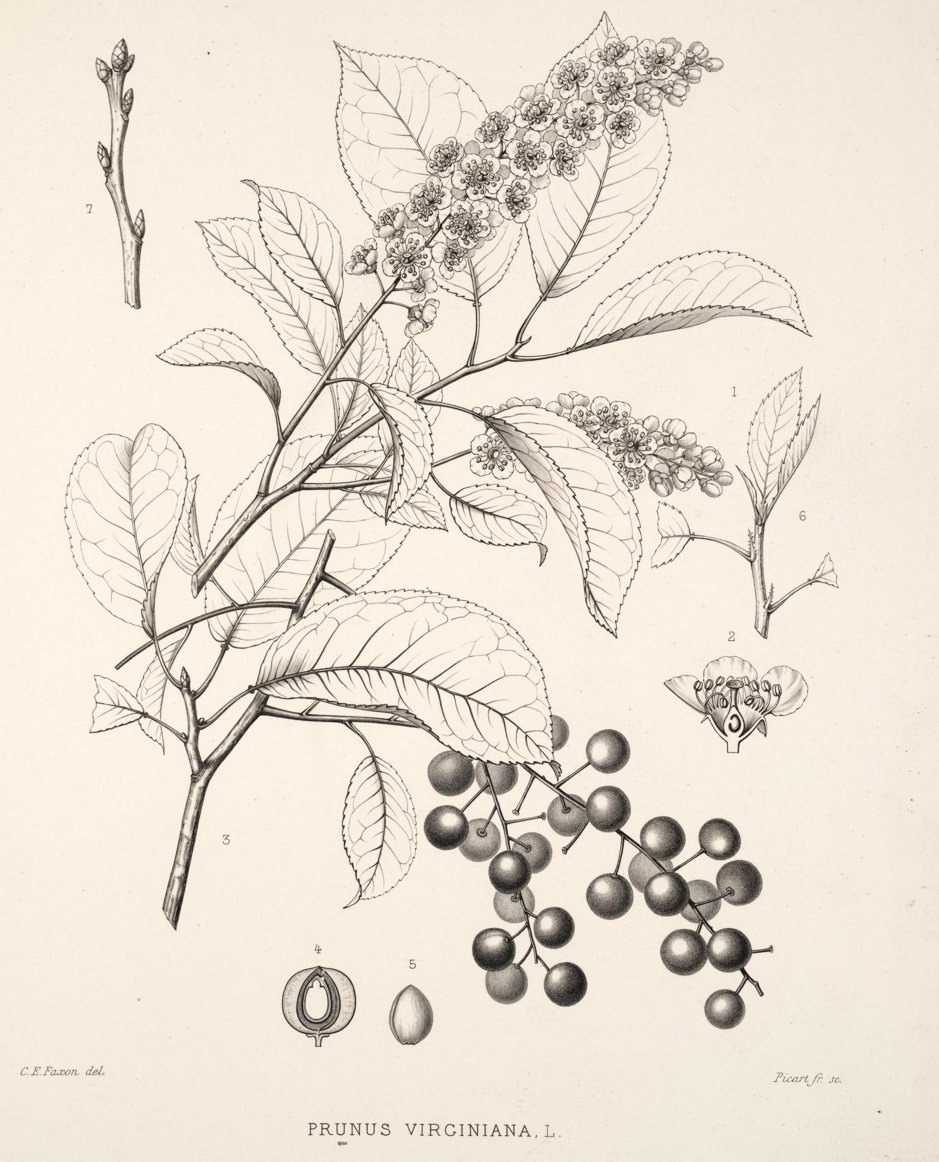
- Prunus virginiana, the chokecherry of North America: a tall shrub or small tree of forest margins, fence-rows, and highways, with racemes of white flowers and a fruit that ripens from bright red to almost black and furs the mouth until it is fully ripe.
- Kind
- Plant, in 4 older authorities
- Constituents
- prussic acid, tannin, kuromanin, and 1 more
- Poisoning
- Cyanide from the kernels
- Earliest authority here
- C. S. Rafinesque
- In other databases
- Plants of the World Online search · GBIF search · Wikidata search
Caution. Prussic acid in the bark, leaves, and kernels: the leaves poison cattle, and goats fed the leaves and flowers for a month took harm to the brain and the thyroid.
Chokecherry: what was it used for?
The bark, bitter and astringent, with that of the wild black cherry as a tonic, febrifuge, and sedative, ten to forty grains of the powder in infusion or tincture, never boiled; the astringent fruit with cider in domestic medicine; the fruit itself a staple food of the northern Indians and sold by the quantity in the markets of Canadian cities.
Chokecherry: foraging it in the Midwest
- Part
- Fruit; inner bark
- When
- Late summer, after frost for the fruit
The Pillager Ojibwe liked the fruit, which whites found too acrid, “especially after the fruit has been frosted,” and made a tea of the inner bark for lung trouble. The bark, leaves, and kernels hold prussic acid; the ripe flesh is the food.
After Smith. All the foragables of the Midwest. Historical record, not a field guide: identify before you gather, and read the whole entry.
Chokecherry: what does modern science say?
The bark, Rafinesque knew, holds prussic acid, and the leaves poison cattle. Goats fed ground chokecherry leaves and flowers for four weeks, at a dose reckoned as 2.5 milligrams of hydrogen cyanide per kilogram a day, showed clinical signs in two of them, vacuoles in the thyroid laid to thiocyanate, and lesions of the midbrain laid to cyanide. The fruit is rich in phenolics and in the anthocyanin kuromanin, which freezing preserves and hot-air drying wastes; and among eighty-five Indigenous remedies of the Canadian Prairies tested against MRSA, the chokecherry extract was active only under conditions imitating a wound.
Chokecherry: is it poisonous?
Yes, in some form or dose. Prussic acid in the bark, leaves, and kernels: the leaves poison cattle, and goats fed the leaves and flowers for a month took harm to the brain and the thyroid. Its poisoning is cyanide from the kernels: Minutes to a few hours, as the glycoside is hydrolysed in the gut. Historical description, not medical advice; in a poisoning, call a poison centre.
Pharmacognosy & Toxicology
- Constituents
- prussic acidhydrogen cyanide, freed from the bark, leaves, and kernels; the goats’ dose was reckoned in it
- tanninwith gum and mucus in the bitter, astringent bark, by Rafinesque’s account
- kuromaninthe anthocyanin of the fruit, measured with its phenolics and flavonoids
- malvidin and pelargonidin 3-O-glucosidesthe anthocyanins whose accumulation turns the leaves purple-red
- Mechanism
- Cyanide: in goats fed the leaves and flowers for four weeks, the spongiosis and spheroids of the midbrain were laid to cyanide and the vacuoles of the thyroid to its metabolite thiocyanate. The bark’s old use as sedative and febrifuge went with the prussic acid, which heat drives off.
- Toxic dose
- Ten to forty grains of the powdered bark, by Rafinesque, who found it brought the pulse from 75 to 50; the goats had 2.5 milligrams of hydrogen cyanide per kilogram a day in ground leaves and flowers.
- Syndrome
- Cyanide from the kernels
- Standing
- Never official in its own right: King’s dismissed the prunin made from it. The modern literature is on the fruit’s antioxidants, the leaves’ pigments, the plant’s cyanide, and the antimicrobial promise of its extract.
- Soto-Blanco, B., Stegelmeier, B. L., Pfister, J. A., Gardner, D. R., & Panter, K. E. (2008). Comparative effects of prolonged administration of cyanide, thiocyanate and chokecherry (Prunus virginiana) to goats. Journal of Applied Toxicology 28: 356–363. doi:10.1002/jat.1286 Verified against its record · PMID 17631662
- Téllez-Pérez, C., et al. (2020). Antioxidant content of frozen, convective air-dried, freeze-dried, and swell-dried chokecherries (Prunus virginiana L.). Molecules 25: 1190. doi:10.3390/molecules25051190 Verified against its record · PMID 32155801
- Li, X., et al. (2021). Molecular and metabolic insights into anthocyanin biosynthesis for leaf color change in chokecherry (Padus virginiana). International Journal of Molecular Sciences 22: 10697. doi:10.3390/ijms221910697 Verified against its record · PMID 34639038
- Rieger, C. D., et al. (2024). The antimicrobial potential of traditional remedies of Indigenous peoples from Canada against MRSA planktonic and biofilm bacteria in wound infection mimetic conditions. Microbiology Spectrum 12: e0234124. doi:10.1128/spectrum.02341-24 Verified against its record · PMID 39530700
The abstract of each source, beneath its citation. For Club members. About the Club or sign in.
Constituent names open the compound’s record at PubChem, and “ChEMBL” beside a name opens its record at ChEMBL, the European Bioinformatics Institute’s database of bioactive molecules. Where a mechanism line was checked against ChEMBL (ChEMBL 37, read 1 October 2026), the check is shown with the measured value and its source paper, or says plainly that nothing has been measured. Doses are as the references give them, for description only; this is not medical advice. Each source carries the result of its check against Crossref, PubMed, or the authority’s page: see Verification.
Chokecherry: what lore surrounds it?
The name is in the mouth: a fruit that furs the tongue to the roof of the mouth, as an early New England colonist complained. Its Latin name wandered for a century, Linnaeus’s Prunus virginiana being borne by the wild black cherry of the pharmacopoeia until the botanists gave it back to the chokecherry. Sargent found that it early drew the colonists’ attention but did not reach European gardens until the middle of the eighteenth century; that a yellow-fruited form was found at Dedham in Massachusetts; and that the inner bark’s strong, disagreeable smell tells it in winter from the wild black cherry, whose bark smells aromatic. The modern plant is an ornamental valued for leaves that turn purple-red, a colour a 2021 study traced to the glucosides of malvidin and pelargonidin.
Chokecherry: what did the older authorities say?
- C. S. Rafinesque
- Counts Prunus virginiana with the black cherries as active medicine: the bark bitter and astringent, holding prussic acid, tannin, gum, and mucus; tonic, febrifuge, and sedative, very useful in fevers, agues, hectic fever, dyspepsia, and chronic asthma; ten to forty grains of the powder, in infusion or tincture, heat driving off the prussic acid; the bark of the root stronger; it brings the pulse from 75 to 50, and in large doses is narcotic. “Leaves poison cattle, berries intoxicate birds, used for cherry bounce, baneful: kernels equal to bitter almonds.”
- King’s American Dispensatory
- Explains that the wild cherry of the pharmacopoeia, Prunus serotina, “was long confused with and went by the name of Prunus virginiana, which properly belongs to the Choke cherry”; describes the chokecherry as a shrub of six to ten feet, common in the United States and Canada and, by Sargent’s reckoning, “the most widely distributed of any American species of tree,” its fruit “bitterish, and exceedingly astringent” and often employed with cider in domestic medicine; and dismisses the “concentration” called prunin or cerasin, made from both cherries, as an inefficient agent seldom used.
- Charles Sprague Sargent
- Describes it in the Silva as the most widely distributed North American tree, growing within the arctic circle and from Labrador across to the Pacific and south to Georgia, Texas, and northern Mexico; its fruit austere and astringent in early autumn, but sweet and edible later; gathered in Canada in great quantities, sold in the markets of the large cities, eaten by the French Canadians, and formerly an important food of the northern Indians. A handsome plant in flower, “but it is generally disfigured by the Black Knot, which makes it a dangerous neighbor to orchards of cultivated Plum-trees.”
- William Wood
- In New England’s Prospect, as Sargent quotes him: the cherry trees “yeeld great store of Cherries, which grow on clusters like grapes; they be much smaller than our English Cherrie, nothing neare so good if they be not very ripe; they so furre the mouth that the tongue will cleave to the roofe, and the throate wax horse with swallowing those red Bullies (as I may call them), being little better in taste. English ordering may bring them to be an English Cherrie, but yet they are as wilde as the Indians.”
Sources
- Rafinesque, C. S. (1828). Medical Flora, or Manual of the Medical Botany of the United States of North America, vol. 2, “Prunus,” pp. 253–254. Internet Archive, b21468710_0002. Primary text
- Felter, H. W., & Lloyd, J. U. (1898). King’s American Dispensatory, “Prunus Virginiana (U. S. P.)—Wild Cherry,” with its Related Species. As transcribed at Henriette’s Herbal Homepage, henriettes-herb.com. Standard reference work
- Sargent, C. S. (1892). The Silva of North America, vol. 4, “Prunus Virginiana. Choke Cherry,” pp. 41–43 and Plate CLVIII. Internet Archive, mobot31753000329240. Primary text
Verification
- Checked
- October 1, 2026
- Passes
- Every sentence read against its sources, in the pass over the remaining 343 entries
- The Standing line checked against the authority it names (EMA, WHO, FDA, CITES, Commission E)
- Every dated or regulatory claim checked by category across the database
- Sources
- 7 cited: 4 verified against its record, 2 primary text, 1 standard reference work. 4 with the abstract on file.
- Corrections
- None were needed.
What was checked, how, and what was found is set out on the Verification page. A checked source is one whose record was found; it does not make the entry medical advice.
Cite This Entry
Version 1 · first published October 3, 2026
- Chicago
“Chokecherry.” In Materia Medica, edited by B. C. P. Statema. Version 1. The Thinking Press, 2026–. Last modified October 3, 2026. https://thethinkingpress.org/materia-medica/chokecherry.
- MLA
“Chokecherry.” Materia Medica, edited by B. C. P. Statema, version 1, The Thinking Press, 3 Oct. 2026, thethinkingpress.org/materia-medica/chokecherry. Accessed 8 Oct. 2026.
- APA
Chokecherry. (2026, October 3). In B. C. P. Statema (Ed.), Materia medica (Version 1). The Thinking Press. Retrieved October 8, 2026, from https://thethinkingpress.org/materia-medica/chokecherry
Club members keep entries on a shelf with private notes, print the plates as cards, and receive an entry by email each week. Create a free account before January 1, 2027 and all of it is yours for good. About the Club
See Also
Poisoned alike: cyanide from the kernels
Sharing tannin
Drawing on the same sources: Rafinesque, Felter, Sargent, Li
Ground cherry · Cattail · Jewelweed · Ghost pipe · Brewer’s yeast · Juneberry · Black walnut · Foetid pills · the bibliography →
Nearby in the alphabet
Chrism (Olive oil mixed with balsam and consecrated by a bishop) · Chocolate · Cinchona (The bark of Cinchona trees of the Andes) · Chicory (Cichorium intybus) · Cinnabar (Mercury sulfide) · Chaste tree (a Mediterranean shrub with spikes of lilac flowers and peppery fruit) · Cinnamon (The bark of Cinnamomum verum) · Chanterelle (apricot-scented mushroom with blunt ridges for gills)
Historical description, not medical advice.