
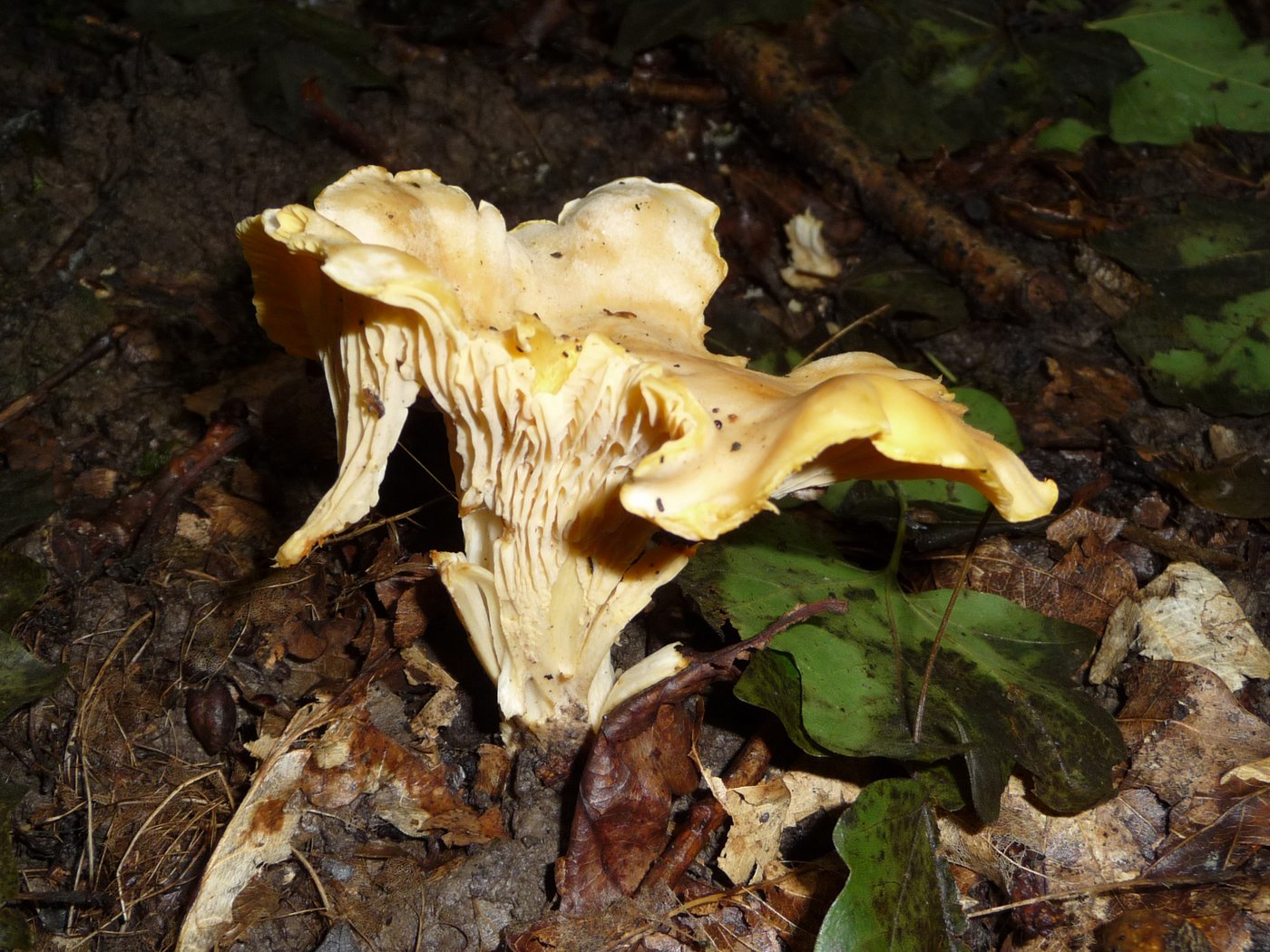
Chanterelle
Cantharellus cibarius
- Known today as
- A golden, apricot-scented mushroom with blunt ridges for gills.
- Kind
- Fungus
- Constituents
- carotenoids, ergocalciferol (vitamin D2), chanterelle polysaccharides
- In other databases
- GBIF search · Wikidata search
Revised October 3, 2026: Checked against its sources, each read in full, in part, or in its abstract. Version 1, first published September 25, 2026.
Chanterelle: what was it used for?
One of the great edible fungi of Europe.
Chanterelle: what does modern science say?
A safe and nutritious food once correctly identified.
Pharmacognosy & Toxicology
- Constituents
- carotenoidsthe pigments
- ergocalciferol (vitamin D2)a good source; formed from ergosterol by UV light
- chanterelle polysaccharides
- Mechanism
- A safe edible, a good source of vitamin D2 and carotenoids; its poisonous look-alike the jack-o’-lantern is the hazard. In the Materia Medica for the table and the forager’s caution only.
- Toxic dose
- A food.
- Standing
- A food.
- Phillips, K. M., et al. (2012). “Vitamin D4 in mushrooms.” PLoS ONE 7. Read in full · the text read
Constituent names open the compound’s record at PubChem, and “ChEMBL” beside a name opens its record at ChEMBL, the European Bioinformatics Institute’s database of bioactive molecules. Where a mechanism line was checked against ChEMBL (ChEMBL 37, read 1 October 2026), the check is shown with the measured value and its source paper, or says plainly that nothing has been measured. Doses are as the references give them, for description only; this is not medical advice. Each source carries the result of its check against Crossref, PubMed, or the authority’s page: see Verification.
Chanterelle: what lore surrounds it?
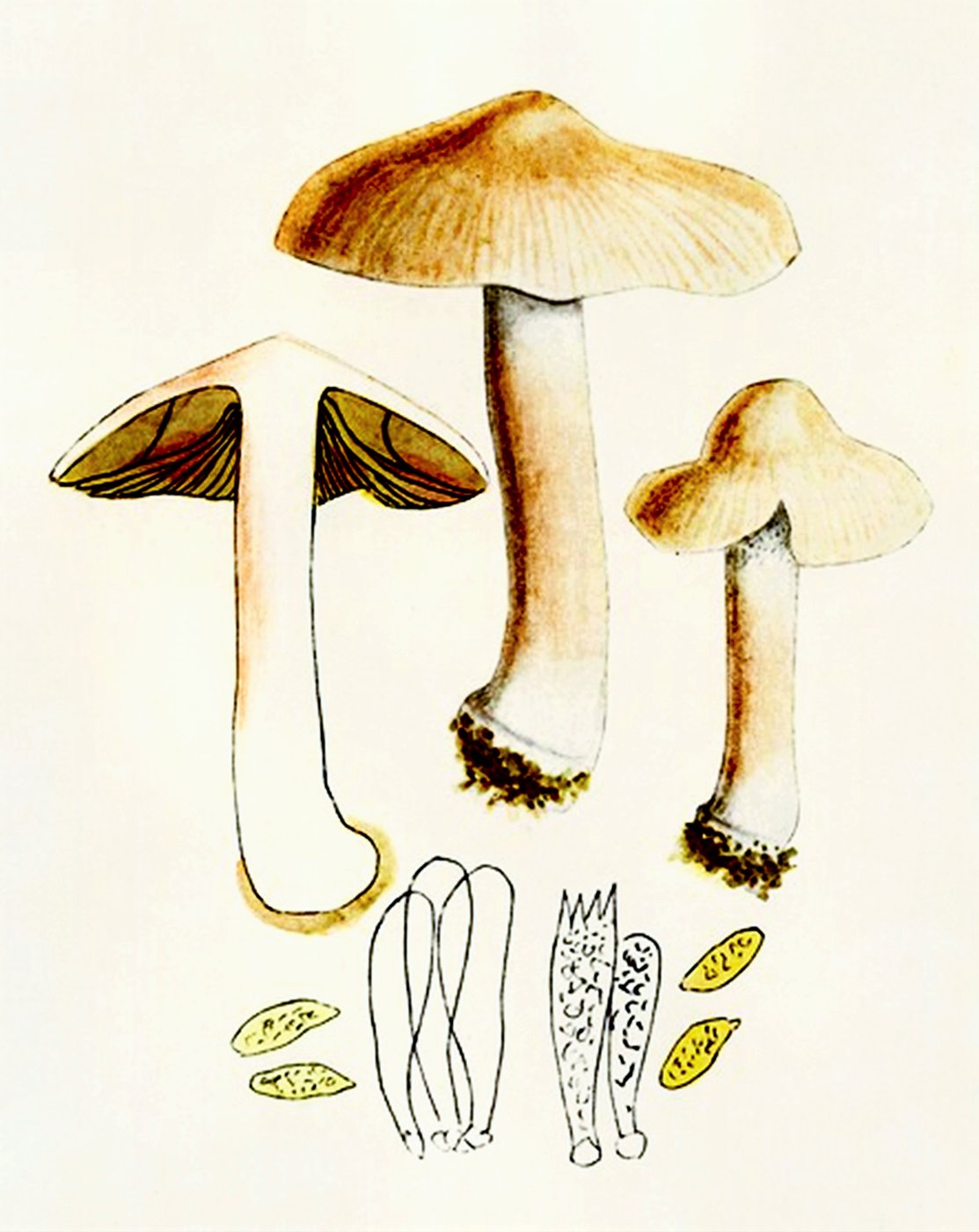
Its poisonous look-alikes include the jack-o’-lantern and, for the careless gatherer of young caps, the deadly webcap (see Deadly webcap).
In Their Own Words
Badham records that a waiter told him chanterelles were no novelty to him, having dressed them for years on state occasions at the Freemasons' Tavern.
“I learnt from the waiter, that they were not novelties to him; that in fact, he had been in the habit of dressing them for years, on state occasions, at the Freemasons’ Tavern.”
Charles David Badham, M.D., A Treatise on the Esculent Funguses of England, Cantharellus cibarius, Plate IX. London: Reeve, Brothers, King William Street, Strand, 1847 (Internet Archive OCR text). The text, read in part
Cooke describes the chanterelle as of a bright, deep yellow colour, with a smell like that of ripe apricots.
“It is of a bright, deep yellow colour, with a smell like that of ripe apricots”
M. C. Cooke, A Plain and Easy Account of British Fungi, Cantharellus, p. 62. London: Robert Hardwicke, 192, Piccadilly, 1862 (Internet Archive OCR text). The text, read in part
Each passage is quoted from the text named, which the press fetched and read, and was checked word for word against a fresh copy of it; the link opens that copy. Passages are given as printed, without the editors’ footnote numbers, and with words broken across lines joined.
Sources
- Wikipedia, “Cantharellus cibarius,” en.wikipedia.org (read 2 October 2026). Read in full · the text read
- Wikipedia (de), “Echter Pfifferling,” de.wikipedia.org (read 2 October 2026). Read in full · the text read
- Kumar, A., et al. (2025). Nutritional, nutraceutical, and medicinal potential of Cantharellus cibarius Fr.: a comprehensive review. Food Science & Nutrition 13: e4641. Read in full · the text read
Verification
- Checked
- October 1, 2026, and October 3, 2026
- Passes
- Every sentence read against its sources, in the pass over the remaining 343 entries
- The Standing line checked against the authority it names (EMA, WHO, FDA, CITES, Commission E)
- Every dated or regulatory claim checked by category across the database
- Every source read, in full, in part, or in its abstract, and every sentence checked against what was read (October 3, 2026)
- Sources
- 4 cited: 4 read in full.
- Corrections
- None were needed.
What was checked, how, and what was found is set out on the Verification page. A checked source is one whose record was found; it does not make the entry medical advice.
Cite This Entry
Version 1 · first published September 25, 2026 · last revised October 3, 2026
- Chicago
“Chanterelle.” In Materia Medica, edited by B. C. P. Statema. Version 1. The Thinking Press, 2026–. Last modified October 3, 2026. https://thethinkingpress.org/materia-medica/chanterelle.
- MLA
“Chanterelle.” Materia Medica, edited by B. C. P. Statema, version 1, The Thinking Press, 3 Oct. 2026, thethinkingpress.org/materia-medica/chanterelle. Accessed 8 Oct. 2026.
- APA
Chanterelle. (2026, October 3). In B. C. P. Statema (Ed.), Materia medica (Version 1). The Thinking Press. Retrieved October 8, 2026, from https://thethinkingpress.org/materia-medica/chanterelle
Club members keep entries on a shelf with private notes, print the plates as cards, and receive an entry by email each week. Create a free account before January 1, 2027 and all of it is yours for good. About the Club
See Also
Sharing carotenoids
Drawing on the same sources: Wikipedia, Phillips
Civet · Carmelite water · Cochia pills · Morel · Yellow stainer · Saffron milk cap · the bibliography →
Nearby in the alphabet
Chaste tree (a Mediterranean shrub with spikes of lilac flowers and peppery fruit) · Chamomile (Matricaria chamomilla) · Chicory (Cichorium intybus) · Chaga (cracked, charcoal-like growth on living birch) · Chocolate · Centaury (Centaurium erythraea) · Chokecherry (the chokecherry of North America) · Cattail

Historical description, not medical advice.