
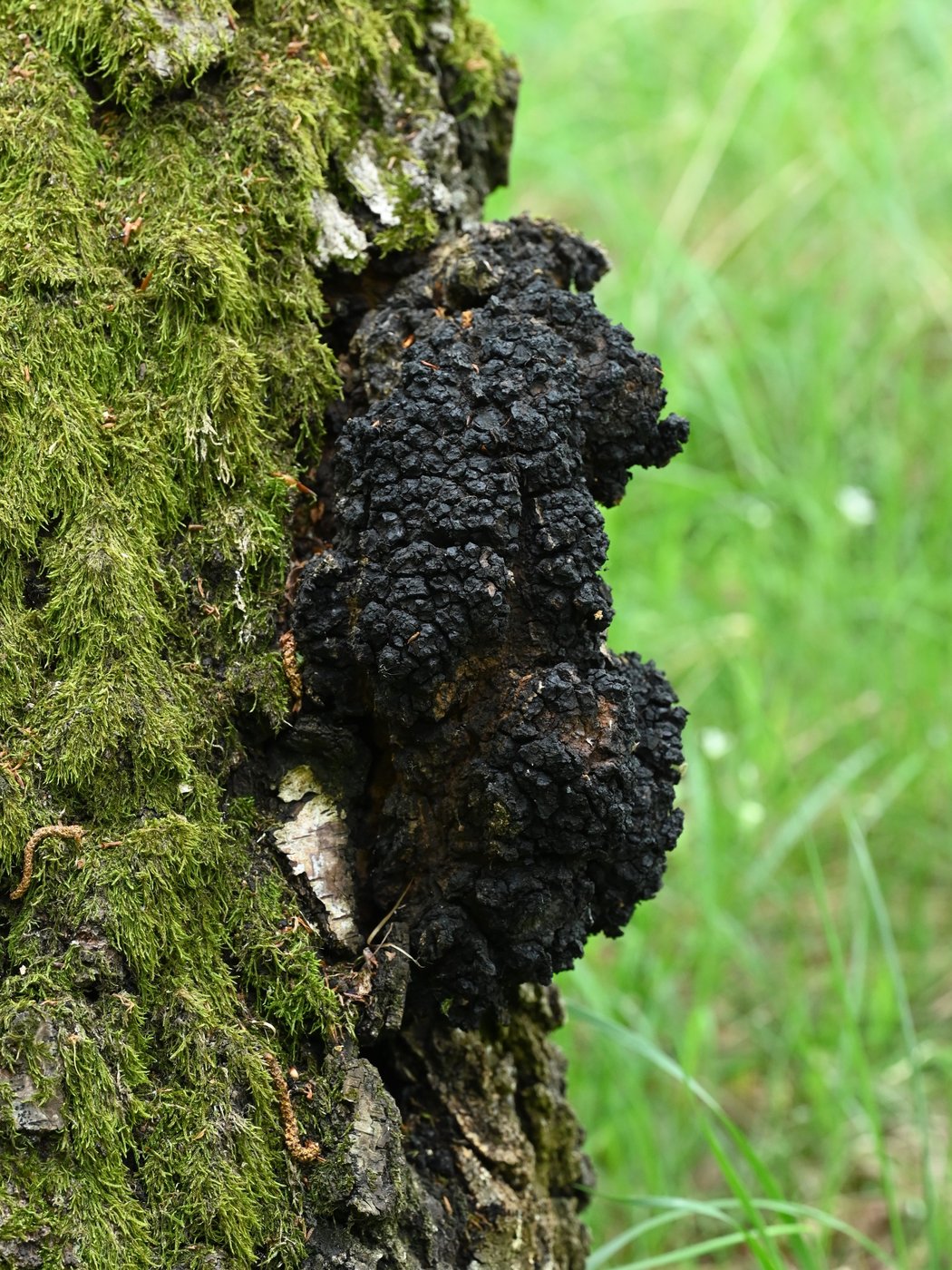
Chaga
Inonotus obliquus
- Known today as
- A black, cracked, charcoal-like growth on living birch.
- Kind
- Fungus, in 2 older authorities
- Constituents
- betulin, betulinic acid, oxalic acid
- Poisoning
- Oxalate poisoning
- Earliest authority here
- The Khanty and the Russians
- In other databases
- GBIF search · Wikidata search
Revised October 3, 2026: Tradition, lore, modern assessment, and sources extended. Checked against its sources, each read in full, in part, or in its abstract. Version 1, first published September 25, 2026.
Caution. Heavy use can damage the kidneys.
Chaga: what was it used for?
Brewed as a tea in Russian and Siberian folk medicine for stomach complaints and cancer.
Chaga: what does modern science say?
Heavy use has caused kidney damage from its oxalates. Chaga concentrates betulin from the birch, which has anti-tumour activity in the laboratory, and its oxalate content is among the highest of any organism: a Japanese woman who took it daily for months went into kidney failure, and other patients have been reported since.
Pharmacognosy & Toxicology
- Constituents
- betulin ChEMBLfrom the birch
- betulinic acid ChEMBL
- oxalic acid ChEMBLvery high
- Mechanism
- Oxalate nephropathy with chronic use.
- Toxic dose
- Months or years of daily use in the reported cases.
- Syndrome
- Oxalate poisoning
- Kikuchi, Y., et al. (2014). Clinical Nephrology 81. Abstract read · the text read
The abstract of each source, beneath its citation. For Club members. About the Club or sign in.
Constituent names open the compound’s record at PubChem, and “ChEMBL” beside a name opens its record at ChEMBL, the European Bioinformatics Institute’s database of bioactive molecules. Where a mechanism line was checked against ChEMBL (ChEMBL 37, read 1 October 2026), the check is shown with the measured value and its source paper, or says plainly that nothing has been measured. Doses are as the references give them, for description only; this is not medical advice. Each source carries the result of its check against Crossref, PubMed, or the authority’s page: see Verification.
Chaga: what lore surrounds it?
Its use by poor Russians is mentioned in Solzhenitsyn’s Cancer Ward, as Géry and colleagues note.
Among the Potawatomi it is shkitagen, the fungus that holds an ember without going out, carried as a fire-keeper.
Chaga: what did the older authorities say?
- The Khanty and the Russians
- The Khanty drank it for gastritis and ulcers, and Russian farmers and workers too poor to buy tea drank it as an infusion; the name is from the Komi word for mushroom.
- Soviet medicine
- Recognised its decoction in 1955 and entered it in the Soviet Pharmacopoeia as Befunginum.
Sources
- Kikuchi, Y., et al. (2014). “Chaga mushroom-induced oxalate nephropathy.” Clinical Nephrology 81. Abstract read · the text read
- Géry, A., et al. (2018). Chaga (Inonotus obliquus), a future potential medicinal fungus in oncology? A chemical study and a comparison of the cytotoxicity against human lung adenocarcinoma cells (A549) and human bronchial epithelial cells (BEAS-2B). Integrative Cancer Therapies 17: 832–843. Read in full · the text read
- Fordjour, E., et al. (2023). Chaga mushroom: a super-fungus with countless facets and untapped potential. Frontiers in Pharmacology 14: 1273786. Read in full · the text read
- Lee, S., et al. (2026). Kidney injury induced by high-dose Chaga mushroom consumption: experimental evidence in a rat model. Journal of Korean Medical Science 41: e37. Read in full · the text read
Verification
- Checked
- October 1, 2026, and October 3, 2026
- Passes
- Every sentence read against its sources, in the pass over the remaining 343 entries
- Every dated or regulatory claim checked by category across the database
- Every source read, in full, in part, or in its abstract, and every sentence checked against what was read (October 3, 2026)
- Sources
- 5 cited: 3 read in full, 2 abstract read. 2 with the abstract on file.
- Corrections
- None were needed.
What was checked, how, and what was found is set out on the Verification page. A checked source is one whose record was found; it does not make the entry medical advice.
Cite This Entry
Version 1 · first published September 25, 2026 · last revised October 3, 2026
- Chicago
“Chaga.” In Materia Medica, edited by B. C. P. Statema. Version 1. The Thinking Press, 2026–. Last modified October 3, 2026. https://thethinkingpress.org/materia-medica/chaga.
- MLA
“Chaga.” Materia Medica, edited by B. C. P. Statema, version 1, The Thinking Press, 3 Oct. 2026, thethinkingpress.org/materia-medica/chaga. Accessed 8 Oct. 2026.
- APA
Chaga. (2026, October 3). In B. C. P. Statema (Ed.), Materia medica (Version 1). The Thinking Press. Retrieved October 8, 2026, from https://thethinkingpress.org/materia-medica/chaga
Club members keep entries on a shelf with private notes, print the plates as cards, and receive an entry by email each week. Create a free account before January 1, 2027 and all of it is yours for good. About the Club
See Also
Poisoned alike: oxalate poisoning
Purslane · Wood sorrel · Sorrel, syrup of · the syndrome, with all of them →
Sharing betulinic acid, oxalic acid
Nearby in the alphabet
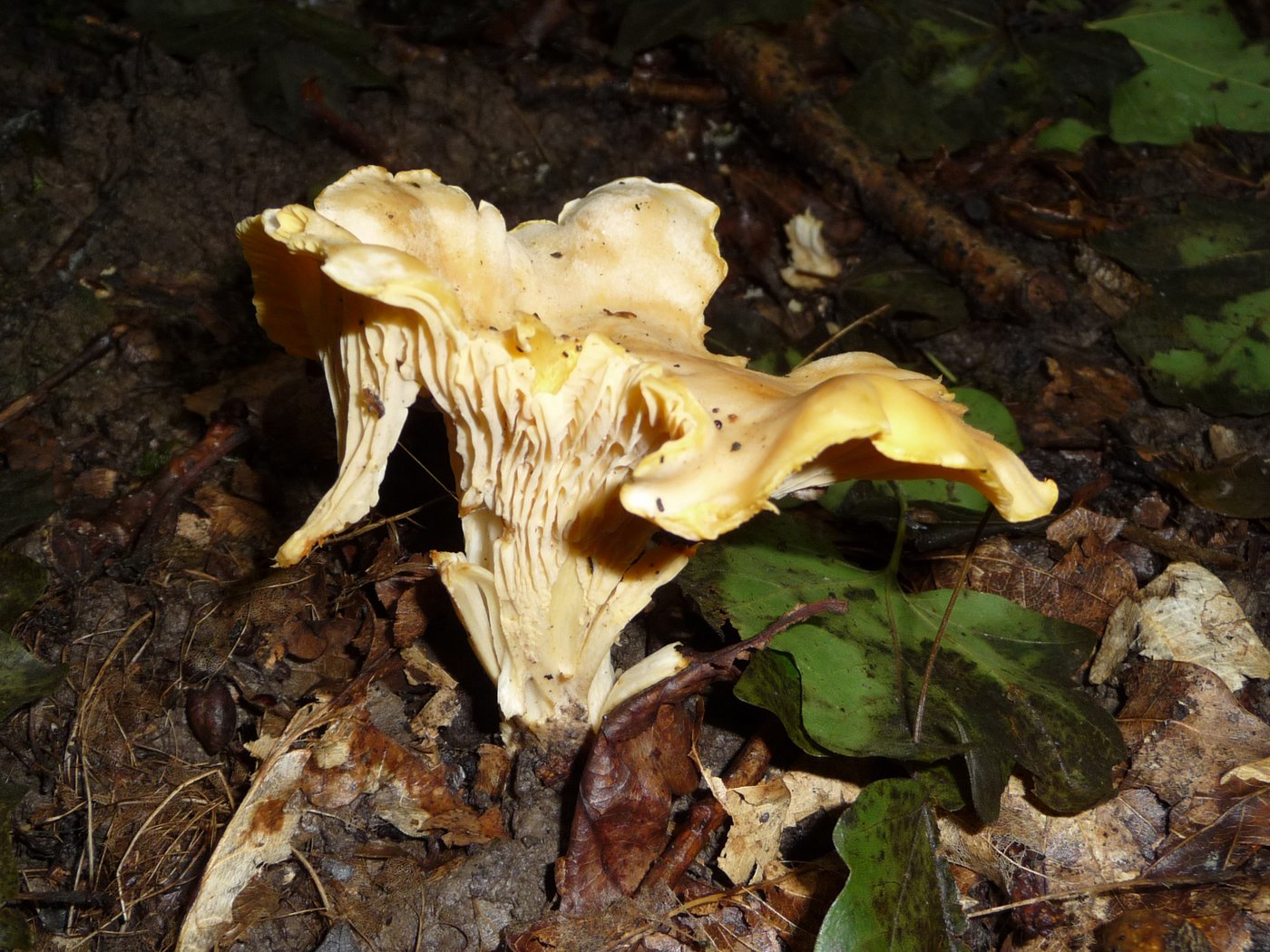
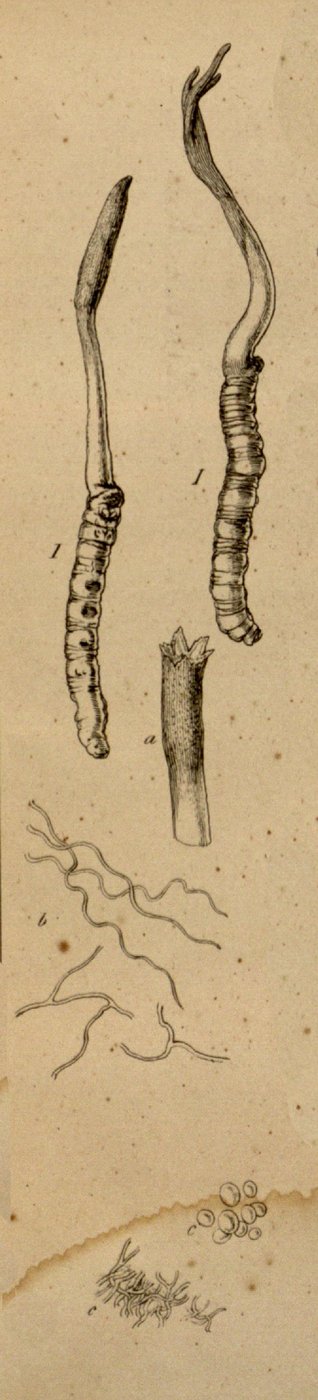
Chamomile (Matricaria chamomilla) · Centaury (Centaurium erythraea) · Chanterelle (apricot-scented mushroom with blunt ridges for gills) · Cattail · Chaste tree (a Mediterranean shrub with spikes of lilac flowers and peppery fruit) · Catmint (Clinopodium nepeta) · Chicory (Cichorium intybus) · Caterpillar fungus (sending up a slender stalk)

Historical description, not medical advice.