
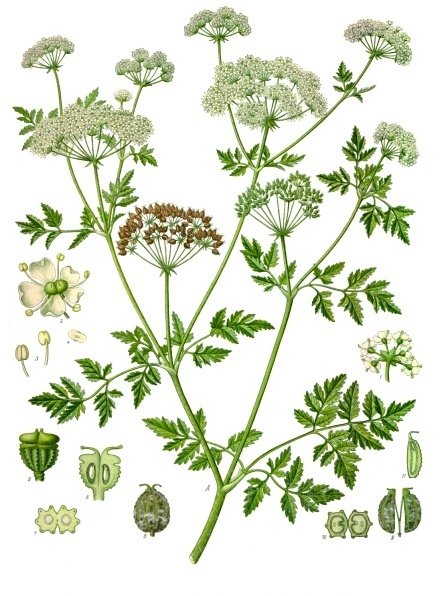
Hemlock
Cicuta; Greek kōneion
- Known today as
- Poison hemlock, Conium maculatum, of the carrot family.
- Kind
- Plant, in 4 older authorities
- Constituents
- coniine, gamma-coniceine, conhydrine
- Earliest authority here
- Plato (c. 428–348 BC)
- Qualities
- Cold in the fourth degree (Galenic tradition). What the degrees mean
- In other databases
- Plants of the World Online search · GBIF search · Wikidata search
Revised October 1, 2026: Tradition, lore, modern assessment, and sources extended. Version 1, first published September 25, 2026.
Caution. Easily mistaken for wild carrot, parsley, or fennel.
Hemlock: what does modern science say?
Its alkaloid coniine paralyzes the muscles and at last the breath, while the mind stays clear, just as Plato describes. Coniine, its alkaloid, was the first alkaloid ever synthesised, by Albert Ladenburg in 1886; it blocks the junction of nerve and muscle like curare. Six to eight leaves can kill an adult, and most modern poisonings come from mistaking it for wild carrot or parsley, which it outgrows: hemlock stands head-high, smooth, spotted purple, and smells of mice when crushed.
Hemlock: is it poisonous?
Yes, in some form or dose. Easily mistaken for wild carrot, parsley, or fennel. Its poisoning is nicotinic poisoning (coniine, nicotine, cytisine): Minutes to an hour. Historical description, not medical advice; in a poisoning, call a poison centre.
Pharmacognosy & Toxicology
- Constituents
- coniine ChEMBLthe chief alkaloid; a piperidine
- gamma-coniceinemore toxic, highest in the young plant
- conhydrine
- Mechanism
- Coniine acts at the nicotinic receptors of nerve and muscle, first stimulating and then blocking them, as curare does.
- Checked against ChEMBL
- coniine: Only weak support for “acts at the nicotinic receptors”: Acetylcholine receptor subunit alpha (electric ray), IC50 30 µM, CHEMBL3046562; Nicotinic acetylcholine receptor alpha 5 subunit (Musca domestica), Ki >1 mM, CHEMBL3045843.
- Toxic dose
- About 150–300 mg of coniine, some six to eight leaves, or a few grams of the seed, has killed an adult.
- Syndrome
- Nicotinic poisoning (coniine, nicotine, cytisine)
- Standing
- No medicinal use. Störck’s hemlock left the pharmacopoeias in the nineteenth century.
- Nelson, L. S., et al. (2007). Handbook of Poisonous and Injurious Plants. Verified against its record · doi:10.1007/978-1-4939-8926-3
Constituent names open the compound’s record at PubChem, and “ChEMBL” beside a name opens its record at ChEMBL, the European Bioinformatics Institute’s database of bioactive molecules. Where a mechanism line was checked against ChEMBL (ChEMBL 37, read 1 October 2026), the check is shown with the measured value and its source paper, or says plainly that nothing has been measured. Doses are as the references give them, for description only; this is not medical advice. Each source carries the result of its check against Crossref, PubMed, or the authority’s page: see Verification.
What Medicine Makes of It
- The Witches’ OintmentNightshades on the skin, and what they do.
Hemlock: what lore surrounds it?
Theramenes, Phocion, and Polemarchus died by the Athenian cup as Socrates did. Its purple-blotched stem was said to carry the mark of Cain, and in Scotland the children’s name for it is “dead man’s oatmeal.”
Hemlock: what did the older authorities say?
- Plato
- The Phaedo tells of Socrates’ death by the cup of hemlock in 399 BC, the numbness rising from his feet toward his heart.
- Athens
- Hemlock was the state poison of the Athenian courts.
- Theophrastus
- Records that Thrasyas of Mantinea devised a painless draught of hemlock juice and poppy, and that the Athenian executioners pounded the leaves and seed fresh for each dose.
- Anton von Störck
- The Viennese physician revived hemlock in 1760 as a remedy for cancers and hard swellings, testing it on himself, and for a century it stood in every pharmacopoeia as a sedative and resolvent.
Sources
- Plato, Phaedo. Verified against its record · doi:10.1093/actrade/9780198720492.book.1
- Dioscorides, De materia medica. Read in part · the text read
- Theophrastus, Enquiry into Plants IX. Verified against its record · doi:10.4159/dlcl.theophrastus-enquiry_plants.1916
- Störck, A. (1760). Libellus quo demonstratur cicutam. Book, not indexed
Verification
- Checked
- October 1, 2026
- Passes
- Every sentence read against its sources, in the pass over the remaining 343 entries
- The Standing line checked against the authority it names (EMA, WHO, FDA, CITES, Commission E)
- Every dated or regulatory claim checked by category across the database
- The mechanism read against ChEMBL (ChEMBL 37): curated mechanisms and measured activity
- Sources
- 5 cited: 1 read in part, 3 verified against its record, 1 book, not indexed.
- Corrections
- None were needed.
What was checked, how, and what was found is set out on the Verification page. A checked source is one whose record was found; it does not make the entry medical advice.
Cite This Entry
Version 1 · first published September 25, 2026 · last revised October 1, 2026
- Chicago
“Hemlock.” In Materia Medica, edited by B. C. P. Statema. Version 1. The Thinking Press, 2026–. Last modified October 1, 2026. https://thethinkingpress.org/materia-medica/hemlock.
- MLA
“Hemlock.” Materia Medica, edited by B. C. P. Statema, version 1, The Thinking Press, 1 Oct. 2026, thethinkingpress.org/materia-medica/hemlock. Accessed 8 Oct. 2026.
- APA
Hemlock. (2026, October 1). In B. C. P. Statema (Ed.), Materia medica (Version 1). The Thinking Press. Retrieved October 8, 2026, from https://thethinkingpress.org/materia-medica/hemlock
Club members keep entries on a shelf with private notes, print the plates as cards, and receive an entry by email each week. Create a free account before January 1, 2027 and all of it is yours for good. About the Club
See Also
Poisoned alike: nicotinic poisoning (coniine, nicotine, cytisine)
Lesser bean-trefoil · Gorse · Tobacco · Broom · the syndrome, with all of them →
Also in Theophrastus
Licorice in Theophrastus · Cinnabar in Theophrastus · Mandrake in Theophrastus · White lead in Theophrastus · everything Theophrastus names →
Also in Anton von Störck
Meadow saffron in Anton von Störck · everything Anton von Störck names →
Drawing on the same sources: Dioscorides, Theophrastus, Nelson
Hemp · Gum arabic · Henbane · Colocynth · the bibliography →
Nearby in the alphabet
Heartsease (the wild pansy of fields and banks, purple, white, and yellow) · Hazel (Corylus avellana) · Herb bennet (of the rose family, with a root that smells of cloves) · Hawthorn (Crataegus monogyna) · Herb Paris (true-lover’s knot, a woodland plant with a single black berry) · Hartshorn (rasped, burnt, or distilled)

Historical description, not medical advice.