
Wild ginger
Canada snakeroot, heart snakeroot, Indian ginger, coltsfoot, broadleaf asarabacca; Asarum canadense of Linnaeus, Asarum latifolium of Salisbury; the Ojibwe namepîn, sturgeon potato; the Potawatomi ba’boan
- Known today as
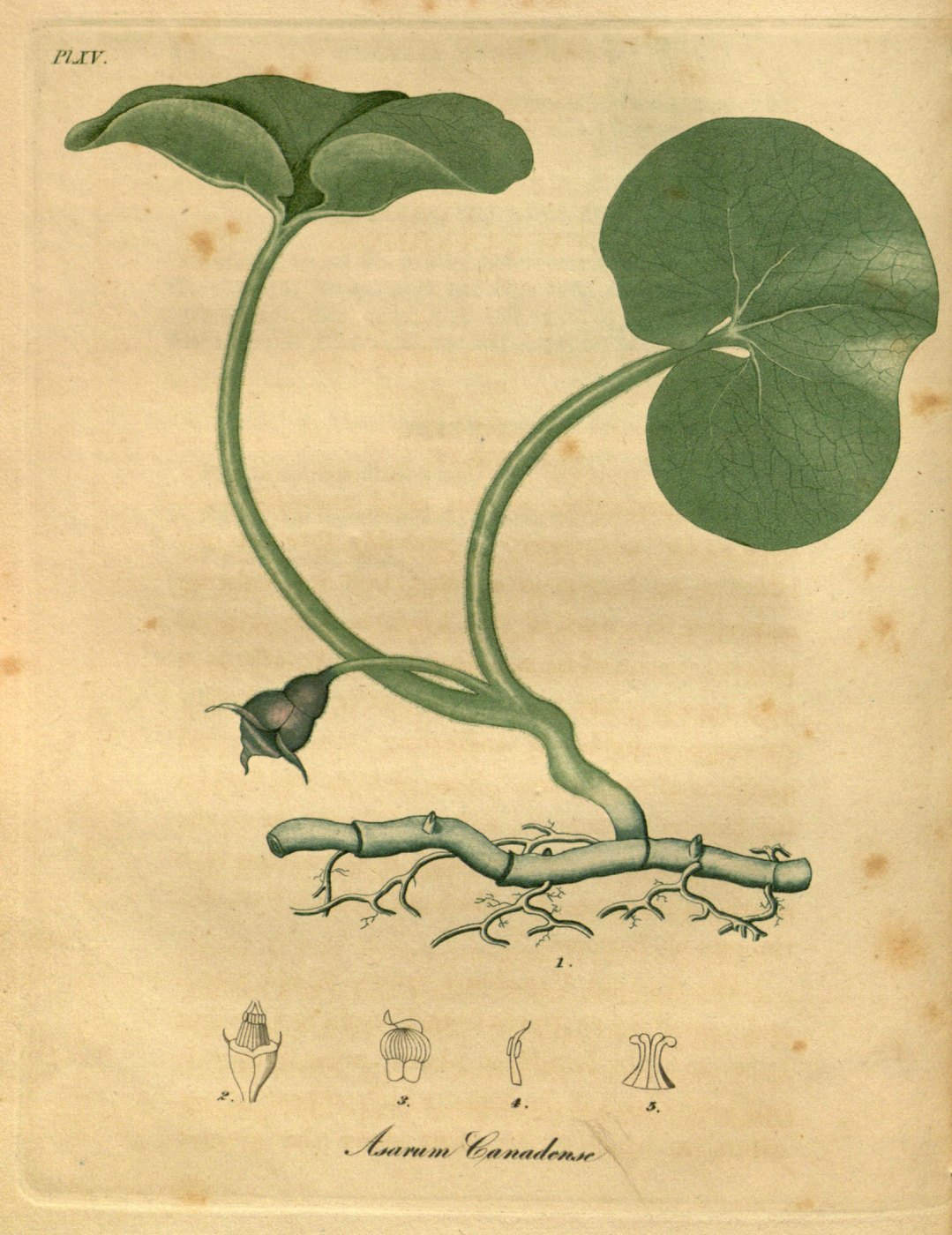
- Asarum canadense, the humblest plant of the rich shady woods from Canada to Carolina and Missouri: two kidney-shaped hairy leaves on long stalks and, hidden in their fork at the ground, one brownish-purple three-cleft flower in May and June, over a creeping fleshy root that smells and tastes of ginger. Its European kin the asarabacca is an emetic; this is not.
- Kind
- Plant, in 4 older authorities
- Constituents
- a pungent volatile oil, a red bitter resin, aristolochic acid analogues
- Earliest authority here
- Jacob Bigelow
- In other databases
- Plants of the World Online search · GBIF search · Wikidata search
Caution. The genus carries aristolochic acids and their analogues, which destroy the kidney and cause cancer of the urinary tract, and regulators have banned or restricted plants that contain them; the Canadian species has not been measured in any study read here, and the old seasoning use is not a reason to take it in quantity.
Wild ginger: what was it used for?
A seasoning and a stomachic through the Midwest. The Pillager Ojibwe, Smith says, called it a potato for sick people, who chewed the root and could then eat anything they desired, and used it in cookery to take the muddy taste from fish and render any meat digestible; the Forest Potawatomi flavoured meat and fish with it and gave it to those who could keep nothing on their stomachs; Densmore’s Chippewa put it in any food as it cooked, as an appetiser, and took it for indigestion. Bigelow, who had seen the root used in the country as a sudorific, satisfied himself that half a drachm of the fresh powder excited neither vomiting nor nausea, and knew “no indigenous article which promises so fairly” as a substitute for ginger; Rafinesque made a cordial of its tincture and syrup, a snuff of the dried leaves, and a wine by fermenting the whole plant, and found the roots sold for Virginia snakeroot.
Wild ginger: foraging it in the Midwest
- Part
- Root
- When
- Spring to autumn
Rich shady woods, hills, and alluvial ground from Canada to Missouri; the creeping root, found by its two kidney-shaped leaves, was the seasoning of the Lake tribes. The genus carries a kidney poison, and the species has not been measured.
After Rafinesque; Smith. All the foragables of the Midwest. Historical record, not a field guide: identify before you gather, and read the whole entry.
Wild ginger: what does modern science say?
The genus is under a cloud. Species of Asarum, like Aristolochia, contain aristolochic acid analogues, the compounds behind aristolochic acid nephropathy and cancers of the upper urinary tract; a 2017 study of the medicinally used Chinese species found potentially nephrotoxic aristolactams in nearly every sample, in water as well as alcohol extracts and in every part of the plant, though most extracts did not kill kidney cells at the doses tested. The 2019 review of these toxins names Asarum with Aristolochia as their source, calls the kidney damage and the DNA lesions irreversible, and notes the bans and warnings of the regulators. No study read for this entry measured the Canadian species itself.
Wild ginger: is it poisonous?
Yes, in some form or dose. The genus carries aristolochic acids and their analogues, which destroy the kidney and cause cancer of the urinary tract, and regulators have banned or restricted plants that contain them; the Canadian species has not been measured in any study read here, and the old seasoning use is not a reason to take it in quantity. Historical description, not medical advice; in a poisoning, call a poison centre.
Pharmacognosy & Toxicology
- Constituents
- a pungent volatile oilwith the taste and smell of the plant, by Bigelow; a phenol, pinene, a blue oil, and a lactone by Densmore’s list
- a red bitter resinwhich with the oil carries the activity into alcohol; little or no tannin
- aristolochic acid analoguesaristolactams found in the medicinally used Asian species of the genus, in every part and in water as well as alcohol extracts; not measured in the Canadian species in any study read here
- Mechanism
- An aromatic stimulant and carminative by the old accounts, and not the emetic its European kin is. The hazard of the genus is the aristolochic acids: they form DNA adducts with a signature of A-to-T transversions, cause an irreversible nephropathy and cancer of the upper urinary tract, and have led regulators to ban or restrict the plants that hold them.
- Toxic dose
- Half a drachm of the fresh powdered root, by Bigelow, without nausea; a root chewed, or a seasoning in the pot, by the Ojibwe and Potawatomi.
- Standing
- A seasoning and a folk stomachic in a genus now known for a kidney poison; the species itself awaits measurement.
- Michl, J., Bello, O., Kite, G. C., Simmonds, M. S. J., & Heinrich, M. (2017). Medicinally used Asarum species: high-resolution LC-MS analysis of aristolochic acid analogs and in vitro toxicity screening in HK-2 cells. Frontiers in Pharmacology 8: 215. doi:10.3389/fphar.2017.00215 Verified against its record · PMID 28588481
- Han, J., Xian, Z., Zhang, Y., Liu, J., & Liang, A. (2019). Systematic overview of aristolochic acids: nephrotoxicity, carcinogenicity, and underlying mechanisms. Frontiers in Pharmacology 10: 648. doi:10.3389/fphar.2019.00648 Verified against its record · PMID 31244661
The abstract of each source, beneath its citation. For Club members. About the Club or sign in.
Constituent names open the compound’s record at PubChem, and “ChEMBL” beside a name opens its record at ChEMBL, the European Bioinformatics Institute’s database of bioactive molecules. Where a mechanism line was checked against ChEMBL (ChEMBL 37, read 1 October 2026), the check is shown with the measured value and its source paper, or says plainly that nothing has been measured. Doses are as the references give them, for description only; this is not medical advice. Each source carries the result of its check against Crossref, PubMed, or the authority’s page: see Verification.
Wild ginger: what lore surrounds it?
A flower that hides at the ground under its own leaves, so that Bigelow had to pluck the plant to find it; the sturgeon potato of the Ojibwe, who gave the sick a root to chew so that they could eat. Rafinesque wanted it exported as American ginger, and it was sold instead as a counterfeit snakeroot.
Wild ginger: what did the older authorities say?
- Jacob Bigelow
- The plant “affords a striking exception to the rule, that botanical affinities are capable of indicating the medicinal qualities of vegetables”: it is not the emetic its European relation is, whatever the books copied from Cornutus say. The root tastes between ginger and the Virginia snakeroot; country practitioners spoke to him of it as a warm stimulant and diaphoretic, and “as a substitute for ginger, in common domestic use, I know of no indigenous article which promises so fairly as this.”
- C. S. Rafinesque
- “Aromatic stimulant and diaphoretic, cordial, emenagogue, subtonic, errhine, &c.; but not properly emetic like the A. europeum.” Useful in cachexia, melancholy, palpitations, low fevers, convalescence, and whooping cough, in small and repeated doses; the dried leaves “make a fine stimulating and cephalic snuff”; and the roots “deserve to be collected more extensively, as an article of trade and exportation; being an excellent substitute for ginger in every instance.”
- Huron H. Smith
- The sturgeon potato: “The Pillager Ojibwe called this a potato for sick people. They are supposed to chew the root, and then they can eat anything they desire.” In cookery “they claim it takes away any muddy taste from fish, and will render any meat dish digestible by anyone, even if they are sick. The roots are processed in lye water for cookery on a large scale.”
- Frances Densmore
- “The root of this plant was regarded as an ‘appetizer,’ being put in any food as it was being cooked. It was also used for indigestion.” Carminative and a flavour in the National Formulary.
Sources
- Bigelow, J. (1817). American Medical Botany, vol. 1, “Asarum canadense. Canada Snake root. Wild ginger,” pp. 149–154 and Plate XV. Internet Archive, mobot31753000788213. Primary text
- Rafinesque, C. S. (1828). Medical Flora, or Manual of the Medical Botany of the United States of North America, vol. 1, no. 12, “Asarum canadense.” Internet Archive, b21468710_0001. Primary text
- Smith, H. H. (1932). Ethnobotany of the Ojibwe Indians, Bulletin of the Public Museum of the City of Milwaukee 4(3), “Wild Ginger,” under medicines and foods. Project Gutenberg, 49527. Primary text
- Smith, H. H. (1933). Ethnobotany of the Forest Potawatomi Indians, Bulletin of the Public Museum of the City of Milwaukee 7(1), “Wild Ginger.” Internet Archive, ethnobotany-of-the-forest-potawatomi-indians-by-huron-h.-smith-1933. Primary text
- Densmore, F. (1928). Uses of Plants by the Chippewa Indians, Forty-fourth Annual Report of the Bureau of American Ethnology, “Asarum canadense.” Internet Archive, usesofplantsbych00dens. Primary text
Verification
- Checked
- October 1, 2026
- Passes
- Every sentence read against its sources, in the pass over the remaining 343 entries
- The Standing line checked against the authority it names (EMA, WHO, FDA, CITES, Commission E)
- Every dated or regulatory claim checked by category across the database
- Sources
- 7 cited: 2 verified against its record, 5 primary text. 2 with the abstract on file.
- Corrections
- None were needed.
What was checked, how, and what was found is set out on the Verification page. A checked source is one whose record was found; it does not make the entry medical advice.
Cite This Entry
Version 1 · first published October 4, 2026
- Chicago
“Wild ginger.” In Materia Medica, edited by B. C. P. Statema. Version 1. The Thinking Press, 2026–. Last modified October 4, 2026. https://thethinkingpress.org/materia-medica/wild-ginger.
- MLA
“Wild ginger.” Materia Medica, edited by B. C. P. Statema, version 1, The Thinking Press, 4 Oct. 2026, thethinkingpress.org/materia-medica/wild-ginger. Accessed 8 Oct. 2026.
- APA
Wild ginger. (2026, October 4). In B. C. P. Statema (Ed.), Materia medica (Version 1). The Thinking Press. Retrieved October 8, 2026, from https://thethinkingpress.org/materia-medica/wild-ginger
Club members keep entries on a shelf with private notes, print the plates as cards, and receive an entry by email each week. Create a free account before January 1, 2027 and all of it is yours for good. About the Club
See Also
Drawing on the same sources: Bigelow, Rafinesque, Smith, Densmore
Bloodroot · Pokeweed · Ginseng · Black walnut · Wild bergamot · Burdock · the bibliography →
Nearby in the alphabet
Wild rue (Peganum harmala) · Wild garlic (Allium ursinum) · Winter-grain mould (Pink and white moulds of grain left in the field over winter) · Wild carrot, seed of (Queen Anne’s lace) · Witch ball (often silvered or colored, hung in the window) · Witch bottle · White willow (The bark and leaves of Salix alba)
Historical description, not medical advice.