
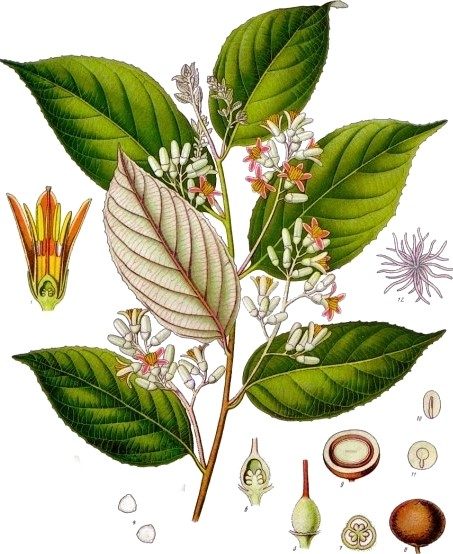
Benzoin
Belzoin
- Known today as
- Gum benzoin, the resin of Styrax benzoin of Sumatra.
- Kind
- Resin & Wood, in 2 older authorities
- Constituents
- benzoic acid, cinnamic acid, coniferyl benzoate, and 1 more
- Earliest authority here
- Its name
- In other databases
- Plants of the World Online search · GBIF search · Wikidata search
- In the Canale glossary
- On the Manner of Discerning and Healing the Bewitched, Appendix A: Part Three, Chapter 9: Anointings
Revised October 1, 2026: Tradition, lore, modern assessment, and sources extended. Version 1, first published September 25, 2026.
Benzoin: what did Canale use it for?
In the oil for the bewitched (ch. 9).
Benzoin: what does modern science say?
Antiseptic; still in compound tincture of benzoin. Compound tincture of benzoin, the Friar’s balsam of the old chests, is still painted on skin to make dressings adhere and breathed in steam for colds; benzoic acid and its salts preserve foods and soft drinks the world over.
Pharmacognosy & Toxicology
- Constituents
- benzoic acid ChEMBLup to 20 per cent, free and as esters
- cinnamic acid ChEMBLin Sumatra benzoin
- coniferyl benzoate
- vanillin ChEMBLthe sweetness
- Mechanism
- Benzoic acid is antiseptic and antifungal, and the resin painted on skin dries to a protective film, the “friar’s balsam” use; breathed in steam it is an expectorant by irritation. It is a recognised contact allergen.
- Toxic dose
- Safe externally; allergic dermatitis is common enough that it is in patch-test series.
- Standing
- Compound benzoin tincture is in the USP and the BP as a skin protectant and inhalation; the FDA declined to list it as a skin protectant in its 2003 monograph.
- Scardamaglia, L., et al. (2003). “Compound tincture of benzoin: a common contact allergen?” Australasian Journal of Dermatology 44. Abstract read · the text read
The abstract of each source, beneath its citation. For Club members. About the Club or sign in.
Constituent names open the compound’s record at PubChem, and “ChEMBL” beside a name opens its record at ChEMBL, the European Bioinformatics Institute’s database of bioactive molecules. Where a mechanism line was checked against ChEMBL (ChEMBL 37, read 1 October 2026), the check is shown with the measured value and its source paper, or says plainly that nothing has been measured. Doses are as the references give them, for description only; this is not medical advice. Each source carries the result of its check against Crossref, PubMed, or the authority’s page: see Verification.
Benzoin: what lore surrounds it?
Sumatra benzoin, rich in cinnamic acid, went to the apothecaries; Siam benzoin, sweeter, to the perfumers; benzoic acid, first obtained from the resin by sublimation in the sixteenth century, took its name from it.
Benzoin: what did the older authorities say?
- Its name
- From the Arabic lubān jāwī, “frankincense of Java,” worn down to benjoin by the Italian and French traders who brought it from Sumatra in the fifteenth century.
- The churches
- Burned it as incense, and in Russia and the Orthodox East it remains the chief ingredient of church incense; in the West it went into pomanders, pastilles, and the perfumes of the glovers.
Sources
- [29] DailyMed, U.S. National Library of Medicine. Compound Benzoin Tincture (Medical Chemical Corporation), label updated 1 July 2026. dailymed.nlm.nih.gov. Verified against its record · doi:10.1057/978-1-349-96157-3_5219
- Pomet, P. (1694). Histoire générale des drogues. Book, seen in reviews
Verification
- Checked
- October 1, 2026
- Passes
- Every sentence read against its sources, in the pass over the remaining 343 entries
- The Standing line checked against the authority it names (EMA, WHO, FDA, CITES, Commission E)
- Every dated or regulatory claim checked by category across the database
- Sources
- 3 cited: 1 abstract read, 1 verified against its record, 1 book, seen in reviews. 1 with the abstract on file.
- Corrections
- said the FDA lists it as a skin protectant. The FDA's 2003 final monograph expressly declined to include compound benzoin tincture.
What was checked, how, and what was found is set out on the Verification page. A checked source is one whose record was found; it does not make the entry medical advice.
Cite This Entry
Version 1 · first published September 25, 2026 · last revised October 1, 2026
- Chicago
“Benzoin.” In Materia Medica, edited by B. C. P. Statema. Version 1. The Thinking Press, 2026–. Last modified October 1, 2026. https://thethinkingpress.org/materia-medica/benzoin.
- MLA
“Benzoin.” Materia Medica, edited by B. C. P. Statema, version 1, The Thinking Press, 1 Oct. 2026, thethinkingpress.org/materia-medica/benzoin. Accessed 8 Oct. 2026.
- APA
Benzoin. (2026, October 1). In B. C. P. Statema (Ed.), Materia medica (Version 1). The Thinking Press. Retrieved October 8, 2026, from https://thethinkingpress.org/materia-medica/benzoin
Club members keep entries on a shelf with private notes, print the plates as cards, and receive an entry by email each week. Create a free account before January 1, 2027 and all of it is yours for good. About the Club
See Also
Sharing benzoic acid, cinnamic acid, vanillin
Drawing on the same sources: Pomet, Scardamaglia
Nearby in the alphabet
Betony (Betonica officinalis) · Ben-nut (Moringa oleifera (or M) · Bezoar stone (A concretion formed in the stomach of goats and other animals) · Bells (and wrongly, called their “baptism) · Birch polypore (A white bracket of dead birch) · Basil (Ocimum basilicum) · Bistort (snakeweed) · Barley water (A thin decoction of barley)
Historical description, not medical advice.