
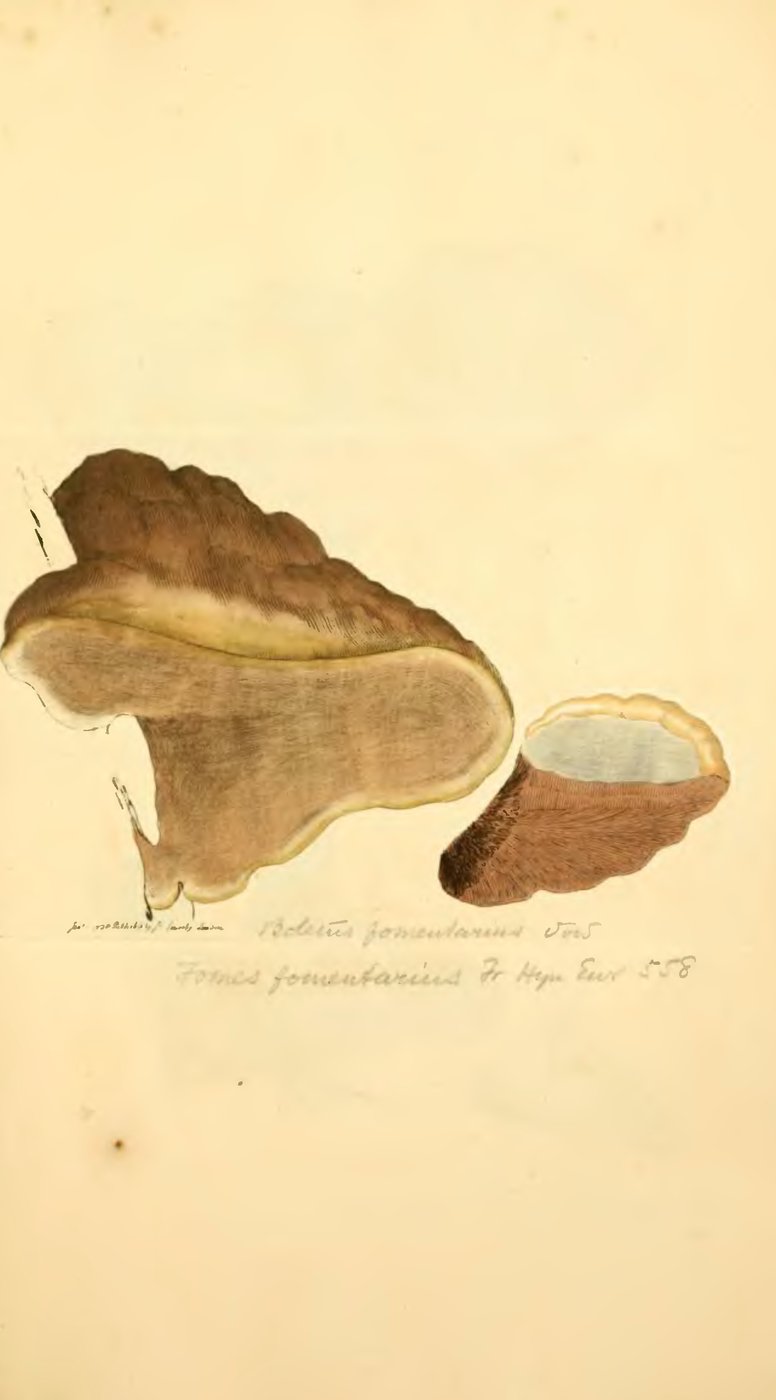
Tinder fungus
Fomes fomentarius; amadou, surgeon’s agaric
- Known today as
- A hoof-shaped bracket of birch and beech.
- Kind
- Fungus
- Constituents
- fomentariol, beta-glucans and chitin, lanostane triterpenes
- In other databases
- GBIF search · Wikidata search
Tinder fungus: what was it used for?
Its soft inner layer, beaten into felt, made amadou: tinder for flint and steel, a dressing to stop bleeding, and even caps and purses.
Tinder fungus: what does modern science say?
Amadou does help blood clot. The fungus is being studied for its antimicrobial compounds.
Pharmacognosy & Toxicology
- Constituents
- fomentariolthe red-brown pigment
- beta-glucans and chitinthe felt of amadou
- lanostane triterpenes
- Mechanism
- Amadou is a felt of chitin and glucan that absorbs blood and holds a clot, which is why surgeons used it as a styptic into the nineteenth century, and it takes a spark, which is why Ötzi carried it. Nothing in it is absorbed.
- Toxic dose
- Inert.
- Standing
- A material of fly-tiers and museum conservators; no medical use.
- Grienke, U., et al. (2014). “European medicinal polypores: a modern view on traditional uses.” Journal of Ethnopharmacology 154. Verified against its record · doi:10.1016/j.jep.2014.04.030
The abstract of each source, beneath its citation. For Club members. About the Club or sign in.
Constituent names open the compound’s record at PubChem, and “ChEMBL” beside a name opens its record at ChEMBL, the European Bioinformatics Institute’s database of bioactive molecules. Where a mechanism line was checked against ChEMBL (ChEMBL 37, read 1 October 2026), the check is shown with the measured value and its source paper, or says plainly that nothing has been measured. Doses are as the references give them, for description only; this is not medical advice. Each source carries the result of its check against Crossref, PubMed, or the authority’s page: see Verification.
Tinder fungus: what lore surrounds it?
Ötzi, the man found in the Alpine ice who died about 5,300 years ago, carried a piece of it in his pouch with his fire-making kit.
In Their Own Words
Mrs Grieve says the prepared fungus (Polyporus fomentarius) was formerly much used by surgeons, applied with pressure, to stop bleeding, and that steeped in nitre it made the tinder called amadou.
“In this state, it was formerly much used by surgeons for arresting haemorrhage, being applied with pressure. When it is steeped in a solution of nitre and afterwards dried, it constitutes 'Spunk,' 'punk' or tinder, the Amadou of the French”
Mrs. M. Grieve, A Modern Herbal: “Fungi”, “Fungi”: Boletus chirurgorum (surgeon's agaric). The text of A Modern Herbal as published on botanical.com. The text, read in part
The 1911 Britannica describes amadou as a soft tough tinder derived from Polyporus fomentarius, a fungus somewhat like a mushroom in its manner of growth.
“AMADOU, a soft tough substance used as tinder, derived from Polyporus fomentarius, a fungus belonging to the group Basidiomycetes and somewhat resembling a mushroom in manner of growth.”
Encyclopædia Britannica, eleventh edition: Amadou, “Amadou”, vol. 1. The 1911 Encyclopædia Britannica, as transcribed on Wikisource. The text, read in full
Each passage is quoted from the text named, which the press fetched and read, and was checked word for word against a fresh copy of it; the link opens that copy. Passages are given as printed, without the editors’ footnote numbers, and with words broken across lines joined.
Sources
- Peintner, U., et al. (1998). The Iceman’s fungi. Mycological Research 102: 1153–1162. Verified against its record · doi:10.1017/s0953756298006546
Verification
- Checked
- October 1, 2026
- Passes
- Every sentence read against its sources, in the fifty-entry sample
- The Standing line checked against the authority it names (EMA, WHO, FDA, CITES, Commission E)
- Every dated or regulatory claim checked by category across the database
- Sources
- 2 cited: 2 verified against its record. 1 with the abstract on file.
- Corrections
- None were needed.
What was checked, how, and what was found is set out on the Verification page. A checked source is one whose record was found; it does not make the entry medical advice.
Cite This Entry
Version 1 · first published September 25, 2026
- Chicago
“Tinder fungus.” In Materia Medica, edited by B. C. P. Statema. Version 1. The Thinking Press, 2026–. Last modified September 25, 2026. https://thethinkingpress.org/materia-medica/tinder-fungus.
- MLA
“Tinder fungus.” Materia Medica, edited by B. C. P. Statema, version 1, The Thinking Press, 25 Sept. 2026, thethinkingpress.org/materia-medica/tinder-fungus. Accessed 8 Oct. 2026.
- APA
Tinder fungus. (2026, September 25). In B. C. P. Statema (Ed.), Materia medica (Version 1). The Thinking Press. Retrieved October 8, 2026, from https://thethinkingpress.org/materia-medica/tinder-fungus
Club members keep entries on a shelf with private notes, print the plates as cards, and receive an entry by email each week. Create a free account before January 1, 2027 and all of it is yours for good. About the Club
See Also
Drawing on the same sources: Grienke
Nearby in the alphabet
Toad (dried, powdered, or worn) · Thyme (T) · Toadflax (Linaria vulgaris) · The thurible · Toadstone (Lepidotes, believed to come from a toad’s head) · Thorn apple (of the nightshade family) · Tobacco (Nicotiana tabacum) · Theriac

Historical description, not medical advice.