
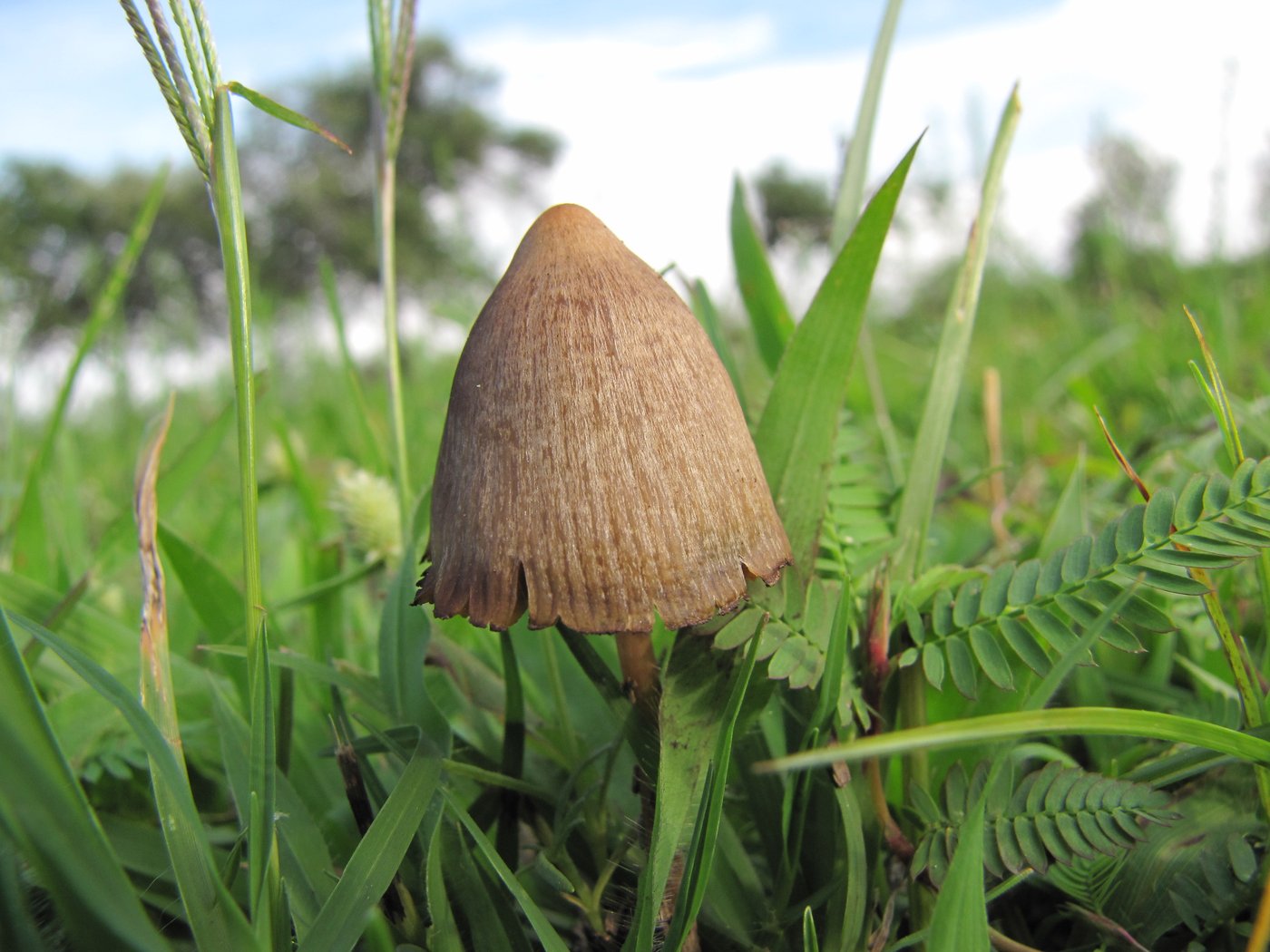
Teonanácatl
Psilocybe mexicana, P. cubensis, P. semilanceata; Nahuatl, “flesh of the gods”
- Known today as
- Small brown mushrooms that stain blue when bruised.
- Kind
- Fungus
- Constituents
- psilocybin, psilocin
- Poisoning
- Psilocybin
- In other databases
- GBIF search · Wikidata search
Caution. Profoundly psychoactive; illegal in most places.
Teonanácatl: what was it used for?
Eaten in sacred healing ceremonies in Mexico before and after the conquest.
Teonanácatl: what does modern science say?
Psilocybin is being tested, with encouraging early results, for treatment-resistant depression; it remains a controlled drug in most countries.
Pharmacognosy & Toxicology
- Constituents
- psilocybin ChEMBLa prodrug
- psilocin ChEMBLthe active form, a serotonin 2A agonist
- Mechanism
- Psilocin acts at the serotonin 2A receptors of the cortex.
- Checked against ChEMBL
- psilocybin: ChEMBL’s curated mechanism: agonist 5-hydroxytryptamine receptor 2A.
- Toxic dose
- Effects from about 10 mg of psilocybin; no fatal dose is established.
- Syndrome
- Psilocybin
- Standing
- A controlled substance; licensed for depression in Australia from 2023 under supervision, and in clinical trials elsewhere.
- Griffiths, R. R., et al. (2006). Psychopharmacology 187. Book, not indexed
Constituent names open the compound’s record at PubChem, and “ChEMBL” beside a name opens its record at ChEMBL, the European Bioinformatics Institute’s database of bioactive molecules. Where a mechanism line was checked against ChEMBL (ChEMBL 37, read 1 October 2026), the check is shown with the measured value and its source paper, or says plainly that nothing has been measured. Doses are as the references give them, for description only; this is not medical advice. Each source carries the result of its check against Crossref, PubMed, or the authority’s page: see Verification.
Teonanácatl: what lore surrounds it?
The Spanish friar Bernardino de Sahagún recorded the Aztec use of teonanácatl. In 1957 R. Gordon Wasson described in Life magazine the ceremony of the Mazatec healer María Sabina, and in 1958 Albert Hofmann isolated psilocybin.
In Their Own Words
Safford quotes, in English, Sahagún's sixteenth-century account of Aztec feasts at which the first thing eaten was black mushrooms called nanacatl, which intoxicated and caused visions.
“The first thing eaten at the party was certain black mushrooms, which they call nanacatl, which intoxicate and cause visions to be seen, and even provoke”
W. E. Safford, Narcotic Plants and Stimulants of the Ancient Americans, “Lophophora Williamsii, the so-called sacred mushroom”, pp. 404–405. From the Smithsonian Report for 1916, pages 387–424 (Publication 2466). Washington: Government Printing Office, 1917. The text, read in part
Safford, having searched in vain for a fungus with the properties of teonanacatl, reports finding instead a narcotic plant with exactly its properties, one form of which, dried as a drug, looks so like a dried mushroom as to deceive a mycologist; in this section he identifies teonanacatl with Lophophora williamsii (peyote), his own identification, not the old writers'.
“No such fungus, however, was discovered, but in its place a narcotic plant having properties exactly like those attributed to the teonanacatl was encountered; moreover, one form of this plant, when prepared as a drug, resembles a dried mushroom so remarkably that at first glance it will even deceive a mycologist”
W. E. Safford, Narcotic Plants and Stimulants of the Ancient Americans, “Lophophora Williamsii, the so-called sacred mushroom”, p. 400. From the Smithsonian Report for 1916, pages 387–424 (Publication 2466). Washington: Government Printing Office, 1917. The text, read in part
Each passage is quoted from the text named, which the press fetched and read, and was checked word for word against a fresh copy of it; the link opens that copy. Passages are given as printed, without the editors’ footnote numbers, and with words broken across lines joined.
Sources
- Bernardino de Sahagún, Florentine Codex. Book, seen in reviews
- Hofmann, A., et al. (1958). Psilocybin, ein psychotroper Wirkstoff aus dem mexikanischen Rauschpilz. Verified against its record · doi:10.1007/bf02159243
Verification
- Checked
- October 1, 2026
- Passes
- Every sentence read against its sources, in the pass over the remaining 343 entries
- The Standing line checked against the authority it names (EMA, WHO, FDA, CITES, Commission E)
- Every dated or regulatory claim checked by category across the database
- The mechanism read against ChEMBL (ChEMBL 37): curated mechanisms and measured activity
- Sources
- 3 cited: 1 verified against its record, 1 book, seen in reviews, 1 book, not indexed.
- Corrections
- None were needed.
What was checked, how, and what was found is set out on the Verification page. A checked source is one whose record was found; it does not make the entry medical advice.
Cite This Entry
Version 1 · first published September 25, 2026
- Chicago
“Teonanácatl.” In Materia Medica, edited by B. C. P. Statema. Version 1. The Thinking Press, 2026–. Last modified September 25, 2026. https://thethinkingpress.org/materia-medica/teonanacatl.
- MLA
“Teonanácatl.” Materia Medica, edited by B. C. P. Statema, version 1, The Thinking Press, 25 Sept. 2026, thethinkingpress.org/materia-medica/teonanacatl. Accessed 8 Oct. 2026.
- APA
Teonanácatl. (2026, September 25). In B. C. P. Statema (Ed.), Materia medica (Version 1). The Thinking Press. Retrieved October 8, 2026, from https://thethinkingpress.org/materia-medica/teonanacatl
Club members keep entries on a shelf with private notes, print the plates as cards, and receive an entry by email each week. Create a free account before January 1, 2027 and all of it is yours for good. About the Club
See Also
Nearby in the alphabet
Terra sigillata (A clay dug on the island of Lemnos and stamped with a seal) · Teasel (Dipsacus fullonum) · Tetragrammaton (not pronounced in Jewish practice) · Tea (The dried leaves of Camellia sinensis) · Theriac · Tansy (Tanacetum vulgare) · Thorn apple (of the nightshade family) · Tamarind (The pod pulp of Tamarindus indica)

Historical description, not medical advice.