
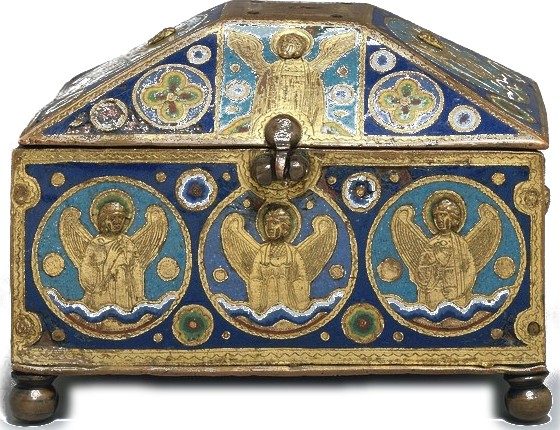
Blessed oil
Oglio benedetto
- Known today as
- Oil blessed by a priest, as distinct from the holy oils blessed and consecrated by the bishop in Holy Week.
- Kind
- Sacramental
- Constituents
- oleic acid, hypericin and hyperforin, boswellic acids
- In the Canale glossary
- On the Manner of Discerning and Healing the Bewitched, Appendix A: Treatise Two: Blessed Objects and Materials
Blessed oil: what did Canale use it for?
For the healing of the sick and the destruction of hexes, with a composition from St. John’s wort, sage, dill, ashes, olive, frankincense, myrrh, and gold, and the Scriptural aromatics (Treatise Two).
Blessed oil: what does modern science say?
Blessed oil is a sacramental; the anointing of the sick is a sacrament and uses the oil of the sick, blessed by the bishop at the Chrism Mass (or, in case of necessity, by a priest).
Pharmacognosy & Toxicology
- Constituents
- oleic acid ChEMBLthe olive oil
- hypericin and hyperforinfrom the St John’s wort
- boswellic acidsfrom the frankincense
- Mechanism
- An olive-oil infusion of St John’s wort, sage, and dill with ashes and resins: the hyperforin of the wort has antibacterial and wound-healing action in the skin, the oil itself is an emollient, and the ashes make the mix alkaline. Rubbed on, it would do what red oil of St John’s wort does, and no more.
- Toxic dose
- External use; hypericin oils can photosensitise fair skin in the sun.
- Standing
- The red oil of St John’s wort has an EMA monograph (2009) for minor wounds and sunburn; the blessing adds a rite.
- EMA/HMPC (2009). Community herbal monograph on Hypericum perforatum L., herba (traditional use). Verified against its record
- Samadi, S., et al. (2010). “The effect of Hypericum perforatum on the wound healing and scar of cesarean.” Journal of Alternative and Complementary Medicine 16. Verified against its record · doi:10.1089/acm.2009.0317
The abstract of each source, beneath its citation. For Club members. About the Club or sign in.
Constituent names open the compound’s record at PubChem, and “ChEMBL” beside a name opens its record at ChEMBL, the European Bioinformatics Institute’s database of bioactive molecules. Where a mechanism line was checked against ChEMBL (ChEMBL 37, read 1 October 2026), the check is shown with the measured value and its source paper, or says plainly that nothing has been measured. Doses are as the references give them, for description only; this is not medical advice. Each source carries the result of its check against Crossref, PubMed, or the authority’s page: see Verification.
In Their Own Words
Leclercq writes in the Catholic Encyclopedia that the oil of the sick might once be blessed not only by priests but by virtuous laymen and even women, citing St. Monegundus blessing oil and salt for the sick.
“The oil of the sick might be blessed not only by priests, but also by laymen of high repute for virtue, and even by women. In the sixth century St. Monegundus on his death-bed blessed oil and salt which were afterwards used for the sick”
Henri Leclercq, The Catholic Encyclopedia, “Holy Oils”, “Holy Oils”, section 'Oil of the sick'. Vol. 7. New York: Robert Appleton Company, 1910 (New Advent transcription). The text, read in full
Morrisroe lists oil among the articles of food that have benedictions assigned to them in the Roman Ritual.
“The following articles of food have benedictions assigned to them: paschal lamb, eggs, oil, wine, lard, cheese, butter, dripping, salt, and water which is used as antidote to rabies.”
Patrick Morrisroe, The Catholic Encyclopedia, “Blessing”, “Blessing”, (b) articles of food. Vol. 2. New York: Robert Appleton Company, 1907 (New Advent transcription). The text, read in full
Each passage is quoted from the text named, which the press fetched and read, and was checked word for word against a fresh copy of it; the link opens that copy. Passages are given as printed, without the editors’ footnote numbers, and with words broken across lines joined.
Sources
- [21] Herbermann, C. G., et al. (eds.) (1907–1912). The Catholic Encyclopedia. New York: Robert Appleton Company. Online at newadvent.org. Articles: Agnus Dei (H. Thurston); Amulet (M. Hassett); Ash Wednesday (H. Thurston); Bells (H. Thurston); Holy Oils (H. Leclercq); Paschal Candle (H. Thurston); Scapular (J. Hilgers). Read in part · the text read
- [24] Code of Canon Law (1983), cann. 998–999 and 1166. vatican.va. Book, seen in reviews
- [116] United States Conference of Catholic Bishops. The Blessing of the Oils and the Consecration of the Chrism. usccb.org. Book, seen in reviews
Verification
- Checked
- October 1, 2026
- Passes
- Every sentence read against its sources, in the pass over the remaining 343 entries
- The Standing line checked against the authority it names (EMA, WHO, FDA, CITES, Commission E)
- Every dated or regulatory claim checked by category across the database
- Sources
- 5 cited: 1 read in part, 2 verified against its record, 2 book, seen in reviews. 1 with the abstract on file.
- Corrections
- None were needed.
What was checked, how, and what was found is set out on the Verification page. A checked source is one whose record was found; it does not make the entry medical advice.
Cite This Entry
Version 1 · first published September 25, 2026
- Chicago
“Blessed oil.” In Materia Medica, edited by B. C. P. Statema. Version 1. The Thinking Press, 2026–. Last modified September 25, 2026. https://thethinkingpress.org/materia-medica/blessed-oil.
- MLA
“Blessed oil.” Materia Medica, edited by B. C. P. Statema, version 1, The Thinking Press, 25 Sept. 2026, thethinkingpress.org/materia-medica/blessed-oil. Accessed 8 Oct. 2026.
- APA
Blessed oil. (2026, September 25). In B. C. P. Statema (Ed.), Materia medica (Version 1). The Thinking Press. Retrieved October 8, 2026, from https://thethinkingpress.org/materia-medica/blessed-oil
Club members keep entries on a shelf with private notes, print the plates as cards, and receive an entry by email each week. Create a free account before January 1, 2027 and all of it is yours for good. About the Club
See Also
Sharing oleic acid
Chrism · Moringa oleifera · Corylus avellana · Sweet almond, oil of
Nearby in the alphabet
Blessed paper (Paper blessed so that what is written on it may take effect) · Blessed herbs (especially on the feast of the Assumption (15 August)) · Bloodroot (the first flower of the spring woods from Canada to the South) · Blessed candles (and the Paschal candle) · Bloodstone (iron oxide, which streaks blood-red) · Blessed bread (distinct from the Eucharist) · Bogbean · Blessed ashes (blessed on Ash Wednesday)


Historical description, not medical advice.