
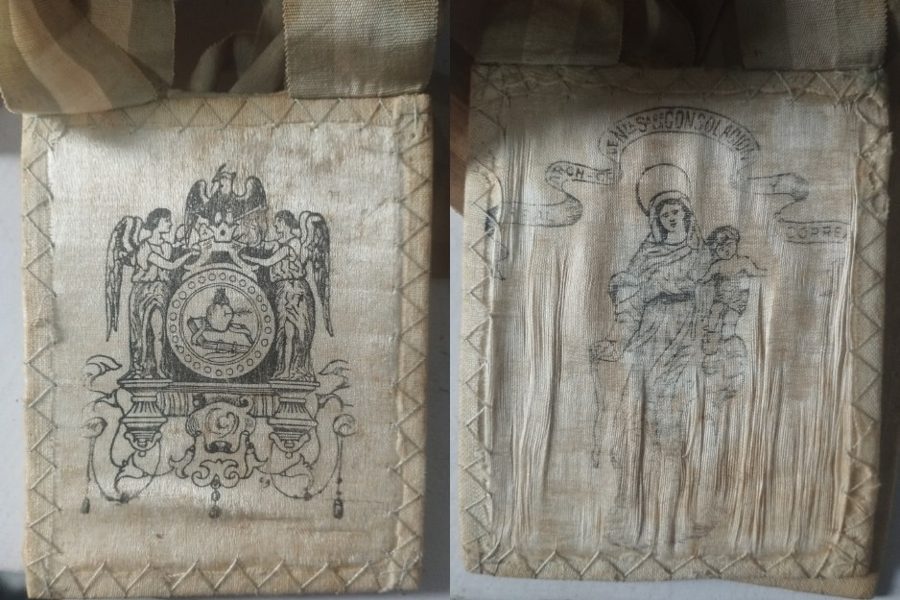
Scapular
Scapolare
- Known today as
- Two small pieces of wool joined by strings, worn over the shoulders, a miniature of the monastic scapular.
- Kind
- Sacramental, in 1 older authority
- Earliest authority here
- The Catholic Encyclopedia (New York, 1907–1914)
- In the Canale glossary
- On the Manner of Discerning and Healing the Bewitched, Appendix A: Treatise Two: Blessed Objects and Materials
Revised October 1, 2026: An authority added from a text read in full. Version 1, first published September 25, 2026.
Scapular: what did Canale use it for?
Blessed “as a sign of innocence and humility” (Treatise Two).
Scapular: what does modern science say?
The brown scapular of Our Lady of Mount Carmel, the best known, was already widespread in Europe by the end of the sixteenth century.
What Medicine Makes of It
- Amulets, Blessed Objects, and the Meaning ResponseWhy what cannot work sometimes works.
- Scruples and the BesiegedThe obsessio of the manuals, and obsessive-compulsive disorder.
- The Noonday DemonAcedia of the desert monks, and depression.
- The FlagellantsPain as devotion, and what pain does to the one who chooses it.
Scapular: what did the older authorities say?
- The Catholic Encyclopedia
- The Catholic Encyclopedia derives the scapular from the monk's apron, “a working garment or apron such as was then worn by agricultural labourers,” the scapulare propter opera of St. Benedict's Rule. Of the Brown Scapular it gives the pious tradition of the Virgin's words to St. Simon Stock at Cambridge in 1251, “whoever dies in this garment, will not suffer everlasting fire,” and adds that this tradition “appears in such a precise form for the first time in 1642” and “cannot be supported by historical documents.” The wearer is to trust in Mary “not presumptuously relying on the scapular as on a miraculous amulet,” and the badge should be “two segments of brown woollen cloth.”
Sources
- [21] Herbermann, C. G., et al. (eds.) (1907–1912). The Catholic Encyclopedia. New York: Robert Appleton Company. Online at newadvent.org. Articles: Agnus Dei (H. Thurston); Amulet (M. Hassett); Ash Wednesday (H. Thurston); Bells (H. Thurston); Holy Oils (H. Leclercq); Paschal Candle (H. Thurston); Scapular (J. Hilgers). Read in part · the text read
- The Catholic Encyclopedia (New York, 1907–1914), “Scapular.” newadvent.org/cathen/13508b.htm Standard reference work
Verification
- Checked
- October 1, 2026
- Passes
- Every dated or regulatory claim checked by category across the database
- Each quotation from the older authorities checked word for word against the text, read in full
- Sources
- 2 cited: 1 read in part, 1 standard reference work.
- Corrections
- None were needed.
What was checked, how, and what was found is set out on the Verification page. A checked source is one whose record was found; it does not make the entry medical advice.
Cite This Entry
Version 1 · first published September 25, 2026 · last revised October 1, 2026
- Chicago
“Scapular.” In Materia Medica, edited by B. C. P. Statema. Version 1. The Thinking Press, 2026–. Last modified October 1, 2026. https://thethinkingpress.org/materia-medica/scapular.
- MLA
“Scapular.” Materia Medica, edited by B. C. P. Statema, version 1, The Thinking Press, 1 Oct. 2026, thethinkingpress.org/materia-medica/scapular. Accessed 8 Oct. 2026.
- APA
Scapular. (2026, October 1). In B. C. P. Statema (Ed.), Materia medica (Version 1). The Thinking Press. Retrieved October 8, 2026, from https://thethinkingpress.org/materia-medica/scapular
Club members keep entries on a shelf with private notes, print the plates as cards, and receive an entry by email each week. Create a free account before January 1, 2027 and all of it is yours for good. About the Club
See Also
Also in The Catholic Encyclopedia
St. Agatha’s bread in The Catholic Encyclopedia · The SATOR square in The Catholic Encyclopedia · St. Benedict medal in The Catholic Encyclopedia · Rosary in The Catholic Encyclopedia · everything The Catholic Encyclopedia names →
Nearby in the alphabet
Self-heal (Prunella vulgaris) · Scammony (The dried root resin of Convolvulus scammonia) · Senna (The leaves and pods of Senna alexandrina) · Savin (a low juniper) · Shepherd’s purse · Shiitake (cultivated in China and Japan for about a thousand years) · Sassafras (The root bark of Sassafras albidum)


Historical description, not medical advice.