
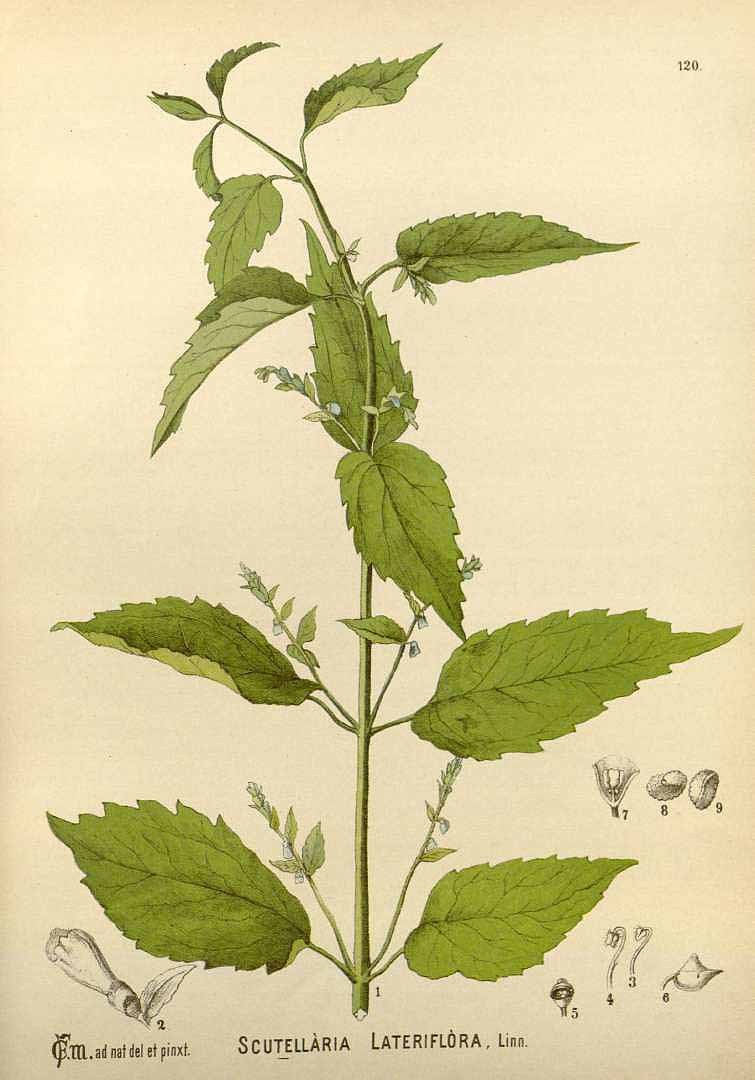
Skullcap
Scutellaria, Scullcap; Virginian Scullcap, Mad-dog Scullcap, Madweed (S. lateriflora); Common or Greater Scullcap, Helmet Flower, Hoodwort (S. galericulata); Lesser Scullcap (S. minor); French Toque
- Known today as
- Virginian or American skullcap, Scutellaria lateriflora, a slender labiate with inconspicuous blue flowers in one-sided racemes, flowering in July; the whole herb is used. Not to be confused with Chinese skullcap, Scutellaria baicalensis, whose root is the source of baicalin and baicalein. Of about ninety species, Grieve counts two native to Britain, S. galericulata and S. minor, on the banks of rivers and lakes.
- Kind
- Plant, in 3 older authorities
- Earliest authority here
- American popular use, as Grieve records (A Modern Herbal, 1931)
- In other databases
- Plants of the World Online search · GBIF search · Wikidata search
Caution. Skullcap products have been adulterated with germander (Teucrium), which contains potentially liver-toxic diterpenes, and cases of liver injury have been reported; a 2024 editorial in the World Journal of Hepatology points to the significant death rate in skullcap-induced liver injury. Grieve warns that overdoses of the tincture cause giddiness, stupor, confusion, twitching of the limbs and an intermittent pulse. Not a treatment for polycystic ovary syndrome.
Skullcap: what was it used for?
“One of the finest nervines ever discovered,” Grieve calls the American herb: tonic, nervine and antispasmodic, and slightly astringent. It was given in hysteria, convulsions, hydrophobia, St. Vitus’s dance and rickets, in nervous headaches and neuralgia, and was suggested for epilepsy; the dried extract, one to three grains as a pill, relieved severe hiccough. The usual dose was an infusion of an ounce of the powdered herb to a pint of boiling water, half a teacupful every few hours.
Skullcap: how is it taken as a tea?
An infusion of an ounce of the powdered herb to a pint of boiling water, given half a teacupful every few hours, as a nervine and against nervous headache, Grieve says.
All the herbal teas of the database. Historical directions, not medical advice.
Skullcap and polycystic ovary syndrome: what do the studies show?
No study in women; Chinese skullcap and its baicalin only in rats, mice and cells
- Androgens
- Testosterone and LH down in rats (baicalin)
- Insulin and glucose
- Rise in insulin and HOMA-IR held back in rats (baicalin)
- Cycles
- Regular estrous cycles restored in rats
- Hirsutism and skin
- Not studied
None of these studies is of the American skullcap of the herbalists, and none is of a woman. A search of PubMed in October 2026 for skullcap, Scutellaria, baicalin or baicalein with polycystic ovary syndrome found twelve papers; those that test the plant or its flavones use Chinese skullcap, Scutellaria baicalensis, or the baicalin and baicalein of its root, in animals or cells. In rats made polycystic with DHEA, baicalin lowered free and total testosterone, LH and FSH, held back the rise in insulin and HOMA-IR, and returned more of the rats to regular estrous cycles (Wang and colleagues, 2019). In another rat model it reversed the high androgens and restored the cycles, and in cultured NCI-H295R cells it lowered testosterone by suppressing the enzyme HSD3B2 (Yu and colleagues, 2019); a third rat study found free testosterone and LH lower (Xu and colleagues, 2023). Baicalein reduced oxidative stress and ferroptosis in the ovaries of rats (Li and colleagues, 2024); baicalin eased the fatty liver of a mouse model (Jin and colleagues, 2025); and the herb itself restored the gut flora of PCOS rats and reduced ovarian inflammation and insulin resistance (Pan and colleagues, 2026). The authors of a 2026 study in human granulosa cells warn that baicalin “should be viewed as a promising mechanistic lead rather than an established therapeutic agent,” with animal and clinical studies still needed.
All seven herbs side by side. The studies are listed among the sources below, each with its abstract. A summary of research, not medical advice.
Skullcap: what does modern science say?
Two small placebo-controlled trials of the American herb have been run. In 43 healthy volunteers, 350 mg three times a day for two weeks did not lower anxiety scores significantly against placebo, but overall mood disturbance fell on skullcap and not on placebo, without any fall in energy or cognition (Brock and colleagues, 2014). In 66 adults with mild to moderate primary insomnia, 400 mg a day of an extract for 56 days improved sleep quality and the sleep–wake measures, and no one reported side effects (Di Minno and colleagues, 2025). The research on polycystic ovary syndrome is all of Chinese skullcap, in animals and cells; it is set out below.
Skullcap: what lore surrounds it?
The name is from the Latin scutella, a little dish, after the lid of the calyx. When the flower falls, the upper lip of the calyx closes on the lower as if on a hinge, so that it looks like a capsule with a lid; when the seed is ripe the dry cup splits in two and lets it fall. “The only insect known to visit the first species,” Hooker wrote of the Greater Scullcap, “is a butterfly.”
Skullcap: what did the older authorities say?
- American popular use, as Grieve records
- Known as Mad-dog Scullcap or Madweed, “having the reputation of being a certain cure for hydrophobia.”
- William Bramwell, as Grieve quotes him
- Writing in the British Medical Journal in 1915 on skullcap in epilepsy: “Its efficacy appears to be partly due to its stimulating the kidneys to increased activity.”
- Grieve, of the English species
- S. galericulata was at one time given for the tertian ague, an ounce or two of the expressed juice or an infusion of a handful or two of the herb, and was said to help where the fits were more obstinate than violent; “in England, however, the remedy was not in use.”
Sources
- Grieve, M. A Modern Herbal, “Scullcaps.” As published on botanical.com. Read in full · the text read
- Brock, C., Whitehouse, J., Tewfik, I., and Towell, T. (2014). “American skullcap (Scutellaria lateriflora): a randomised, double-blind placebo-controlled crossover study of its effects on mood in healthy volunteers.” Phytotherapy Research 28: 692–698. doi:10.1002/ptr.5044. Abstract read · the text read
- Di Minno, A., Morone, M. V., Buccato, D. G., et al. (2025). “Efficacy and tolerability of a chemically characterized Scutellaria lateriflora L. extract-based food supplement for sleep management: a single-center, controlled, randomized, crossover, double-blind clinical trial.” Nutrients 17: 1491. doi:10.3390/nu17091491. Abstract read · the text read
- Lin, L. Z., Harnly, J. M., and Upton, R. (2009). “Comparison of the phenolic component profiles of skullcap (Scutellaria lateriflora) and germander (Teucrium canadense and T. chamaedrys), a potentially hepatotoxic adulterant.” Phytochemical Analysis 20: 298–306. doi:10.1002/pca.1127. Abstract read · the text read
- Sandasi, M., Vermaak, I., Chen, W., and Viljoen, A. M. (2014). “Skullcap and germander: preventing potential toxicity through the application of hyperspectral imaging and multivariate image analysis as a novel quality control method.” Planta Medica 80: 1329–1339. doi:10.1055/s-0034-1383037. Abstract read · the text read
- Soldera, J. (2024). “Insights into skullcap herb-induced liver injury.” World Journal of Hepatology 16: 120–122. doi:10.4254/wjh.v16.i2.120. Abstract read · the text read
- Wang, W., Zheng, J., Cui, N., et al. (2019). “Baicalin ameliorates polycystic ovary syndrome through AMP-activated protein kinase.” Journal of Ovarian Research 12: 109. doi:10.1186/s13048-019-0585-2. Abstract read · the text read
- Yu, J., Liu, Y., Zhang, D., et al. (2019). “Baicalin inhibits recruitment of GATA1 to the HSD3B2 promoter and reverses hyperandrogenism of PCOS.” Journal of Endocrinology 240: 497–507. doi:10.1530/JOE-18-0678. Abstract read · the text read
- Xu, X., Xu, X., Wang, X., and Shen, L. (2023). “Baicalin suppress the development of polycystic ovary syndrome via regulating the miR-874-3p/FOXO3 and miR-144/FOXO1 axis.” Pharmaceutical Biology 61: 878–885. doi:10.1080/13880209.2023.2208636. Abstract read · the text read
- Li, Y. Y., Peng, Y. Q., Yang, Y. X., et al. (2024). “Baicalein improves the symptoms of polycystic ovary syndrome by mitigating oxidative stress and ferroptosis in the ovary and gravid placenta.” Phytomedicine 128: 155423. doi:10.1016/j.phymed.2024.155423. Abstract read · the text read
- Jin, B. H., Xu, H., Zhang, Z. Y., et al. (2025). “Baicalin mitigates polycystic ovary syndrome-associated non-alcoholic fatty liver disease by inhibiting the AR/SREBP1 axis.” International Journal of Molecular Medicine 56: 189. doi:10.3892/ijmm.2025.5630. Abstract read · the text read
- Pan, Z., Zhang, C., Chu, Q., et al. (2026). “Targeting the gut-ovarian axis: Scutellaria baicalensis improves polycystic ovary syndrome by modulating gut microbiota composition and inhibiting the LPS/TLR4/NF-κB signaling pathway.” mSystems 11: e0182525. doi:10.1128/msystems.01825-25. Abstract read · the text read
- Ye, J., Zhao, X., Cen, S., et al. (2026). “ZBP1-driven PANoptosis in granulosa cells mediates follicular arrest in PCOS: integrated transcriptomic evidence and baicalin’s therapeutic potential.” Naunyn-Schmiedeberg’s Archives of Pharmacology, online ahead of print. doi:10.1007/s00210-026-05689-9. Abstract read · the text read
Verification
- Checked
- October 1, 2026
- Passes
- Every dated or regulatory claim checked by category across the database
- Sources
- 13 cited: 1 read in full, 12 abstract read. 12 with the abstract on file.
- Corrections
- None were needed.
What was checked, how, and what was found is set out on the Verification page. A checked source is one whose record was found; it does not make the entry medical advice.
Club members can point at a technical term in this entry, such as a constituent, an action, or a word of Jung’s, to read its definition from the source. The Club.
Cite This Entry
Version 1 · first published October 10, 2026
- Chicago
“Skullcap.” In Materia Medica, edited by B. C. P. Statema. Version 1. The Thinking Press, 2026–. Last modified October 10, 2026. https://thethinkingpress.org/materia-medica/skullcap.
- MLA
“Skullcap.” Materia Medica, edited by B. C. P. Statema, version 1, The Thinking Press, 10 Oct. 2026, thethinkingpress.org/materia-medica/skullcap. Accessed 10 Oct. 2026.
- APA
Skullcap. (2026, October 10). In B. C. P. Statema (Ed.), Materia medica (Version 1). The Thinking Press. Retrieved October 10, 2026, from https://thethinkingpress.org/materia-medica/skullcap
Club members keep entries on a shelf with private notes, print the plates as cards, and receive an entry by email each week. Create a free account before January 1, 2027 and all of it is yours for good. About the Club
See Also
Also in M. Grieve
Rosemary rice water in M. Grieve · Pokeweed in M. Grieve · Sumac in M. Grieve · Pawpaw in M. Grieve · everything M. Grieve names →
Drawing on the same sources: Grieve, Wang, Yu, Xu
Snapdragon · Shepherd’s purse · Southernwood · Eryngo · Oil of bricks · Frankincense · the bibliography →
Nearby in the alphabet
Snail (shelled and boiled, distilled, or eaten) · Silver · Silphium (probably a giant fennel (Ferula)) · Solomon’s seal (Polygonatum multiflorum and its relatives) · The sickener (brittle mushroom of wet pine woods) · Sorrel, syrup of · Shiitake (cultivated in China and Japan for about a thousand years)
Historical description, not medical advice.

