
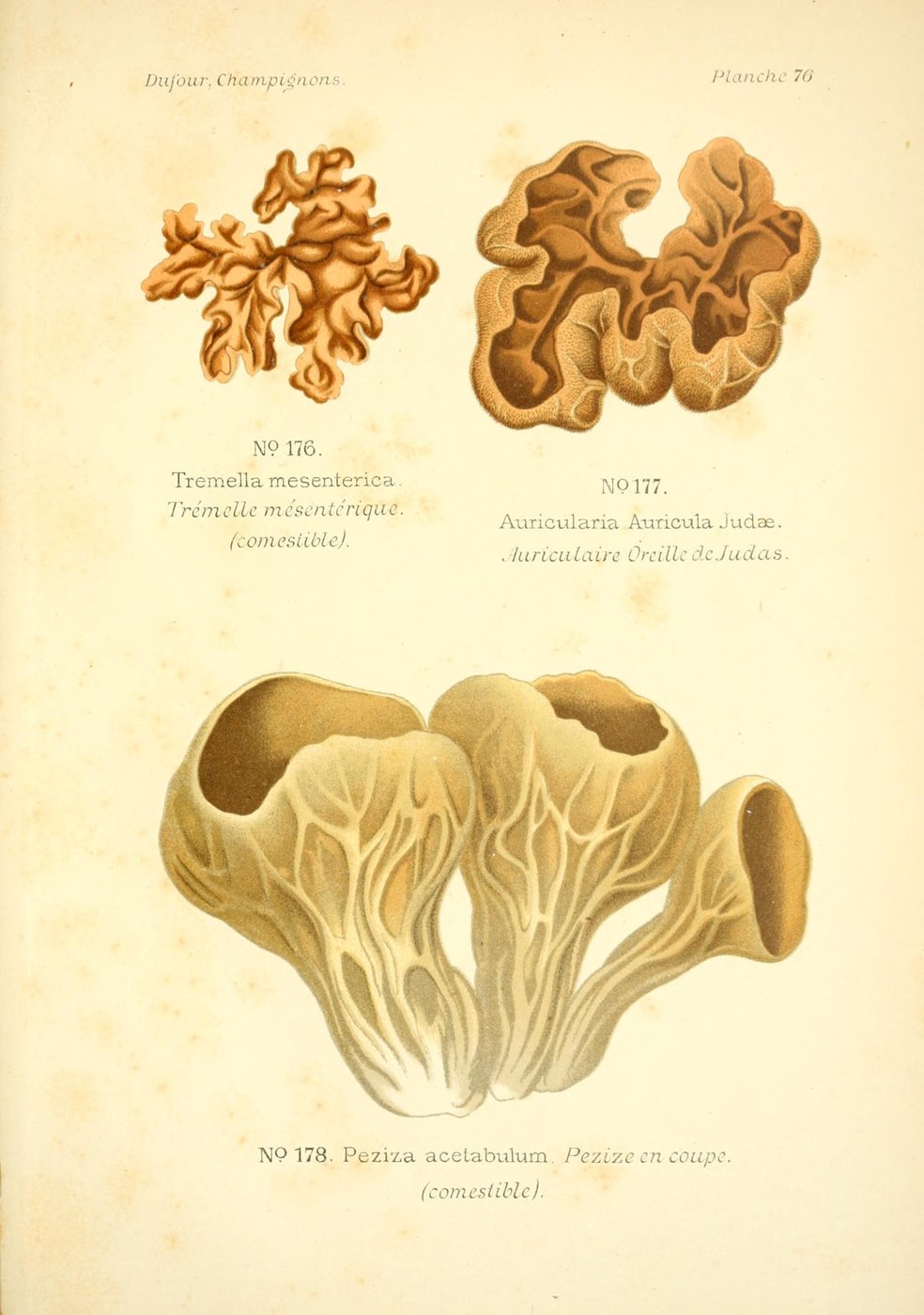
Witches’ butter
Exidia glandulosa and Tremella mesenterica
- Known today as
- Black or yellow jelly fungi that swell on dead branches after rain.
- Kind
- Fungus
- Constituents
- glucuronoxylomannan, water
- In other databases
- GBIF search · Wikidata search
Witches’ butter: what was it used for?
None.
Witches’ butter: what does modern science say?
Harmless; the yellow kind is eaten in China.
Pharmacognosy & Toxicology
- Constituents
- glucuronoxylomannana polysaccharide of Tremella
- water ChEMBL95 per cent
- Mechanism
- Jelly fungi of no toxin and no action; the related silver ear (Tremella fuciformis) is a Chinese dessert whose polysaccharide holds water in cosmetics. The name is the folklore of the thing that appears overnight on a gate.
- Toxic dose
- Harmless.
- Standing
- Inedible for texture, not for toxin.
- Phillips, R. (2006). Mushrooms. Macmillan. Verified against its record · doi:10.5325/j.ctt7v3rx.7
Constituent names open the compound’s record at PubChem, and “ChEMBL” beside a name opens its record at ChEMBL, the European Bioinformatics Institute’s database of bioactive molecules. Where a mechanism line was checked against ChEMBL (ChEMBL 37, read 1 October 2026), the check is shown with the measured value and its source paper, or says plainly that nothing has been measured. Doses are as the references give them, for description only; this is not medical advice. Each source carries the result of its check against Crossref, PubMed, or the authority’s page: see Verification.
Witches’ butter: what lore surrounds it?
In Scandinavian folklore it was the butter of witches or trolls; found on a gate or door, it meant a spell had been laid on the house, and piercing it with pins was thought to wound the witch.
In Their Own Words
Charles McIlvaine says that Tremella mesenterica, stewed, closely resembles “these same knots” (of his failed cornstarch) and has a mild, woody, slightly sweet flavour and is good.
“T. mesenterica, when stewed, very much resembles these same knots. It has a mild, woody flavor, slightly sweet, and is good.”
Captain Charles McIlvaine, Toadstools, Mushrooms, Fungi, Edible and Poisonous; One Thousand American Fungi, Tremella mesenterica, p. 530. Indianapolis: The Bowen-Merrill Company (named in the preface; the scan has no title page), Internet Archive OCR text. The text, read in part
M. C. Cooke lists Tremella lutescens and T. mesenterica among edible fungi, but says both are usually too small to be of any value as food.
“Tremella lutescens. Pers. Tremella mesenterica. Retz. These two species of Tremella are usually too small to be of any value as an esculent.”
M. C. Cooke, M.A., LL.D., A.L.S., British Edible Fungi: How to Distinguish and How to Cook Them, List of Edible Fungi, p. 233. London: Kegan Paul, Trench, Trübner & Co. Ltd., Paternoster House, Charing Cross Road, 1891 (Internet Archive OCR text). The text, read in part
Each passage is quoted from the text named, which the press fetched and read, and was checked word for word against a fresh copy of it; the link opens that copy. Passages are given as printed, without the editors’ footnote numbers, and with words broken across lines joined.
Sources
- Kvideland, R., & Sehmsdorf, H. K. (eds.) (1988). Scandinavian Folk Belief and Legend. Verified against its record · doi:10.5749/9780816683901
Verification
- Checked
- October 1, 2026
- Passes
- Every sentence read against its sources, in the pass over the remaining 343 entries
- The Standing line checked against the authority it names (EMA, WHO, FDA, CITES, Commission E)
- Every dated or regulatory claim checked by category across the database
- Sources
- 2 cited: 2 verified against its record.
- Corrections
- None were needed.
What was checked, how, and what was found is set out on the Verification page. A checked source is one whose record was found; it does not make the entry medical advice.
Cite This Entry
Version 1 · first published September 25, 2026
- Chicago
“Witches’ butter.” In Materia Medica, edited by B. C. P. Statema. Version 1. The Thinking Press, 2026–. Last modified September 25, 2026. https://thethinkingpress.org/materia-medica/witches-butter.
- MLA
“Witches’ butter.” Materia Medica, edited by B. C. P. Statema, version 1, The Thinking Press, 25 Sept. 2026, thethinkingpress.org/materia-medica/witches-butter. Accessed 8 Oct. 2026.
- APA
Witches’ butter. (2026, September 25). In B. C. P. Statema (Ed.), Materia medica (Version 1). The Thinking Press. Retrieved October 8, 2026, from https://thethinkingpress.org/materia-medica/witches-butter
Club members keep entries on a shelf with private notes, print the plates as cards, and receive an entry by email each week. Create a free account before January 1, 2027 and all of it is yours for good. About the Club
See Also
Sharing water
Drawing on the same sources: Phillips
Yellow stainer · The sickener · Chanterelle · the bibliography →
Nearby in the alphabet
Woad (Isatis tinctoria) · Witch marks (Symbols scratched or burned near doors and fireplaces) · Wood sorrel (Oxalis acetosella) · Witch bottle · Woodlouse · Witch ball (often silvered or colored, hung in the window) · Woody nightshade · Winter-grain mould (Pink and white moulds of grain left in the field over winter)
_BHL3270624.jpg)
Historical description, not medical advice.