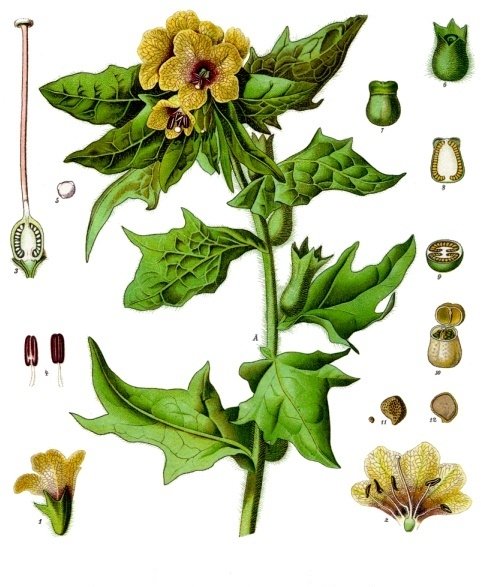
Henbane
Hyoscyamus; Greek hyoskyamos, “hog’s bean”
- Known today as
- Hyoscyamus niger, of the nightshade family.
- Kind
- Plant, in 2 older authorities
- Constituents
- hyoscyamine, scopolamine
- Poisoning
- Tropane (anticholinergic) poisoning
- Earliest authority here
- Dioscorides (c. AD 40–90)
- Qualities
- Cold in the third degree (Galenic tradition). What the degrees mean
- In other databases
- Plants of the World Online search · GBIF search · Wikidata search
Caution. Poisonous: delirium, hallucination, and death in overdose.
Henbane: what does modern science say?
Its hyoscyamine and scopolamine are deliriants; scopolamine remains in use against motion sickness in tiny, controlled doses.
Henbane: is it poisonous?
Yes, in some form or dose. Poisonous: delirium, hallucination, and death in overdose. Its poisoning is tropane (anticholinergic) poisoning: Thirty minutes to a few hours; longer from the skin. Historical description, not medical advice; in a poisoning, call a poison centre.
Pharmacognosy & Toxicology
- Constituents
- Mechanism
- Muscarinic blockade, with scopolamine’s sedation and amnesia.
- Checked against ChEMBL
- scopolamine: ChEMBL’s curated mechanism: antagonist Muscarinic acetylcholine receptor M1.
- Toxic dose
- The seeds hold most; a few grams have poisoned.
- Syndrome
- Tropane (anticholinergic) poisoning
- Standing
- Henbane leaf is in a few European pharmacopoeias still; the extracted alkaloids are the drugs.
- Nelson, L. S., et al. (2007). Handbook of Poisonous and Injurious Plants. Verified against its record · doi:10.1007/978-1-4939-8926-3
Constituent names open the compound’s record at PubChem, and “ChEMBL” beside a name opens its record at ChEMBL, the European Bioinformatics Institute’s database of bioactive molecules. Where a mechanism line was checked against ChEMBL (ChEMBL 37, read 1 October 2026), the check is shown with the measured value and its source paper, or says plainly that nothing has been measured. Doses are as the references give them, for description only; this is not medical advice. Each source carries the result of its check against Crossref, PubMed, or the authority’s page: see Verification.
What Medicine Makes of It
- The Witches’ OintmentNightshades on the skin, and what they do.
Henbane: what lore surrounds it?
Early modern writers on magic, Giambattista della Porta among them, described “witches’ ointments” compounded of sleep-bringing herbs of this family, and modern historians have wondered whether their effects lie behind reports of night flight to the sabbath.
The name carries its lore: “bane” meant simply “that which causes death” when the word entered English around 1265, and one proposed root reaches back to a word for vision and magical power. Henbane seeds were found in a Viking-age grave at Fyrkat in Denmark, and some historians have wondered whether the plant, not only drink, fed the berserkers’ rage. Albertus Magnus, about 1250, listed henbane among the herbs necromancers burned to summon the dead.
Henbane: what did the older authorities say?
- Dioscorides
- Gives it to bring sleep and to ease pain, and warns that it brings madness.
- Medieval dentistry
- The seeds were burned and the smoke drawn into the mouth to drive out the “worms” thought to cause toothache.
Sources
- Dioscorides, De materia medica. Read in part · the text read
- Giambattista della Porta, Magia naturalis (1558). Book, seen in reviews
- Wikipedia, “Hyoscyamus niger.” Book, not indexed
Verification
- Checked
- October 1, 2026
- Passes
- Every sentence read against its sources, in the pass over the remaining 343 entries
- The Standing line checked against the authority it names (EMA, WHO, FDA, CITES, Commission E)
- Every dated or regulatory claim checked by category across the database
- The mechanism read against ChEMBL (ChEMBL 37): curated mechanisms and measured activity
- Sources
- 4 cited: 1 read in part, 1 verified against its record, 1 book, seen in reviews, 1 book, not indexed.
- Corrections
- None were needed.
What was checked, how, and what was found is set out on the Verification page. A checked source is one whose record was found; it does not make the entry medical advice.
Cite This Entry
Version 1 · first published September 25, 2026
- Chicago
“Henbane.” In Materia Medica, edited by B. C. P. Statema. Version 1. The Thinking Press, 2026–. Last modified September 25, 2026. https://thethinkingpress.org/materia-medica/henbane.
- MLA
“Henbane.” Materia Medica, edited by B. C. P. Statema, version 1, The Thinking Press, 25 Sept. 2026, thethinkingpress.org/materia-medica/henbane. Accessed 8 Oct. 2026.
- APA
Henbane. (2026, September 25). In B. C. P. Statema (Ed.), Materia medica (Version 1). The Thinking Press. Retrieved October 8, 2026, from https://thethinkingpress.org/materia-medica/henbane
Club members keep entries on a shelf with private notes, print the plates as cards, and receive an entry by email each week. Create a free account before January 1, 2027 and all of it is yours for good. About the Club
See Also
Poisoned alike: tropane (anticholinergic) poisoning
Mandrake · Deadly nightshade · Nutmeg and clove · Woody nightshade · Thorn apple · the syndrome, with all of them →
Also in Dioscorides
Isinglass in Dioscorides · Hemp in Dioscorides · Iva in Dioscorides · Ginger in Dioscorides · everything Dioscorides names →
Drawing on the same sources: Dioscorides, Wikipedia, Nelson
Honey · Human fat · Hemlock · Rue · the bibliography →
Nearby in the alphabet
Herb bennet (of the rose family, with a root that smells of cloves) · Herb Paris (true-lover’s knot, a woodland plant with a single black berry) · Hiera of Pacchius · Heartsease (the wild pansy of fields and banks, purple, white, and yellow) · Hiera picra (mastic, saffron, and other aromatics) · Hazel (Corylus avellana)

Historical description, not medical advice.