
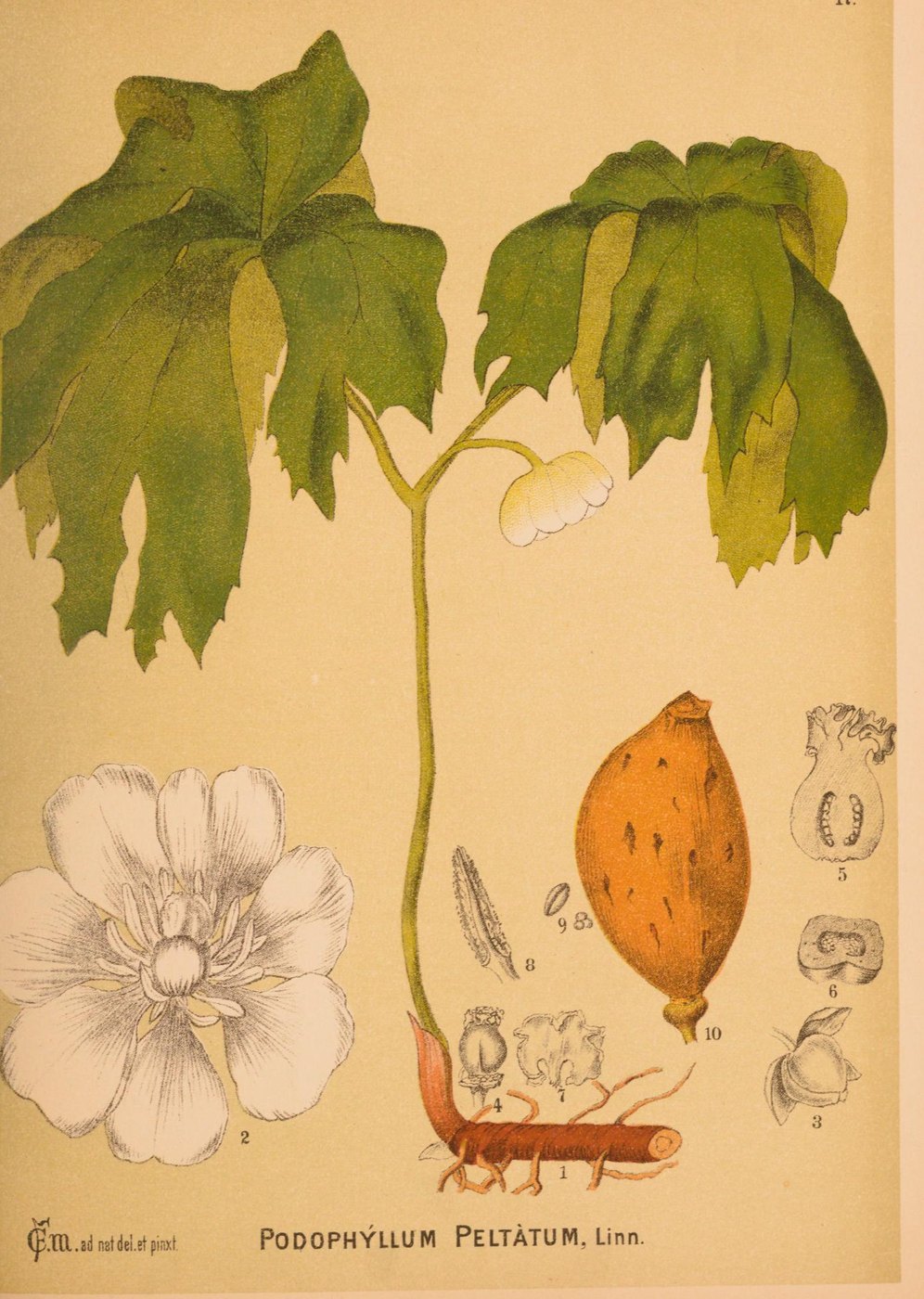
Mayapple
May-apple, American mandrake, Indian apple, hog apple, wild lemon, duck’s foot, wild jalap, raccoon-berry; Podophyllum peltatum of Linnaeus, Anapodophyllum canadense of Catesby; the source of podophyllin and podophyllotoxin
- Known today as
- Podophyllum peltatum, a herb of low shady ground and damp open woods that spreads by its creeping root into beds: a single stem a foot high, forking into two umbrella-like peltate leaves with one nodding white flower in the fork, followed by a large yellow egg-shaped fruit. It flowers in May and fruits in August, from New England to Georgia and throughout the interior.
- Kind
- Plant, in 3 older authorities
- Constituents
- podophyllotoxin, podophyllin, picropodophyllin and podophylloquercetin
- Earliest authority here
- Jacob Bigelow
- In other databases
- Plants of the World Online search · GBIF search · Wikidata search
Deadly. The root and resin are drastic purgatives and in overdose have killed; the resin applied to warts has caused coma and lasting nerve damage. The leaves and the spring shoots are poisonous and have been fatal as a potherb. Only the fully ripe yellow fruit is eaten, and that has purged the susceptible.
Mayapple: what was it used for?
Bigelow ranked the root among the surest and most active of native cathartics, answering the purposes of jalap, aloes, and rhubarb, twenty grains of the fine powder being commonly enough, and he had it from Professor Barton that the leaves were poisonous and the whole plant somewhat narcotic; the Shakers of Lebanon prepared an esteemed extract. Millspaugh calls it “one of the principal remedies used by the American aborigines,” valued for its cathartic action, and names the resin podophyllin, first used by Professor John King in 1835, that went into the cathartic pills of a century. The ripe fruit, Bigelow’s “wild lemons,” was eaten with impunity, though Millspaugh saw catharsis follow indulgence in it and knew of fatal results from the spring foliage taken as a potherb. In Britain it entered the Pharmacopoeia in 1864.
Mayapple: foraging it in the Midwest
- Part
- Ripe fruit only
- When
- August
In beds on low shady ground and damp open woods, flowering in May and fruiting in August; only the fully ripe yellow fruit is taken, and that has purged the susceptible. Root, leaves, and spring shoots are poisons, and the shoots have killed as a potherb.
After Bigelow; Millspaugh. All the foragables of the Midwest. Historical record, not a field guide: identify before you gather, and read the whole entry.
Mayapple: what does modern science say?
Podophyllotoxin, the crystalline principle, is the parent of the topoisomerase inhibitors used against cancer, and the resin is still applied to genital warts; both are poisons. In 1979 a young woman treated for warts with three to eight millilitres of the resin returned in a coma twenty hours later with the marrow, the liver, and the nervous system all injured, and six months afterward still had neurological sequelae; in 1982 a man who swallowed ten grams of podophyllum showed no symptoms for ten hours and then lost his reflexes, fell into coma with a marked lactic acidosis, and died at thirty-nine hours despite haemoperfusion.
Mayapple: is it poisonous?
Yes, and it can kill. The root and resin are drastic purgatives and in overdose have killed; the resin applied to warts has caused coma and lasting nerve damage. The leaves and the spring shoots are poisonous and have been fatal as a potherb. Only the fully ripe yellow fruit is eaten, and that has purged the susceptible. Historical description, not medical advice; in a poisoning, call a poison centre.
Pharmacognosy & Toxicology
- Constituents
- podophyllotoxinthe crystalline purgative principle of the root and resin; the parent of the semisynthetic topoisomerase inhibitors
- podophyllinthe resin precipitated from the alcoholic extract, Professor King’s preparation of 1835; about eighty-four pounds to the ton of root, by Millspaugh
- picropodophyllin and podophylloquercetinPodwissotzki’s fractions of the resin, the latter blamed for the griping
- Mechanism
- A drastic irritant purgative on the bowel and, systemically, a poison of dividing cells and of the nervous system: in the two reported cases the marrow, the liver, and the brain were injured, one patient dying in coma with lactic acidosis thirty-nine hours after ten grams by mouth, another surviving a topical overdose with lasting neurological damage.
- Toxic dose
- Twenty grains of the powdered root, by Bigelow, as a cathartic; the resin was applied to warts and taken in cathartic pills. Ten grams by mouth was fatal.
- Standing
- A historical purgative whose principle became a chemotherapy precursor and a wart paint; the plant itself is a poison in every part but the ripe fruit.
- Cassidy, D. E., Drewry, J., & Fanning, J. P. (1982). Podophyllum toxicity: a report of a fatal case and a review of the literature. Journal of Toxicology: Clinical Toxicology 19: 35–44. doi:10.3109/15563658208990364 Verified against its record · PMID 6759681
- Moher, L. M., & Maurer, S. A. (1979). Podophyllum toxicity: case report and literature review. Journal of Family Practice 9: 237–240. Verified against its record · PMID 458391
The abstract of each source, beneath its citation. For Club members. About the Club or sign in.
Constituent names open the compound’s record at PubChem, and “ChEMBL” beside a name opens its record at ChEMBL, the European Bioinformatics Institute’s database of bioactive molecules. Where a mechanism line was checked against ChEMBL (ChEMBL 37, read 1 October 2026), the check is shown with the measured value and its source paper, or says plainly that nothing has been measured. Doses are as the references give them, for description only; this is not medical advice. Each source carries the result of its check against Crossref, PubMed, or the authority’s page: see Verification.
Mayapple: what lore surrounds it?
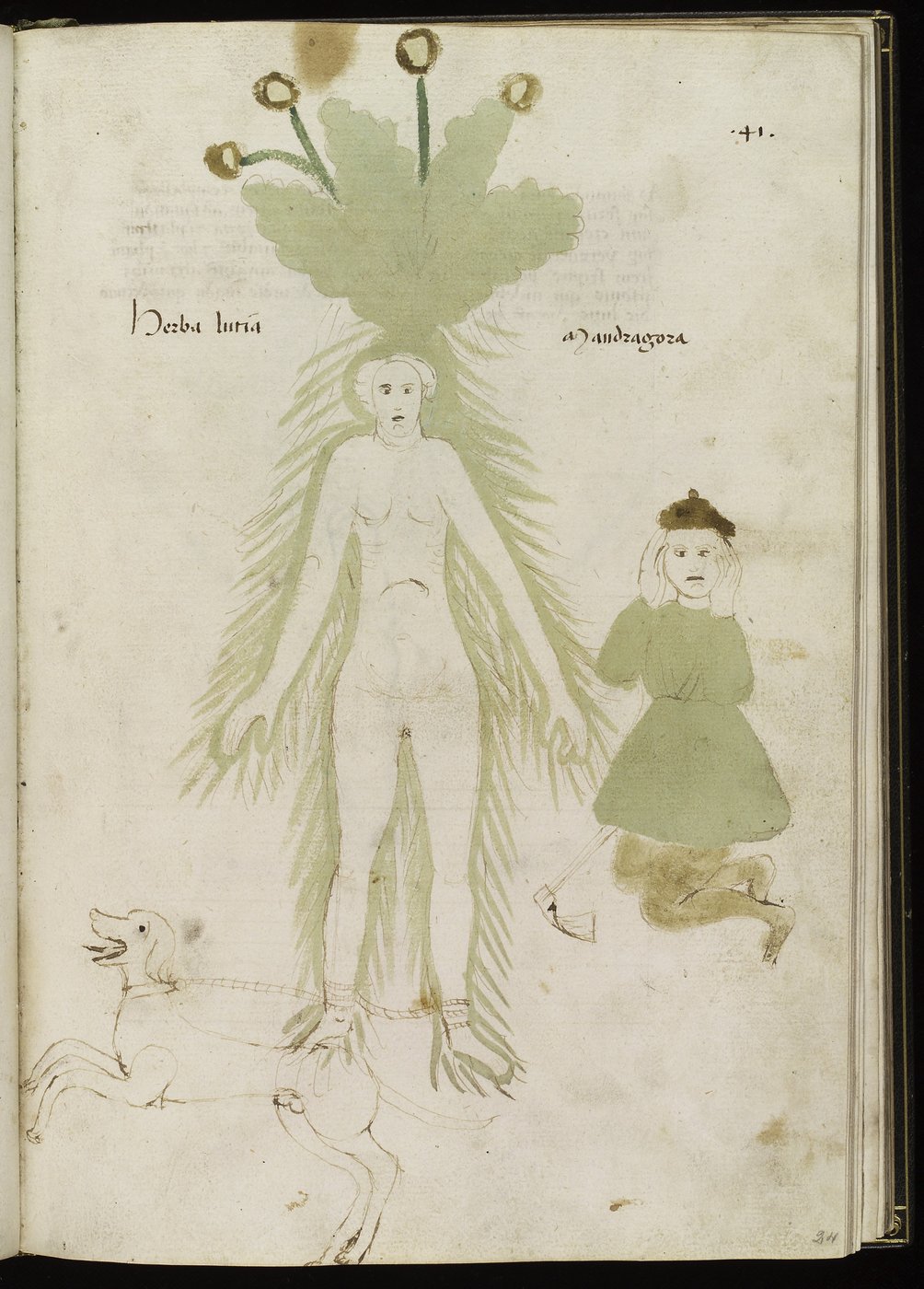
The American mandrake is no mandrake: Millspaugh is at pains to say the true one is Atropa mandragora of southern Europe, and the Greek name Podophyllum, foot-leaf, comes from a fancied likeness of the leaf to the webbed foot of a water bird, whence duck’s foot. Bigelow, who never saw it farther north on the coast than Boston, found it always in beds, and used its root as the text for a lesson in when to dig roots at all: in the cold season, when the sap is down, though the savages and ignorant persons who gathered ginseng and snakeroot for export took them when the tops were easiest to see.
Mayapple: what did the older authorities say?
- Jacob Bigelow
- “We have hardly any native plant which answers better the common purposes of jalap, aloes and rhubarb, and which is more safe and mild in its operation.” The root should be given in substance in fine powder, twenty grains; it is dug in the cold season, autumn and winter, when the virtue of perennials is gathered in the root, though he doubted the difference was as great as commonly supposed. The fruit “is acid and agreeable to the taste of many persons. It is sometimes called wild lemons, and is eaten with impunity.”
- Charles F. Millspaugh
- The apples when fully ripe “are gathered, especially by children, who seem to relish their sweet, mawkish taste,” and are sold in markets, “though catharsis often follows indulgence in them, and, to susceptible persons, it is often quite severe.” The odour of the flowers is nauseous. “The foliage and stems, when appearing in spring, have been used for a potherb, and in some cases with fatal results.” Podophyllin is prepared by exhausting the root with alcohol and pouring the syrupy percolate into cold water; the yield is about eighty-four pounds to the ton, highest in April.
- Mrs. M. Grieve
- The American Mandrake: “a medicine of most extensive service; its greatest power lies in its action upon the liver and bowels.” In large doses it produces nausea and vomiting, “and even inflammation of the stomach and intestines, which has been known to prove fatal.” The leaves and roots are poisonous; the fruit is edible, sweet though slightly acid. The drug was well known to the North American Indians as an emetic and vermifuge.
Sources
- Bigelow, J. (1818). American Medical Botany, vol. 2, “Podophyllum peltatum. May Apple,” pp. 34–40 and Plate XXII. Internet Archive, mobot31753000788221. Primary text
- Millspaugh, C. F. (1887). American Medicinal Plants, vol. 1, no. 17, “Podophyllum peltatum,” and Plate 17. Internet Archive, americanmedicina01mill_0. Primary text
- Grieve, M. A Modern Herbal, “Mandrake, American.” As published on botanical.com. Standard reference work
Verification
- Checked
- October 1, 2026
- Passes
- Every sentence read against its sources, in the pass over the remaining 343 entries
- The Standing line checked against the authority it names (EMA, WHO, FDA, CITES, Commission E)
- Every dated or regulatory claim checked by category across the database
- Sources
- 5 cited: 2 verified against its record, 2 primary text, 1 standard reference work. 2 with the abstract on file.
- Corrections
- None were needed.
What was checked, how, and what was found is set out on the Verification page. A checked source is one whose record was found; it does not make the entry medical advice.
Cite This Entry
Version 1 · first published October 4, 2026
- Chicago
“Mayapple.” In Materia Medica, edited by B. C. P. Statema. Version 1. The Thinking Press, 2026–. Last modified October 4, 2026. https://thethinkingpress.org/materia-medica/mayapple.
- MLA
“Mayapple.” Materia Medica, edited by B. C. P. Statema, version 1, The Thinking Press, 4 Oct. 2026, thethinkingpress.org/materia-medica/mayapple. Accessed 8 Oct. 2026.
- APA
Mayapple. (2026, October 4). In B. C. P. Statema (Ed.), Materia medica (Version 1). The Thinking Press. Retrieved October 8, 2026, from https://thethinkingpress.org/materia-medica/mayapple
Club members keep entries on a shelf with private notes, print the plates as cards, and receive an entry by email each week. Create a free account before January 1, 2027 and all of it is yours for good. About the Club
See Also
Also in M. Grieve
Pawpaw in M. Grieve · Ground cherry in M. Grieve · Pokeweed in M. Grieve · Ginseng in M. Grieve · everything M. Grieve names →
Drawing on the same sources: Bigelow, Millspaugh, Grieve
Wild ginger · Milkweed · Meadowsweet · Masterwort and angelica · the bibliography →
Nearby in the alphabet
Meadow saffron (Colchicum autumnale) · Mastic · Melon root (Cucumis melo) · Marking-nut electuary (Semecarpus anacardium (note XLIV)) · Marjoram and jasmine (Origanum majorana)
Historical description, not medical advice.