
Madder
Rubia
- Known today as
- Rubia tinctorum. A scrambling perennial grown since antiquity for the red dye in its root.
- Kind
- Plant, in 2 older authorities
- Constituents
- alizarin, purpurin, lucidin, and 1 more
- Poisoning
- The anthranoid purgatives
- Earliest authority here
- Pliny (AD 23/24–79)
- In other databases
- Plants of the World Online search · GBIF search · Wikidata search
Revised October 1, 2026: An older authority added from a text read in full. Version 1, first published September 27, 2026.
Madder: what was it used for?
The chief red dye of the ancient and medieval world; the older pharmacopoeias also list it as a minor diuretic.
Madder: what does modern science say?
A historic textile dye with no established medicinal action.
Pharmacognosy & Toxicology
- Constituents
- Mechanism
- The anthraquinones are mildly laxative and diuretic and are excreted in the urine, which they turn red, and in growing bone, which they stain, the basis of the bone-growth marking that made madder a tool of anatomy. Lucidin and its primeveroside form DNA adducts, and madder root caused kidney and liver tumours in rats.
- Toxic dose
- Any internal use is unwise; a Belgian trial for kidney stones ended with the ban.
- Syndrome
- The anthranoid purgatives
- Standing
- Withdrawn as a medicine in Germany in 1993 after the rodent carcinogenicity; a dye only.
- Westendorf, J., et al. (1998). “Carcinogenicity and DNA adduct formation observed in ACI rats after long-term treatment with madder root, Rubia tinctorum L.” Carcinogenesis 19. Verified against its record · doi:10.1093/carcin/19.12.2163
- Blömeke, B., et al. (1992). “Formation of genotoxic metabolites from anthraquinone glycosides present in Rubia tinctorum.” Mutation Research 265. Verified against its record · doi:10.1016/0027-5107(92)90055-7
The abstract of each source, beneath its citation. For Club members. About the Club or sign in.
Constituent names open the compound’s record at PubChem, and “ChEMBL” beside a name opens its record at ChEMBL, the European Bioinformatics Institute’s database of bioactive molecules. Where a mechanism line was checked against ChEMBL (ChEMBL 37, read 1 October 2026), the check is shown with the measured value and its source paper, or says plainly that nothing has been measured. Doses are as the references give them, for description only; this is not medical advice. Each source carries the result of its check against Crossref, PubMed, or the authority’s page: see Verification.
Madder: what lore surrounds it?
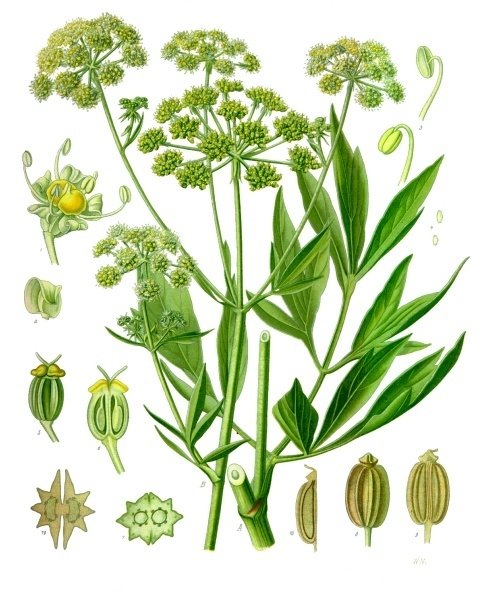
Cotton dyed with madder survives from Mohenjo-daro in the third millennium BC, and Charlemagne’s Capitulare de villis orders it grown on the royal estates beside houseleek and lovage; Dioscorides and Pliny both describe it. The elaborate Turkey red process, with sumac, oak galls, calf’s blood, sheep’s dung, oil, soda, alum, and tin, carried madder dyeing from India through Turkey to France by 1747 and to Manchester by 1784, and the red coats of British infantry were dyed with madder, officers’ finer coats sometimes with costlier cochineal.
Madder: what did the older authorities say?
- Pliny
- Madder is one of two plants “but little known to any but the herd of the sordid and avaricious, and this because of the large profits that are derived from them”; its use “is necessary in dyeing wool and leather,” the Italian kind being most esteemed, “and that more particularly which is grown in the suburbs of the City.” In the medical books the rubia is a diuretic, “employed with hydromel, it is curative of jaundice,” heals lichens with vinegar, and furnishes a potion for sciatica and paralysis. Pliny adds, with some distance, that “some writers” hold the shrub “curative of jaundice, even if worn as an amulet only, and looked at every now and then.”
- Culpeper
- An herb of Mars, opening first and then binding: “a sure remedy for the yellow jaundice” by opening the liver and gall; it diminishes the melancholy humour, is much used in vulnerary drinks for bruises, and the leaves and roots applied cleanse freckles and morphew from the skin.
Sources
- Wikipedia, “Rubia tinctorum.” Book, not indexed
- Pliny the Elder, Natural History 19.17; 24.56, trans. J. Bostock & H. T. Riley (1855), Perseus Digital Library. Primary text
- Culpeper, N. (1653). The Complete Herbal, “Madder.” Project Gutenberg #49513. Primary text
Verification
- Checked
- October 1, 2026
- Passes
- Every sentence read against its sources, in the pass over the remaining 343 entries
- The Standing line checked against the authority it names (EMA, WHO, FDA, CITES, Commission E)
- Every dated or regulatory claim checked by category across the database
- Each quotation from the older authorities checked word for word against the text, read in full
- Sources
- 5 cited: 2 verified against its record, 2 primary text, 1 book, not indexed. 2 with the abstract on file.
- Corrections
- None were needed.
What was checked, how, and what was found is set out on the Verification page. A checked source is one whose record was found; it does not make the entry medical advice.
Cite This Entry
Version 1 · first published September 27, 2026 · last revised October 1, 2026
- Chicago
“Madder.” In Materia Medica, edited by B. C. P. Statema. Version 1. The Thinking Press, 2026–. Last modified October 1, 2026. https://thethinkingpress.org/materia-medica/madder.
- MLA
“Madder.” Materia Medica, edited by B. C. P. Statema, version 1, The Thinking Press, 1 Oct. 2026, thethinkingpress.org/materia-medica/madder. Accessed 8 Oct. 2026.
- APA
Madder. (2026, October 1). In B. C. P. Statema (Ed.), Materia medica (Version 1). The Thinking Press. Retrieved October 8, 2026, from https://thethinkingpress.org/materia-medica/madder
Club members keep entries on a shelf with private notes, print the plates as cards, and receive an entry by email each week. Create a free account before January 1, 2027 and all of it is yours for good. About the Club
See Also
Poisoned alike: the anthranoid purgatives
Myrobalans · Lenitive electuary · Rhubarb · Hiera picra · Yellow dock · Diacatholicon · Cassia, flower of · Compound fumitory · the syndrome, with all of them →
Also in Pliny the Elder
Madonna lily in Pliny the Elder · Long pepper in Pliny the Elder · Manna in Pliny the Elder · Lesser bean-trefoil in Pliny the Elder · everything Pliny the Elder names →
Also in Nicholas Culpeper
Masterwort and angelica in Nicholas Culpeper · Juniper in Nicholas Culpeper · Moonwort in Nicholas Culpeper · Herb Paris in Nicholas Culpeper · everything Nicholas Culpeper names →
Drawing on the same sources: Wikipedia, Culpeper
Nearby in the alphabet
Lungwort (Pulmonaria officinalis) · Mallow and marshmallow (Malva sylvestris and Althaea officinalis) · Lovage (of the carrot family) · Malmsey · Lourdes water · Man on horseback (long counted a good edible)
Historical description, not medical advice.