
Lucerne
Alfalfa, purple medicle, cultivated lucern; Chinese mu-su; Medicago sativa L.
- Known today as
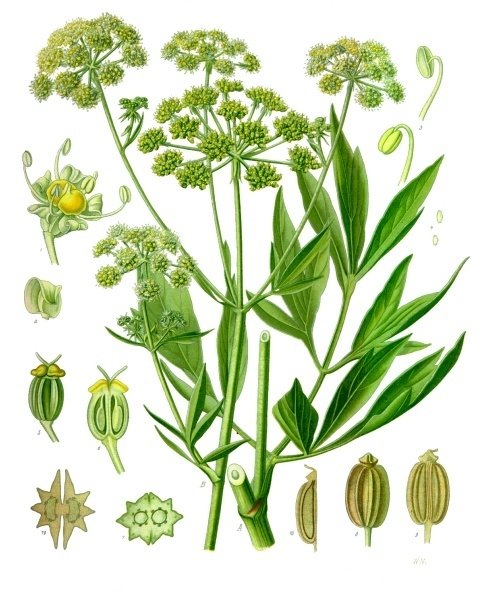
- Medicago sativa, of the family Papilionaceae in Grieve, a deep-rooting perennial with clover-like leaves of three leaflets, spikes of small blue or violet flowers, and spirally twisted pods. It is chiefly a fodder crop, mown twice a year, “greatly relished by horses and cattle,” Grieve writes, fattening them quickly and increasing the milk of cows; in Britain it grows wild only as an escape from cultivation. Grieve gives the whole herb in flower as the part used.
- Kind
- Plant, in 1 older authority
- Earliest authority here
- Stuart, Chinese Materia Medica (1911)
- In other databases
- Plants of the World Online · GBIF · Wikidata
Caution. That 2025 review, published in a lupus journal, compiled its list so that clinicians could counsel patients with autoimmune skin diseases on the risk that such supplements may trigger or worsen them; alfalfa is on it. Grieve notes that the root has sometimes been found as an adulterant of belladonna root.
Lucerne: what was it used for?
A fodder and a vegetable more than a medicine. Grieve gives only one medicinal use: “To increase weight,” an infusion of the herb. In China, Stuart records, it was eaten as a vegetable, thought to benefit the intestines and to be generally depurative, and the root was prescribed for feverish, high-coloured urine.
Lucerne: what does modern science say?
No European monograph covers it, and the searches of Europe PMC made for this entry found no trial of it as a medicine in people; most of the modern literature concerns it as a crop and as animal feed. A 2025 scoping review of herbal supplements that stimulate the immune system named alfalfa among the fifteen with the strongest evidence, from human, animal, and laboratory studies, of immunostimulatory effects.
Pharmacognosy & Toxicology
- Mechanism
- A 2025 scoping review counts alfalfa among the herbal supplements with the strongest evidence of immunostimulatory effects.
- Standing
- There is no European monograph, and no trial of it as a medicine in people was found for this entry.
- Weiner JD, et al. (2025). Identifying immunostimulatory herbal supplements that may flare autoimmune skin diseases: a systematic scoping review. Lupus science & medicine. PMID 41475897. Abstract read · the text read
The abstract of each source, beneath its citation. For Club members. About the Club or sign in.
Constituent names open the compound’s record at PubChem, and “ChEMBL” beside a name opens its record at ChEMBL, the European Bioinformatics Institute’s database of bioactive molecules. Where a mechanism line was checked against ChEMBL (ChEMBL 37, read 1 October 2026), the check is shown with the measured value and its source paper, or says plainly that nothing has been measured. Doses are as the references give them, for description only; this is not medical advice. Each source carries the result of its check against Crossref, PubMed, or the authority’s page: see Verification.
Lucerne: what lore surrounds it?
Grieve explains the plant’s name by its history: it was brought into Greece from the East “after Darius had discovered it in Medea, hence its name.” It reached notice in Britain, she says, in 1757. The two old authorities disagree neatly on its effect on the body: Grieve’s infusion was given to put on weight, while the Chinese avoided eating much of it for fear it would make them thin.
Lucerne: what did the older authorities say?
- Stuart, Chinese Materia Medica (1911)
- It was said to have been brought to China by General Chang Chien of the Han dynasty, its foreign origin shown by the several ways of writing its Chinese name. It was little valued as a vegetable, being almost tasteless, and was eaten sparingly, for it was thought too cooling and “to make one thin, which is always carefully avoided by the Chinese”; eaten with honey it was said to cause dysentery. Stuart notes that the Chinese plant has yellow flowers, not the purple or blue of Europe, so that it is sometimes taken for another species.
Sources
- Grieve, M. A Modern Herbal, “Lucerne.” As published on botanical.com. Read in full · the text read
- Stuart, G. A. (1911). Chinese Materia Medica: Vegetable Kingdom, “Medicago sativa.” Internet Archive, chinesemateriame00stuauoft. Read in part · the text read
- Weiner JD, et al. (2025). Identifying immunostimulatory herbal supplements that may flare autoimmune skin diseases: a systematic scoping review. Lupus science & medicine. PMID 41475897. Abstract read · the text read
Verification
- Checked
- October 1, 2026
- Passes
- Every sentence read against its sources, in the pass over the remaining 343 entries
- The Standing line checked against the authority it names (EMA, WHO, FDA, CITES, Commission E)
- Every dated or regulatory claim checked by category across the database
- Sources
- 3 cited: 1 read in full, 1 read in part, 1 abstract read. 1 with the abstract on file.
- Corrections
- None were needed.
What was checked, how, and what was found is set out on the Verification page. A checked source is one whose record was found; it does not make the entry medical advice.
Club members can point at a technical term in this entry, such as a constituent, an action, or a word of Jung’s, to read its definition from the source. The Club.
Cite This Entry
Version 1 · first published October 17, 2026
- Chicago
“Lucerne.” In Materia Medica, edited by B. C. P. Statema. Version 1. The Thinking Press, 2026–. Last modified October 17, 2026. https://thethinkingpress.org/materia-medica/lucerne.
- MLA
“Lucerne.” Materia Medica, edited by B. C. P. Statema, version 1, The Thinking Press, 17 Oct. 2026, thethinkingpress.org/materia-medica/lucerne. Accessed 17 Oct. 2026.
- APA
Lucerne. (2026, October 17). In B. C. P. Statema (Ed.), Materia medica (Version 1). The Thinking Press. Retrieved October 17, 2026, from https://thethinkingpress.org/materia-medica/lucerne
Club members keep entries on a shelf with private notes, print the plates as cards, and receive an entry by email each week. Create a free account before January 1, 2027 and all of it is yours for good. About the Club
See Also
Drawing on the same sources: Grieve, Stuart
Lungwort · Lovage · Madder · Soya · Human fat · Danshen · the bibliography →
Nearby in the alphabet
Lourdes water · Madonna lily (Lilium candidum) · Long pepper (The dried unripe fruit spikes of Piper longum) · Malabar nut · Lodestone (naturally magnetic iron ore)
Historical description, not medical advice.
