
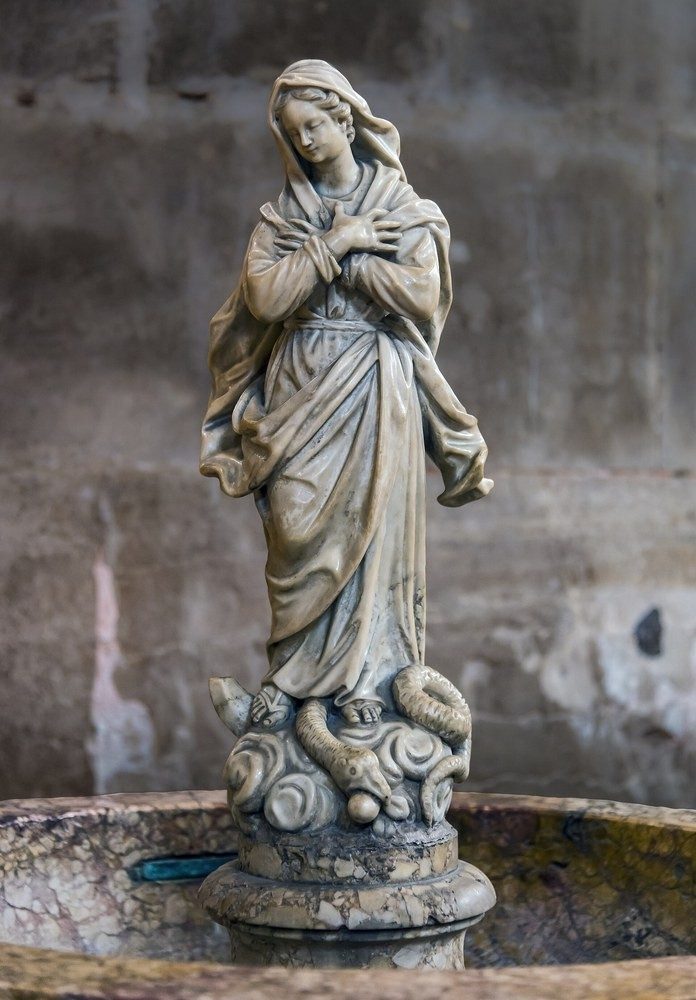
Holy water
Acqua benedetta
- Known today as
- Water blessed by a priest, usually with exorcized salt mixed in.
- Kind
- Sacramental, in 4 older authorities
- Earliest authority here
- The Apostolic Constitutions
- In the Canale glossary
- On the Manner of Discerning and Healing the Bewitched, Appendix A: Treatise Two: Blessed Objects and Materials
Revised October 1, 2026: Tradition, lore, modern assessment, and sources extended. An authority added from a text read in full. Version 1, first published September 25, 2026.
Holy water: what did Canale use it for?
For cleansing places and people, driving out demons, and curing illness, with a long catalogue of miracles; blessed against storms and hail; sprinkled on the bath, the house, and the sick (Treatise Two).
Holy water: what does modern science say?
Still in daily Catholic use. The salt-and-water rite Canale gives survived in the Rituale Romanum until the reforms after the Second Vatican Council; the blessing of water remains in the present Book of Blessings (1984). Studies of the water in church stoups find it rich in bacteria from the dipping of hands, and some churches have gone to dispensers; the blessing in the present Book of Blessings drops the exorcism of the salt that Canale’s rite kept.
What Medicine Makes of It
- PossessionThe possessed of the manuals, and dissociative trance.
- Dancing Manias and the Convent OutbreaksStrasbourg 1518, Loudun 1634, and mass psychogenic illness.
- Amulets, Blessed Objects, and the Meaning ResponseWhy what cannot work sometimes works.
- The Rite as TherapyWhy exorcism works when it works: persuasion, community, and the ending.
- The VoicesLocutions, the discernment of spirits, and hearing voices without illness.
- Scruples and the BesiegedThe obsessio of the manuals, and obsessive-compulsive disorder.
- The Marks on the BodyStigmata, the witch’s mark, and what the mind does to the skin.
- The IncubusThe demon lover of the night, and the sleep that cannot move.
- The ChangelingThe child that was exchanged, and the disabled child of the folk account.
- The OrdealThe hot iron, the swimming of witches, and the lie detector.
Holy water: what lore surrounds it?
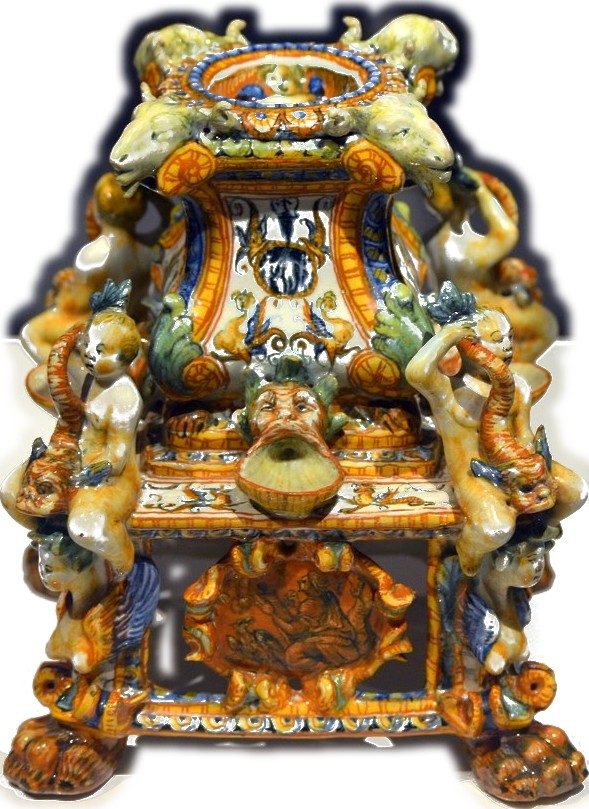
It was thrown on witches to make them confess and poured on the threshold against them, sprinkled on the hail-cloud by the priest in the Alps, and drunk by the sick; the Orthodox bless the waters of rivers at Theophany, and the faithful carry the water home for the year. The stoup at the church door is the Roman cantharus of the atrium turned to a sacramental.
Used in These Compounds
Holy water is an ingredient of 1 compound medicine in the database. For Club members. Create a free account or sign in.
Holy water: what did the older authorities say?
- The Apostolic Constitutions
- Of the fourth century already give a prayer for the blessing of water and oil for health and for the driving out of demons; the Liber Pontificalis ascribes the mixing of salt into it to Pope Alexander I, in the second century, which is legend.
- The Easter water
- Water blessed at the Vigil, with the paschal candle plunged into it, was carried home in bottles and sprinkled on the fields, the beasts, and the beds, and kept against storms through the year.
- The Reformers
- Rejected it as superstition: Luther kept a blessing of water but mocked its use against devils, and the English stoups were smashed in the 1540s, so that the holy water of Canale’s book marks a line between the confessions.
- The Catholic Encyclopedia
- The Catholic Encyclopedia (1910) admits that “the use of holy water in the earliest days of the Christian Era is attested by documents of only comparatively late date,” and gives the fourth-century blessing of Serapion of Thmuis: “Grant unto these creatures the power to heal; may all fevers, every evil spirit, and all maladies be put to flight by him who either drinks these beverages or is anointed with them.” Baptismal water was thought incorrupt, and “scarcely had baptism been administered, when the people would crown around with all sorts of vessels and take away the water, some keeping it carefully in their homes whilst others watered their fields, vineyards, and gardens with it.” Pope Leo IV ordered every priest to bless water each Sunday, and Hincmar of Reims let the people “carry some away in clean vessels so as to sprinkle their houses, fields, vineyards, and cattle, and the provender with which these last are fed, as also to throw over their own food.”
Sources
- [79] Liturgy Office of the Catholic Bishops’ Conference of England and Wales. Book of Blessings (resource sheet). liturgyoffice.org.uk. Book, not indexed
- [84] McNamara, E. (2010). Extraordinary Form; Book of Blessings. Liturgy Q&A, 2 and 16 November 2010. EWTN Library, ewtn.com. Verified against its record · doi:10.1159/000287797
- [120] Weller, P. T. (trans.) (1964). The Roman Ritual, Part XI: Blessings and Other Sacramentals. EWTN Library, ewtn.com. Primary text
- Apostolic Constitutions VIII.29. Book, seen in reviews
- Kirschner, A. K. T., et al. (2012). “Holy springs and holy water: underestimated sources of illness?” Journal of Water and Health 10. Verified against its record · doi:10.2166/wh.2012.005
- The Catholic Encyclopedia (New York, 1907–1914), “Water, Holy.” newadvent.org/cathen/07432a.htm Standard reference work
Verification
- Checked
- October 1, 2026
- Passes
- Every dated or regulatory claim checked by category across the database
- Each quotation from the older authorities checked word for word against the text, read in full
- Sources
- 6 cited: 2 verified against its record, 1 primary text, 1 standard reference work, 1 book, seen in reviews, 1 book, not indexed.
- Corrections
- None were needed.
What was checked, how, and what was found is set out on the Verification page. A checked source is one whose record was found; it does not make the entry medical advice.
Cite This Entry
Version 1 · first published September 25, 2026 · last revised October 1, 2026
- Chicago
“Holy water.” In Materia Medica, edited by B. C. P. Statema. Version 1. The Thinking Press, 2026–. Last modified October 1, 2026. https://thethinkingpress.org/materia-medica/holy-water.
- MLA
“Holy water.” Materia Medica, edited by B. C. P. Statema, version 1, The Thinking Press, 1 Oct. 2026, thethinkingpress.org/materia-medica/holy-water. Accessed 8 Oct. 2026.
- APA
Holy water. (2026, October 1). In B. C. P. Statema (Ed.), Materia medica (Version 1). The Thinking Press. Retrieved October 8, 2026, from https://thethinkingpress.org/materia-medica/holy-water
Club members keep entries on a shelf with private notes, print the plates as cards, and receive an entry by email each week. Create a free account before January 1, 2027 and all of it is yours for good. About the Club
See Also
Also in The Catholic Encyclopedia
The holy water stoup in The Catholic Encyclopedia · The Holy Name, IHS in The Catholic Encyclopedia · Holy wells in The Catholic Encyclopedia · The Hand of Glory in The Catholic Encyclopedia · everything The Catholic Encyclopedia names →
Nearby in the alphabet
Hiera with agaric · Honey (Honey of bees) · Hiera picra (mastic, saffron, and other aromatics) · Honey fungus (from black cords, the “shoestrings,” that spread beneath the bark) · Hiera of Pacchius
Historical description, not medical advice.