
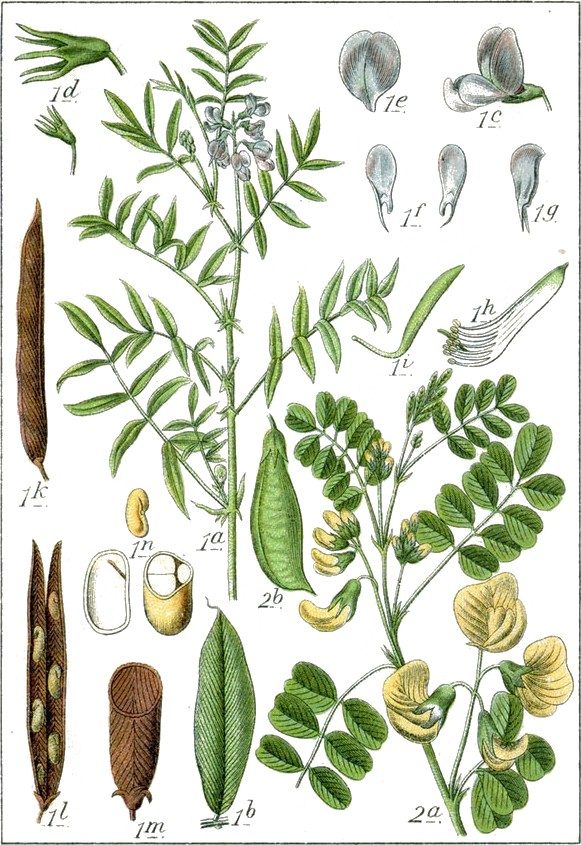
Goat’s rue
Ruta capraria; galega
- Known today as
- Galega officinalis, French lilac.
- Kind
- Plant
- Constituents
- galegine
- In other databases
- Plants of the World Online search · GBIF search · Wikidata search
- In the Canale glossary
- On the Manner of Discerning and Healing the Bewitched, Appendix A: Part Three, Chapter 6: Remedies Given by Mouth After the Purge
Caution. Hazardous in some form or dose; see the modern assessment below.
Goat’s rue: what did Canale use it for?
Seed in a powder for the bewitched; flowers in a conserve; juice in the oil; among the amulets (chs. 6, 9, 10).
Goat’s rue: what does modern science say?
Here the old herbalists hit on something real: goat’s rue is rich in guanidine compounds such as galegine, which lower blood sugar, and the modern diabetes drug metformin descends from this line of research. Its folk reputation was against plague and fevers, and to increase milk.
Goat’s rue: is it poisonous?
Yes, in some form or dose. Historical description, not medical advice; in a poisoning, call a poison centre.
Pharmacognosy & Toxicology
- Constituents
- Mechanism
- Galegine lowers blood sugar and was too toxic to use; the biguanides made from it in the 1920s gave, after Jean Sterne’s trials in 1957, metformin, the most prescribed drug for diabetes in the world.
- Toxic dose
- The plant has killed sheep; galegine in the clinic was abandoned for its toxicity.
- Standing
- Metformin is on the WHO list of essential medicines; the herb is not used.
- Bailey, C. J., and Day, C. (2004). “Metformin: its botanical background.” Practical Diabetes International 21. Verified against its record · doi:10.1002/pdi.606
- Sterne, J. (1957). “Du nouveau dans les antidiabétiques: la NN diméthylamine guanyl guanidine.” Maroc Médical 36. Not indexed
The abstract of each source, beneath its citation. For Club members. About the Club or sign in.
Constituent names open the compound’s record at PubChem, and “ChEMBL” beside a name opens its record at ChEMBL, the European Bioinformatics Institute’s database of bioactive molecules. Where a mechanism line was checked against ChEMBL (ChEMBL 37, read 1 October 2026), the check is shown with the measured value and its source paper, or says plainly that nothing has been measured. Doses are as the references give them, for description only; this is not medical advice. Each source carries the result of its check against Crossref, PubMed, or the authority’s page: see Verification.
Goat’s rue: what lore surrounds it?
Its folk use against the plague was widespread enough in medieval Europe to survive into the modern record, beside its uses for worms and snakebite and to increase milk. The road from folklore to pharmacy is unusually direct here: galegine, the blood-sugar-lowering compound the herbalists were unknowingly using, led researchers to the biguanide drugs, of which metformin is still prescribed today.
In Their Own Words
Culpeper says goat's rue is temperate, resists poison and pestilence, kills worms and helps the falling sickness.
“Galega. Goat’s-rue: Temperate in quality, resists poison, kills worms, helps the falling-sickness, resists the pestilence.”
Nicholas Culpeper, The Complete Herbal, The College's simples, 'Galega'. London: Thomas Kelly, 17, Paternoster Row, MDCCCL (Project Gutenberg eBook #49513). The text, read in part
Mrs Grieve says goat's rue, the herba rutae caprariae of the old herbals, was formerly much used for its sweat-provoking properties in malignant fevers and plague, whence the German name Pestilenzkraut.
“Goat's Rue, known in the old Herbals as Herba rutae caprariae, is a leguminous plant that in former times was much employed on account of its diaphoretic properties in malignant fevers and the plague, hence one of its German popular names of Pestilenzkraut.”
Mrs. M. Grieve, A Modern Herbal: Rue, Goat's, Rue, Goat's. The text of A Modern Herbal as published on botanical.com. The text, read in full
Each passage is quoted from the text named, which the press fetched and read, and was checked word for word against a fresh copy of it; the link opens that copy. Passages are given as printed, without the editors’ footnote numbers, and with words broken across lines joined.
Sources
- [8] Bailey, C. J. (2017). Metformin: historical overview. Diabetologia 60(9): 1566–1576. doi:10.1007/s00125-017-4318-z Verified against its record · doi:10.1007/s00125-017-4318-z
- Wikipedia, “Galega officinalis.” Book, not indexed
Verification
- Checked
- October 1, 2026
- Passes
- Every sentence read against its sources, in the pass over the remaining 343 entries
- The Standing line checked against the authority it names (EMA, WHO, FDA, CITES, Commission E)
- Every dated or regulatory claim checked by category across the database
- Sources
- 4 cited: 2 verified against its record, 1 book, not indexed, 1 not indexed. 2 with the abstract on file.
- Corrections
- None were needed.
What was checked, how, and what was found is set out on the Verification page. A checked source is one whose record was found; it does not make the entry medical advice.
Cite This Entry
Version 1 · first published September 25, 2026
- Chicago
“Goat’s rue.” In Materia Medica, edited by B. C. P. Statema. Version 1. The Thinking Press, 2026–. Last modified September 25, 2026. https://thethinkingpress.org/materia-medica/goats-rue.
- MLA
“Goat’s rue.” Materia Medica, edited by B. C. P. Statema, version 1, The Thinking Press, 25 Sept. 2026, thethinkingpress.org/materia-medica/goats-rue. Accessed 8 Oct. 2026.
- APA
Goat’s rue. (2026, September 25). In B. C. P. Statema (Ed.), Materia medica (Version 1). The Thinking Press. Retrieved October 8, 2026, from https://thethinkingpress.org/materia-medica/goats-rue
Club members keep entries on a shelf with private notes, print the plates as cards, and receive an entry by email each week. Create a free account before January 1, 2027 and all of it is yours for good. About the Club
See Also
Sharing galegine
Drawing on the same sources: Wikipedia
Nearby in the alphabet
Goji berry · Glauber’s salt · Gold leaf (Beaten gold) · Glass powder (Powdered glass) · Gold, frankincense, and myrrh (The gifts of the Magi) · Ginseng · Golden pills (a standard compound of aloes, scammony, and colocynth) · Ginger (The rhizome of Zingiber officinale)
Historical description, not medical advice.