
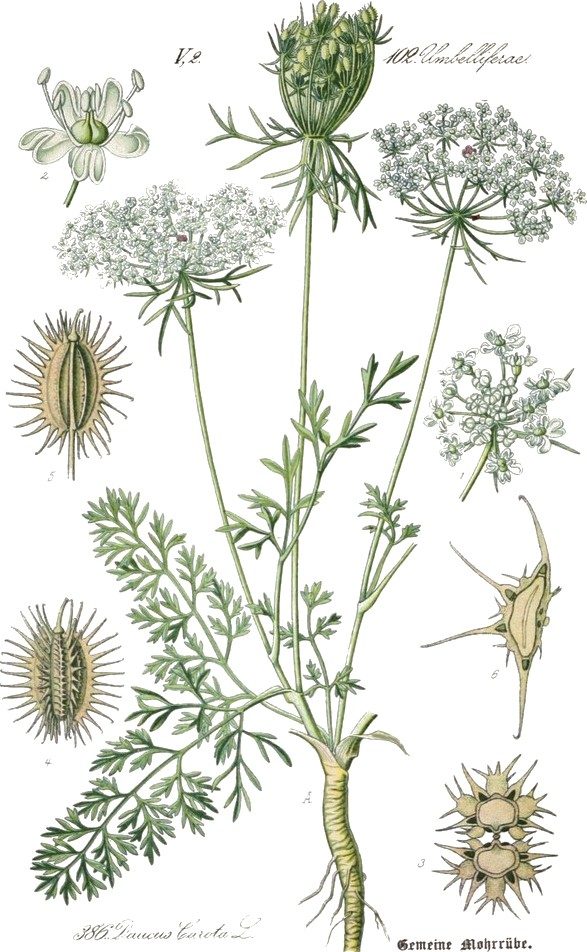
Wild carrot, seed of
Dauco
- Known today as
- Seed of Daucus carota, Queen Anne’s lace.
- Kind
- Plant, in 1 older authority
- Constituents
- carotol, daucol, alpha-pinene, and 1 more
- Earliest authority here
- Pliny (AD 23/24–79)
- In other databases
- Plants of the World Online search · GBIF search · Wikidata search
- In the Canale glossary
- On the Manner of Discerning and Healing the Bewitched, Appendix A: Part Three, Chapter 4: Stronger Purgatives and Compound Medicines
Revised October 1, 2026: An older authority added from a text read in full. Version 1, first published September 25, 2026.
Wild carrot, seed of: what did Canale use it for?
In the melancholic purge, in the gentle vomitories, and in the stuffing of the cockerel (chs. 4–6).
Wild carrot, seed of: what does modern science say?
Reported to be diuretic and carminative, as the old pharmacy also held; not a purgative.
Pharmacognosy & Toxicology
- Constituents
- carotola sesquiterpene alcohol of the seed oil
- daucol
- alpha-pinene ChEMBL
- falcarinol ChEMBLa polyacetylene
- Mechanism
- A carminative and mild diuretic seed of the fennel family, which is why it stood in the purges and the cockerel; its folk use as a morning-after contraceptive rests on an unconfirmed animal study, and the plant must not be confused with hemlock, whose smooth stem and purple spots are the difference.
- Toxic dose
- Safe as a spice; the leaf’s furanocoumarins photosensitise.
- Standing
- No monograph; the cultivated carrot is the food.
- Jansen, G. C., and Wohlmuth, H. (2014). “Carrot seed for contraception: a review.” Australian Journal of Herbal Medicine 26. Matched to its record and reviewed
Constituent names open the compound’s record at PubChem, and “ChEMBL” beside a name opens its record at ChEMBL, the European Bioinformatics Institute’s database of bioactive molecules. Where a mechanism line was checked against ChEMBL (ChEMBL 37, read 1 October 2026), the check is shown with the measured value and its source paper, or says plainly that nothing has been measured. Doses are as the references give them, for description only; this is not medical advice. Each source carries the result of its check against Crossref, PubMed, or the authority’s page: see Verification.
Wild carrot, seed of: what lore surrounds it?
Its modern name, Queen Anne’s lace, carries its own legend: the single dark purple or red floret at the heart of the white flower is said to be a drop of blood, shed when a Queen Anne, variously Anne of Great Britain, Anne of Denmark, or even Anne Boleyn, pricked her finger trying to make lace as fine as the flower.
Wild carrot, seed of: what did the older authorities say?
- Pliny
- Of the daucus he says Petronius Diodotus distinguished four kinds, “the varieties being in reality but two”: the most esteemed of Crete, resembling fennel with whiter, hairier leaves and a root that “has a remarkably pleasant taste and smell”; the seed “white, acrid, hot, and odoriferous,” that of the second kind stronger and to be used more sparingly; quadrupeds will not touch it “except indeed, after abortion”; the seed is the part used, save for the Cretan, whose root is “particularly useful for the stings of serpents”; it is also “curative of head-ache,” and a wine was made of it.
Sources
- [28] Culpeper, N. (1653). Pharmacopœia Londinensis, or, The London Dispensatory [the Royal College of Physicians’ pharmacopoeia in English, with Culpeper’s commentary]. London: Peter Cole. Text Creation Partnership edition A35381. Read in part · the text read
- [66] Ismail, J., Shebaby, W. N., Daher, J., Boulos, J. C., Taleb, R., Daher, C. F., & Mroueh, M. (2024). Phytochemistry and pharmacology of wild carrot (Daucus carota). Encyclopedia MDPI, entry 56267, based on Plants 13(1): 93. doi:10.3390/plants13010093 Verified against its record · doi:10.3390/plants13010093
- Plant-Lore, “Queen Anne’s Lace.” Book, seen in reviews
- Pliny the Elder, Natural History 25.64, 25.84, 14.19, trans. J. Bostock & H. T. Riley (1855), Perseus Digital Library. Primary text
Verification
- Checked
- October 1, 2026
- Passes
- Every sentence read against its sources, in the pass over the remaining 343 entries
- The Standing line checked against the authority it names (EMA, WHO, FDA, CITES, Commission E)
- Every dated or regulatory claim checked by category across the database
- Each quotation from the older authorities checked word for word against the text, read in full
- Sources
- 5 cited: 1 read in part, 1 verified against its record, 1 matched to its record and reviewed, 1 primary text, 1 book, seen in reviews.
- Corrections
- None were needed.
What was checked, how, and what was found is set out on the Verification page. A checked source is one whose record was found; it does not make the entry medical advice.
Cite This Entry
Version 1 · first published September 25, 2026 · last revised October 1, 2026
- Chicago
“Wild carrot, seed of.” In Materia Medica, edited by B. C. P. Statema. Version 1. The Thinking Press, 2026–. Last modified October 1, 2026. https://thethinkingpress.org/materia-medica/wild-carrot-seed-of.
- MLA
“Wild carrot, seed of.” Materia Medica, edited by B. C. P. Statema, version 1, The Thinking Press, 1 Oct. 2026, thethinkingpress.org/materia-medica/wild-carrot-seed-of. Accessed 8 Oct. 2026.
- APA
Wild carrot, seed of. (2026, October 1). In B. C. P. Statema (Ed.), Materia medica (Version 1). The Thinking Press. Retrieved October 8, 2026, from https://thethinkingpress.org/materia-medica/wild-carrot-seed-of
Club members keep entries on a shelf with private notes, print the plates as cards, and receive an entry by email each week. Create a free account before January 1, 2027 and all of it is yours for good. About the Club
See Also
Sharing alpha-pinene
Cupressus sempervirens · Turpentine · Juniperus communis · Pistacia lentiscus
Also in Pliny the Elder
Wild garlic in Pliny the Elder · Wax in Pliny the Elder · Wild rue in Pliny the Elder · Water germander in Pliny the Elder · everything Pliny the Elder names →
Drawing on the same sources: Plant-Lore
Nearby in the alphabet
Wild bergamot · Wild ginger · White willow (The bark and leaves of Salix alba) · White lead (Basic lead carbonate) · Winter-grain mould (Pink and white moulds of grain left in the field over winter) · White hellebore
Historical description, not medical advice.