
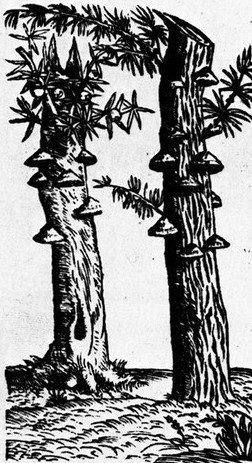
Troche of agaric
Trocisci di agarico
- Known today as
- Lozenges of larch agaric, Laricifomes officinalis (syn. Fomitopsis officinalis), a bracket fungus.
- Kind
- Fungus, in 1 older authority
- Constituents
- agaric acid, agaricol, resins
- Poisoning
- The drastic resins
- Earliest authority quoted here
- Pliny (AD 23/24–79)
- In the Canale glossary
- On the Manner of Discerning and Healing the Bewitched, Appendix A: Part Three, Chapter 4: Stronger Purgatives and Compound Medicines
Revised October 17, 2026: An older authority added from a text read in full. Checked against its sources, each read in full, in part, or in its abstract. Version 1, first published September 25, 2026.
Troche of agaric: what did Canale use it for?
In the purge for phlegmatic patients (ch. 4).
Troche of agaric: what does modern science say?
Larch agaric is a genuine irritant purgative, and was later used chiefly to check the sweats of wasting disease. Grieve (1931) found it little used, though it is still sold as a medicinal mushroom (agarikon).
The toxic dose and the poisoning
- Toxic dose
- Against night-sweats, 1/12 to 1 grain of agaric acid; large doses purge.
- Syndrome
- The drastic resins
The references for these lines are listed under Pharmacognosy, in Science. Doses are as the references give them, for description only; this is not medical advice. In a poisoning, call a poison centre.
Troche of agaric: what did the older authorities say?
- PlinyAD 23/24–79
- Describes agaric as “a fungus of a white colour, upon the trees in the vicinity of the Bosporus,” given in doses of four oboli beaten up in two cyathi of oxymel, the Galatian kind less efficacious; the male firmer and more bitter and “productive too of head-ache,” the female of looser texture, sweet at first and then bitter; after a poisoning, once the patient has vomited, agaric in one denarius with three cyathi of hydromel; and for spitting of blood, in honied wine.
Used in These Compounds
Troche of agaric is an ingredient of 2 compound medicines in the database. For Club members. Create a free account or sign in.
Pharmacognosy
- Constituents
- agaric acida hydroxy-tricarboxylic acid
- agaricol
- resins
- Mechanism
- The agaric of the old pharmacy is the larch polypore (Laricifomes officinalis), not a mushroom: agaric acid in large doses purges, and in small doses, by paralysing the nerve endings of the sweat glands, was given to stop the night-sweats of consumptives, as the British Pharmaceutical Codex still directed in 1911; in isolated mitochondria it acts on the adenine nucleotide translocase and opens the permeability transition pore. The troche was agaric steeped in wine with ginger and made into lozenges, which Culpeper calls the way to correct agaric and make it fitter for use.
- Standing
- Little used by Grieve’s day (1931); the fungus is now counted endangered.
- Grienke, U., et al. (2014). “European medicinal polypores: a modern view on traditional uses.” Journal of Ethnopharmacology 154. Abstract read · the text read
The abstract of each source, beneath its citation. For Club members. About the Club or sign in.
Constituent names open the compound’s record at PubChem, and “ChEMBL” beside a name opens its record at ChEMBL, the European Bioinformatics Institute’s database of bioactive molecules. Where a mechanism line was checked against ChEMBL (ChEMBL 37, read 1 October 2026), the check is shown with the measured value and its source paper, or says plainly that nothing has been measured. Doses are as the references give them, for description only; this is not medical advice. Each source carries the result of its check against Crossref, PubMed, or the authority’s page: see Verification.
Sources
- [9] Bennett, P. I., Bair, Z. J., Bradshaw, A. J., & Stamets, P. (2026). Genomic characterization of the endangered medicinal polypore agarikon (Laricifomes officinalis syn. Fomitopsis officinalis). G3: Genes, Genomes, Genetics, advance article jkag237. doi:10.1093/g3journal/jkag237 Abstract read · the text read
- [16] The British Pharmaceutical Codex (1911). London: Pharmaceutical Society of Great Britain. Monographs as transcribed at Henriette’s Herbal Homepage, henriettes-herb.com. Read in full · the text read
- [28] Culpeper, N. (1653). Pharmacopœia Londinensis, or, The London Dispensatory [the Royal College of Physicians’ pharmacopoeia in English, with Culpeper’s commentary]. London: Peter Cole. Text Creation Partnership edition A35381. Read in part · the text read
- [37] Elkhateeb, W. A., Daba, G. M., Elnahas, M. O., & Thomas, P. W. (2019). Fomitopsis officinalis mushroom: ancient gold mine of functional components and biological activities for modern medicine. Egyptian Pharmaceutical Journal 18(4): 285–289. doi:10.4103/epj.epj_46_19 Abstract read · the text read
- [54] Grieve, M. (1931). A Modern Herbal. Online edition, botanical.com, cited under the plant concerned. Read in full · the text read
- Pliny the Elder, Natural History 25.57, 25.79, 26.19, trans. J. Bostock & H. T. Riley (1855), Perseus Digital Library. Read in part · the text read
- Pliny the Elder, Natural History 25.79, trans. J. Bostock & H. T. Riley (1855), Perseus Digital Library. Read in part · the text read
- Pliny the Elder, Natural History 26.19, trans. J. Bostock & H. T. Riley (1855), Perseus Digital Library. Read in part · the text read
- The British Pharmaceutical Codex (1911), monograph ‘Acidum Agaricum’, as transcribed at Henriette’s Herbal Homepage, henriettes-herb.com. Read in part · the text read
- Chávez, E., et al. (2020). Interaction of agaric acid with the adenine nucleotide translocase induces mitochondrial oxidative stress. Biochemistry Research International 2020: 5253108. Read in full · the text read
Verification
- Checked
- October 1, 2026, October 17, 2026
- Passes
- Read against its sources in the fifty-entry sample
- Every dated or regulatory claim checked by category across the database
- Each quotation from the older authorities checked word for word against the text, read in full
- Every source read, in full, in part, or in its abstract, and every sentence checked against what was read (October 17, 2026)
- Sources
- 11 cited: 3 read in full, 5 read in part, 3 abstract read. 3 with the abstract on file.
- Corrections
- said agaricic acid inhibits citrate synthase. It inhibits the mitochondrial citrate carrier and the adenine nucleotide translocase.
What was checked, how, and what was found is set out on the Verification page. A checked source is one whose record was found; it does not make the entry medical advice.
Club members can point at a technical term in this entry, such as a constituent, an action, or a word of Jung’s, to read its definition from the source. The Club.
Cite This Entry
Version 1 · first published September 25, 2026 · last revised October 17, 2026
- Chicago
“Troche of agaric.” In Materia Medica, edited by B. C. P. Statema. Version 1. The Thinking Press, 2026–. Last modified October 17, 2026. https://thethinkingpress.org/materia-medica/troche-of-agaric.
- MLA
“Troche of agaric.” Materia Medica, edited by B. C. P. Statema, version 1, The Thinking Press, 17 Oct. 2026, thethinkingpress.org/materia-medica/troche-of-agaric. Accessed 22 Nov. 2026.
- APA
Troche of agaric. (2026, October 17). In B. C. P. Statema (Ed.), Materia medica (Version 1). The Thinking Press. Retrieved November 22, 2026, from https://thethinkingpress.org/materia-medica/troche-of-agaric
See Also
Poisoned alike: the drastic resins
Cochia pills · Lapis lazuli, pills of · Diaphenicon · Indian electuary, greater and lesser · Foetid pills · Indian and Arabian pills · Gamboge · Hiera with agaric · the syndrome, with all of them →
Sharing agaric acid, resins
Hamech, confection of · Hiera of Pacchius · Grindelia robusta
Also in Pliny the Elder
Truffle in Pliny the Elder · Tongue stones in Pliny the Elder · Turpentine in Pliny the Elder · Verbena in Pliny the Elder · everything Pliny the Elder names →
Drawing on the same sources: Grienke
Nearby in the alphabet
Tribulus · Turkey tail (found worldwide, banded in concentric rings of brown and tan) · Touch-pieces · Turmeric (of the ginger family, whose root is deep yellow within) · Tormentil
Historical description, not medical advice.
