
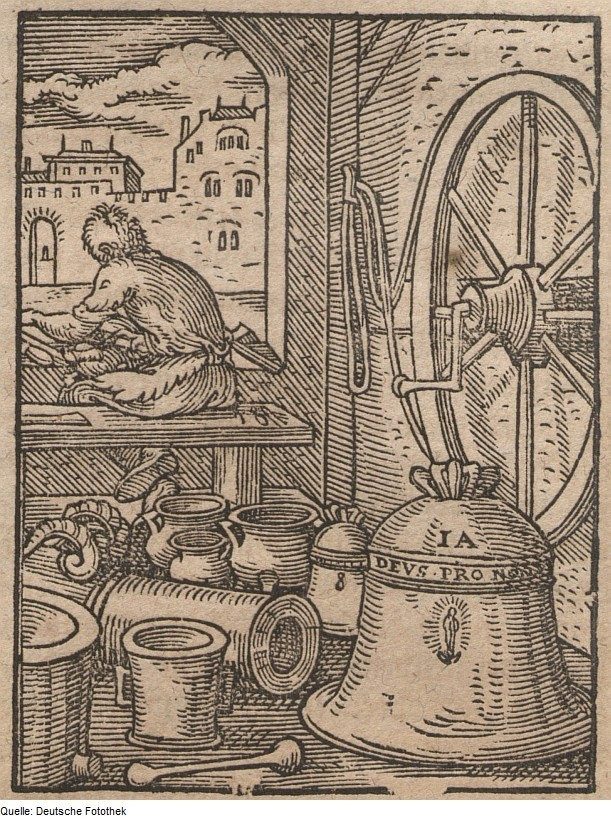
Bells
Campane
- Known today as
- Church bells blessed by the bishop in a rite popularly, and wrongly, called their “baptism.”
- Kind
- Sacramental, in 1 older authority
- Earliest authority quoted here
- The Catholic Encyclopedia (New York, 1907–1914)
- In the Canale glossary
- On the Manner of Discerning and Healing the Bewitched, Appendix A: Treatise Two: Blessed Objects and Materials
Revised October 17, 2026: An authority added from a text read in full. Checked against its sources, each read in full, in part, or in its abstract. Version 1, first published September 25, 2026.
Bells: what did Canale use it for?
Their ringing “is so hateful and hostile to demons that storms stirred up by them are either kept from breaking, or, once broken, are stilled, or turned aside” (Treatise Two; note LXXIII).
Bells: what does modern science say?
Blessed bells were rung against storms, but bell towers, being the highest points, drew lightning: Arago reports that a German savant writing in 1783 computed that in thirty-three years lightning had struck 386 steeples and killed 121 ringers. The blessing of bells continues: the Book of Blessings keeps an Order for the Blessing of Bells.
Bells: what did the older authorities say?
- The Catholic EncyclopediaNew York, 1907–1914
- The Catholic Encyclopedia calls the “baptism” of bells “merely popular and metaphorical,” a phrase “tolerated, but … never been formally recognized by the Church.” In the rite the bishop “mixes salt with water, reciting prayers of exorcism analogous to those always used in the preparation of holy water, but making special reference to the bell and to the evil influences of the air—the phantoms, the storms, the lightning—which threaten the peace of devout Christians.” The bell is washed inside and out, anointed “with the oil of the sick in seven places” outside and “with chrism in four places” within, named for a saint, and the thurible with incense and myrrh is placed under it “so that the smoke arising may fill its cavity.” The ritual “agrees with that in use in Carlovingian times … dating probably as far back as the pontificate of Egbert of York in the middle of the eighth century.”
What Medicine Makes of It
- Dancing Manias and the Convent OutbreaksStrasbourg 1518, Loudun 1634, and mass psychogenic illness.
- The Rite as TherapyWhy exorcism works when it works: persuasion, community, and the ending.
Sources
- [21] Herbermann, C. G., et al. (eds.) (1907–1914). The Catholic Encyclopedia. New York: Robert Appleton Company. Online at newadvent.org. Articles, each at its own address: Agnus Dei (H. Thurston); Amulet (M. Hassett); Ash Wednesday (H. Thurston); Bells (H. Thurston); Holy Oils (H. Leclercq); Paschal Candle (H. Thurston); Scapular (J. Hilgers). Read in full
- [79] Liturgy Office of the Catholic Bishops’ Conference of England and Wales. Book of Blessings (resource sheet). liturgyoffice.org.uk. Read in full · the text read
- The Catholic Encyclopedia (New York, 1907–1914), “Epiphany.” newadvent.org/cathen/05504c.htm Standard reference work
- The Catholic Encyclopedia (New York, 1907–1914), “Bells.” newadvent.org/cathen/02418b.htm Standard reference work
- Arago, F. (1855). Meteorological Essays, trans. under the superintendence of E. Sabine. London: Longman. Read in part · the text read
Verification
- Checked
- October 1, 2026, October 17, 2026
- Passes
- Every dated or regulatory claim checked by category across the database
- Each quotation from the older authorities checked word for word against the text, read in full
- Every source read, in full, in part, or in its abstract, and every sentence checked against what was read (October 17, 2026)
- Sources
- 5 cited: 2 read in full, 1 read in part, 2 standard reference work.
- Corrections
- None recorded.
What was checked, how, and what was found is set out on the Verification page. A checked source is one whose record was found; it does not make the entry medical advice.
Club members can point at a technical term in this entry, such as a constituent, an action, or a word of Jung’s, to read its definition from the source. The Club.
Cite This Entry
Version 1 · first published September 25, 2026 · last revised October 17, 2026
- Chicago
“Bells.” In Materia Medica, edited by B. C. P. Statema. Version 1. The Thinking Press, 2026–. Last modified October 17, 2026. https://thethinkingpress.org/materia-medica/bells.
- MLA
“Bells.” Materia Medica, edited by B. C. P. Statema, version 1, The Thinking Press, 17 Oct. 2026, thethinkingpress.org/materia-medica/bells. Accessed 22 Nov. 2026.
- APA
Bells. (2026, October 17). In B. C. P. Statema (Ed.), Materia medica (Version 1). The Thinking Press. Retrieved November 22, 2026, from https://thethinkingpress.org/materia-medica/bells
See Also

Historical description, not medical advice.
