
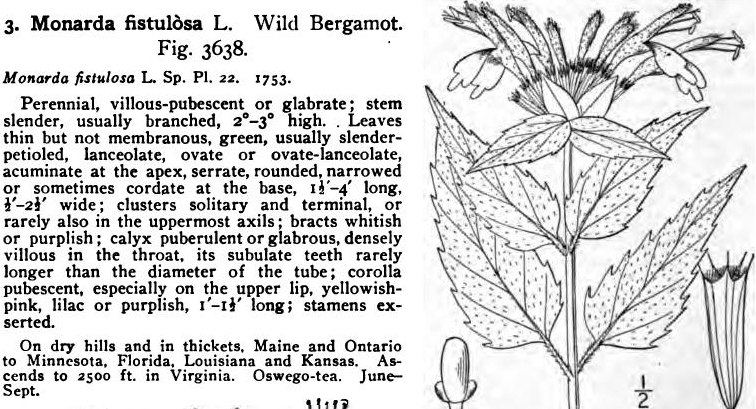
Wild bergamot
Monarda fistulosa of Linnaeus; horsemint; the Ojibwe weca’wûs wackwî’nek, yellow light; kin of the Oswego tea, Monarda didyma, and of the horsemint Monarda punctata that gave the oil of the old shops
- Known today as
- Monarda fistulosa, the lilac-flowered bergamot of the prairies, meadows, and dry open woods of the Midwest, a square-stemmed mint whose whole plant smells of thyme and oregano: its oils are the same carvacrol and thymol.
- Kind
- Plant, in 3 older authorities
- Constituents
- carvacrol and thymol, p-cymene, γ-terpinene, and α-terpinene, rosmarinic acid and luteolin-7-O-glucoside
- Earliest authority here
- Huron H. Smith
- In other databases
- Plants of the World Online search · GBIF search · Wikidata search
Caution. Nothing read for this entry describes harm from the plant or its tea; the oil of the related horsemint blisters the skin, by Rafinesque.
Wild bergamot: what was it used for?
The Flambeau Ojibwe, Smith says, “gather and dry the whole plant, boiling it in a vessel to obtain the volatile oil to inhale to cure catarrh and bronchial affections”; the Menomini used it for catarrh and the Meskwaki for colds, while the Forest Potawatomi, strangely, had no name or use for it. Densmore lists the horsemint among the medicines of the Minnesota Chippewa. Rafinesque, writing of the genus, found the Monardas “equal to camomile” and a more palatable tea, uniting the properties of sage, balm, and chamomile, used in fevers, pleurisies, colic, and gravel; the oil, chiefly from M. punctata, was an officinal rubefacient that Dr. Atlee rubbed on in chronic rheumatism, palsy, and the cold limbs of typhus, and two drops of it in sugar and water stopped vomiting.
Wild bergamot: foraging it in the Midwest
- Part
- Whole flowering plant
- When
- Summer
Prairies, meadows, and dry open woods; the Flambeau Ojibwe gathered and dried the whole plant to boil for its vapour. The Potawatomi, alone among the Wisconsin tribes, did not use it.
After Smith. All the foragables of the Midwest. Historical record, not a field guide: identify before you gather, and read the whole entry.
Wild bergamot: how is it taken as a tea?
A tea of the herb, which Rafinesque found equal to camomile and more palatable, for fevers and colic; the Ojibwe boiled the dried plant and breathed the vapour for catarrh.
All the herbal teas of the database. Historical directions, not medical advice.
Wild bergamot: what does modern science say?
The flower oil is mostly monoterpenes, p-cymene, γ-terpinene, and their kin, and the leaf oil mostly oxygenated ones, carvacrol and thymol above all; in cells both oils, and carvacrol, thymol, and β-myrcene singly, opened the TRPA1 channel that senses irritants, which the authors offered as a cellular basis for part of the plant’s reputation. A dry extract of the herb left after distilling the oil was rich in rosmarinic acid and luteolin glucoside, scavenged radicals, reduced paw swelling and writhing in rodents, and caused no harm to rats at doses up to five grams a kilogram.
Pharmacognosy & Toxicology
- Constituents
- carvacrol and thymolthe oxygenated monoterpenes that dominate the leaf oil; both open the TRPA1 channel
- p-cymene, γ-terpinene, and α-terpinenethe monoterpene hydrocarbons that make up much of the flower oil
- rosmarinic acid and luteolin-7-O-glucosidethe chief polyphenols of the herb left after distillation, 120 milligrams of phenolics per gram of extract
- Mechanism
- The oils and their phenols activate TRPA1, the channel of irritant sensing, in transfected cells, which the authors offer as a basis for the plant’s traditional effects; the polyphenol extract scavenged radicals and reduced inflammation and writhing in rodents.
- Toxic dose
- The dried plant boiled and its vapour inhaled, by the Ojibwe; a tea, by Rafinesque; two drops of the related horsemint oil in sugar and water, by Atlee.
- Standing
- A thyme of the prairie with a cell study and a rodent study behind it and no trial in people; harmless at five grams a kilogram in rats.
- Ghosh, M., et al. (2020). Essential oils from Monarda fistulosa: chemical composition and activation of transient receptor potential A1 (TRPA1) channels. Molecules 25: 4873. doi:10.3390/molecules25214873 Verified against its record · PMID 33105614
- Shanaida, M., Hudz, N., Jasicka-Misiak, I., & Wieczorek, P. P. (2021). Polyphenols and pharmacological screening of a Monarda fistulosa L. dry extract based on a hydrodistilled residue by-product. Frontiers in Pharmacology 12: 563436. doi:10.3389/fphar.2021.563436 Verified against its record · PMID 33995001
The abstract of each source, beneath its citation. For Club members. About the Club or sign in.
Constituent names open the compound’s record at PubChem, and “ChEMBL” beside a name opens its record at ChEMBL, the European Bioinformatics Institute’s database of bioactive molecules. Where a mechanism line was checked against ChEMBL (ChEMBL 37, read 1 October 2026), the check is shown with the measured value and its source paper, or says plainly that nothing has been measured. Doses are as the references give them, for description only; this is not medical advice. Each source carries the result of its check against Crossref, PubMed, or the authority’s page: see Verification.
Wild bergamot: what lore surrounds it?
A plant of neighbours: the Ojibwe, Menomini, and Meskwaki all boiled it for colds while the Potawatomi beside them did not know it, and Rafinesque’s Oswego tea was named for the Indians of one New York lake. Its scent is the thyme of the Mediterranean kitchen grown wild on the prairie, and the chemists found the same two phenols in it.
Wild bergamot: what did the older authorities say?
- Huron H. Smith
- The Flambeau Ojibwe boil the dried plant and inhale the vapour for catarrh and bronchial affections; “in some sections, the whites use it as a domestic antiperiodic and diaphoretic.” Among the Forest Potawatomi “strangely enough” it had no name or use, “rather surprising because the neighboring tribes all make use of it.”
- C. S. Rafinesque
- The Monardas, he says, were called Oswego tea “because first used by the Indians near Oswego lake”; equal to camomile and more palatable, more effectual in fevers and pleurisies, and used in piles, rheumatism, palsy, colic, and gravel. The oil, kept in the shops as a rubefacient, produces heat, redness, pain, and blistering on the skin; Dr. Atlee cured a hard hearing with the liniment rubbed on the head, and claimed it had cured a maniac.
- Frances Densmore
- Horsemint, Monarda mollis, appears in her tables of the Chippewa materia medica beside the wild cherry and the strawberry, among the plants she gathered with their uses from the Minnesota and Wisconsin bands.
Sources
- Smith, H. H. (1932). Ethnobotany of the Ojibwe Indians, Bulletin of the Public Museum of the City of Milwaukee 4(3), “Wild Bergamot.” Project Gutenberg, 49527. Primary text
- Smith, H. H. (1933). Ethnobotany of the Forest Potawatomi Indians, Bulletin of the Public Museum of the City of Milwaukee 7(1), “Wild Bergamot.” Internet Archive, ethnobotany-of-the-forest-potawatomi-indians-by-huron-h.-smith-1933. Primary text
- Densmore, F. (1928). Uses of Plants by the Chippewa Indians, Forty-fourth Annual Report of the Bureau of American Ethnology, the tables of medicinal plants. Internet Archive, usesofplantsbych00dens. Primary text
- Rafinesque, C. S. (1830). Medical Flora, or Manual of the Medical Botany of the United States of North America, vol. 2, no. 64, “Monarda.” Internet Archive, b21468710_0002. Primary text
Verification
- Checked
- October 1, 2026
- Passes
- Every sentence read against its sources, in the pass over the remaining 343 entries
- The Standing line checked against the authority it names (EMA, WHO, FDA, CITES, Commission E)
- Every dated or regulatory claim checked by category across the database
- Sources
- 6 cited: 2 verified against its record, 4 primary text. 2 with the abstract on file.
- Corrections
- None were needed.
What was checked, how, and what was found is set out on the Verification page. A checked source is one whose record was found; it does not make the entry medical advice.
Cite This Entry
Version 1 · first published October 4, 2026
- Chicago
“Wild bergamot.” In Materia Medica, edited by B. C. P. Statema. Version 1. The Thinking Press, 2026–. Last modified October 4, 2026. https://thethinkingpress.org/materia-medica/wild-bergamot.
- MLA
“Wild bergamot.” Materia Medica, edited by B. C. P. Statema, version 1, The Thinking Press, 4 Oct. 2026, thethinkingpress.org/materia-medica/wild-bergamot. Accessed 8 Oct. 2026.
- APA
Wild bergamot. (2026, October 4). In B. C. P. Statema (Ed.), Materia medica (Version 1). The Thinking Press. Retrieved October 8, 2026, from https://thethinkingpress.org/materia-medica/wild-bergamot
Club members keep entries on a shelf with private notes, print the plates as cards, and receive an entry by email each week. Create a free account before January 1, 2027 and all of it is yours for good. About the Club
See Also
Drawing on the same sources: Smith, Densmore, Rafinesque
Wild ginger · Sumac · Black walnut · Bloodroot · the bibliography →
Nearby in the alphabet
Wild carrot, seed of (Queen Anne’s lace) · White willow (The bark and leaves of Salix alba) · Wild garlic (Allium ursinum) · White lead (Basic lead carbonate) · White hellebore · Wild rue (Peganum harmala) · White arsenic (Arsenic trioxide)
Historical description, not medical advice.