
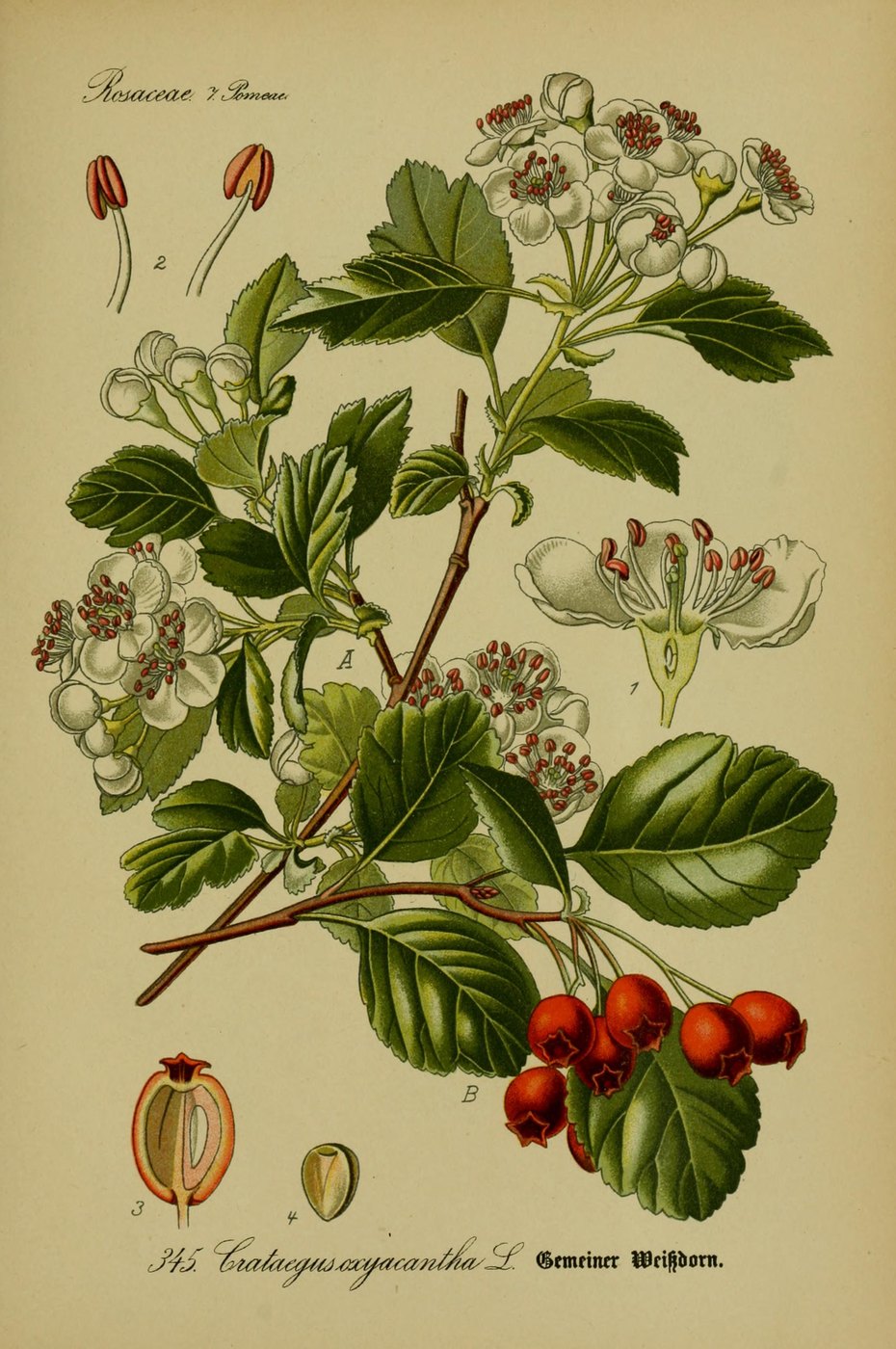
Hawthorn
May, the May tree
- Known today as
- Crataegus monogyna. The May tree, a thorned hedgerow tree whose white blossom marks the start of May in Britain and Ireland.
- Kind
- Plant, in 2 older authorities
- Constituents
- oligomeric procyanidins, vitexin-2″-O-rhamnoside, hyperoside, and 1 more
- Earliest authority here
- Pliny (AD 23/24–79)
- In other databases
- Plants of the World Online search · GBIF search · Wikidata search
Revised October 1, 2026: An older authority added from a text read in full. Version 1, first published September 27, 2026.
Hawthorn: what was it used for?
A decoction of the flowers and leaves traditionally taken to steady the blood pressure and support the heart.
Hawthorn: foraging it in the Midwest
- Part
- Haws; thorns
- When
- Autumn
The Pillager Ojibwe ate the haw apples in the fall of the year, the Flambeau used fruit and bark for a women’s medicine, and the women sewed with the sharp thorns for awls on fine work.
After Smith. All the foragables of the Midwest. Historical record, not a field guide: identify before you gather, and read the whole entry.
Hawthorn: how is it taken as a tea?
Flowers and berries, astringent, in decoction for sore throats; the leaves were used to adulterate tea.
All the herbal teas of the database. Historical directions, not medical advice.
Hawthorn: what does modern science say?
Hawthorn extracts have shown modest benefit for mild heart failure in some clinical trials, one of the few folk heart remedies with real supporting evidence.
Pharmacognosy & Toxicology
- Constituents
- oligomeric procyanidins1–3 per cent
- vitexin-2″-O-rhamnosidea flavone
- hyperoside ChEMBL
- crataegolic acid ChEMBL
- Mechanism
- The procyanidins and flavonoids inhibit phosphodiesterase and prolong the cardiac action potential, which strengthens contraction and dilates the coronary vessels; this is one of the few folk heart remedies whose pharmacology has stood up. The standardised extract WS 1442 improved symptoms and exercise tolerance in heart failure in a Cochrane review (2008); the large SPICE trial (2008) found no fall in deaths.
- Toxic dose
- Very safe; no serious toxicity at trial doses of 900 mg of extract a day.
- Standing
- EMA monograph (2016) for the leaf with flower for mild nervous heart complaints and sleep; in Germany a licensed drug for mild heart failure.
- Pittler, M. H., et al. (2008). “Hawthorn extract for treating chronic heart failure.” Cochrane Database of Systematic Reviews 1. Verified against its record · doi:10.1002/14651858.cd005312
- Holubarsch, C. J. F., et al. (2008). “The efficacy and safety of Crataegus extract WS 1442 in patients with heart failure: the SPICE trial.” European Journal of Heart Failure 10. Verified against its record · doi:10.1016/j.ejheart.2008.10.004
- EMA/HMPC (2016). European Union herbal monograph on Crataegus spp., folium cum flore (EMA/HMPC/159075/2014). Verified against its record
The abstract of each source, beneath its citation. For Club members. About the Club or sign in.
Constituent names open the compound’s record at PubChem, and “ChEMBL” beside a name opens its record at ChEMBL, the European Bioinformatics Institute’s database of bioactive molecules. Where a mechanism line was checked against ChEMBL (ChEMBL 37, read 1 October 2026), the check is shown with the measured value and its source paper, or says plainly that nothing has been measured. Doses are as the references give them, for description only; this is not medical advice. Each source carries the result of its check against Crossref, PubMed, or the authority’s page: see Verification.
Hawthorn: what lore surrounds it?
The only common British plant named for the month it flowers in, hawthorn was central to May Day, its branches cut for May bushes and decked with ribbons and flowers. Solitary “lone bushes” in the Irish landscape were held to be fairy dwellings, and harming one invited supernatural punishment. A strong and widespread taboo forbade bringing the blossom indoors: a British folklore survey of the 1980s found hawthorn named as unlucky more than twice as often as any other plant, a belief with a real chemical root, since the blossom’s trimethylamine is also produced by decaying flesh, giving it a genuine smell of death.
Hawthorn: what did the older authorities say?
- Pliny
- White-thorn appears in Pliny's remedies as an ingredient rather than a subject. Goose blood with olive oil “is kept also as an antidote for all kinds of noxious drugs, made up into lozenges with red earth of Lemnos and juice of white-thorn, five drachmæ of the lozenges being taken in three cyathi of water.” For “ulcerations and chaps of the mouth” he gives “another composition, also, made of veal-suet with stag's marrow and leaves of white-thorn, the whole beaten up together.”
- Culpeper
- A tree of Mars; of the Glastonbury thorn said to flower on Christmas Day he says it “rather shews the superstition of those that observe it,” since the like is found in Romney Marsh and near Nantwich; the seeds beaten to powder and drunk in wine against the stone and the dropsy; the distilled water of the flowers draws out thorns and splinters, “and thus you see the thorn gives a medicine for its own pricking.”
Sources
- Trees for Life, “Hawthorn tree and mythology.” Book, seen in reviews
- Grieve, M. A Modern Herbal, “Hawthorn.” As published on botanical.com.
- Pliny the Elder, Natural History 29.33; 28.50, trans. J. Bostock & H. T. Riley (1855), Perseus Digital Library. Primary text
- Culpeper, N. (1653). The Complete Herbal, “Hawthorn.” Project Gutenberg #49513. Primary text
Verification
- Checked
- October 1, 2026
- Passes
- Every sentence read against its sources, in the pass over the remaining 343 entries
- The Standing line checked against the authority it names (EMA, WHO, FDA, CITES, Commission E)
- Every dated or regulatory claim checked by category across the database
- Each quotation from the older authorities checked word for word against the text, read in full
- Sources
- 7 cited: 3 verified against its record, 2 primary text, 1 book, seen in reviews, 1 not yet checked. 1 with the abstract on file.
- Corrections
- None were needed.
What was checked, how, and what was found is set out on the Verification page. A checked source is one whose record was found; it does not make the entry medical advice.
Cite This Entry
Version 1 · first published September 27, 2026 · last revised October 1, 2026
- Chicago
“Hawthorn.” In Materia Medica, edited by B. C. P. Statema. Version 1. The Thinking Press, 2026–. Last modified October 1, 2026. https://thethinkingpress.org/materia-medica/hawthorn.
- MLA
“Hawthorn.” Materia Medica, edited by B. C. P. Statema, version 1, The Thinking Press, 1 Oct. 2026, thethinkingpress.org/materia-medica/hawthorn. Accessed 8 Oct. 2026.
- APA
Hawthorn. (2026, October 1). In B. C. P. Statema (Ed.), Materia medica (Version 1). The Thinking Press. Retrieved October 8, 2026, from https://thethinkingpress.org/materia-medica/hawthorn
Club members keep entries on a shelf with private notes, print the plates as cards, and receive an entry by email each week. Create a free account before January 1, 2027 and all of it is yours for good. About the Club
See Also
Also in Pliny the Elder
Honeyed wine and honeyed water in Pliny the Elder · Gum arabic in Pliny the Elder · Houndstongue in Pliny the Elder · Ground pine in Pliny the Elder · everything Pliny the Elder names →
Also in Nicholas Culpeper
Herb Paris in Nicholas Culpeper · Juniper in Nicholas Culpeper · Ground ivy in Nicholas Culpeper · everything Nicholas Culpeper names →
Drawing on the same sources: Grieve, Culpeper, Pittler
Heartsease · Herb bennet · Hartshorn · Hiera picra · Lodestone · the bibliography →
Nearby in the alphabet
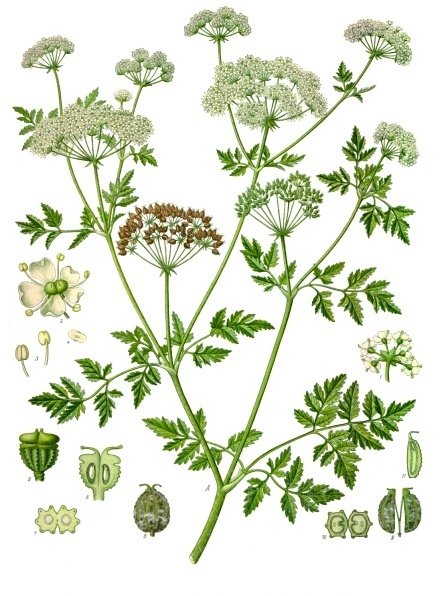
Hazel (Corylus avellana) · The Hand of Glory (holding a candle made from the fat of a hanged man) · Hemlock (Conium maculatum, of the carrot family) · Hamech, confection of (senna, polypody, and colocynth, among many other purgatives) · Hemp (Cannabis sativa) · Hagstone (A stone with a natural hole worn through it)
Historical description, not medical advice.