
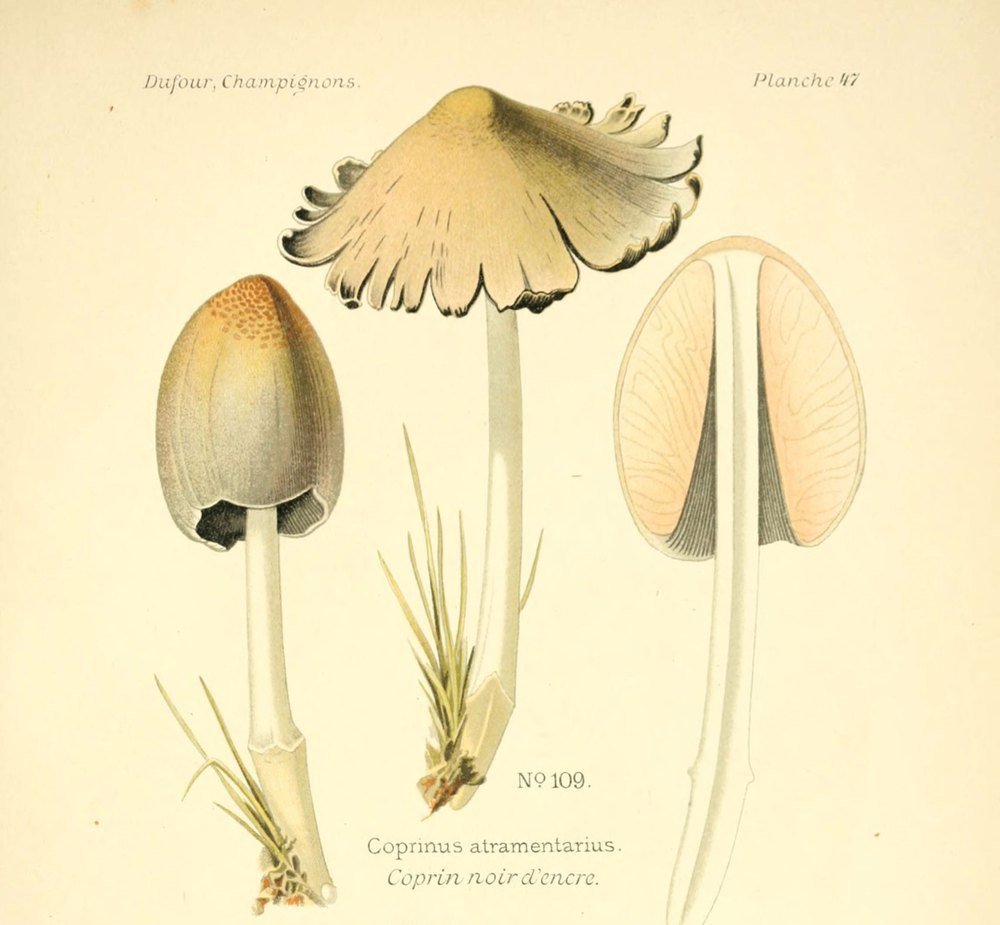
Common ink cap
Coprinopsis atramentaria
- Known today as
- A grey mushroom that dissolves into black ink as it ages.
- Kind
- Fungus
- Constituents
- coprine
- Poisoning
- Coprine and alcohol
- In other databases
- GBIF search · Wikidata search
Revised October 3, 2026: Checked against its sources, each read in full, in part, or in its abstract. Version 1, first published September 25, 2026.
Caution. Poisonous with alcohol, even days later.
Common ink cap: what was it used for?
Its black liquid was once used as ink.
Common ink cap: what does modern science say?
Its coprine blocks the breakdown of alcohol, as the drug disulfiram does, so that a drink taken days after eating it brings flushing, nausea, and a racing heart.
Common ink cap: is it poisonous?
Yes, in some form or dose. Poisonous with alcohol, even days later. Its poisoning is coprine and alcohol: Minutes after drinking alcohol, up to three days after the meal. Historical description, not medical advice; in a poisoning, call a poison centre.
Pharmacognosy & Toxicology
- Constituents
- Mechanism
- Coprine’s metabolite blocks aldehyde dehydrogenase, so alcohol builds up as acetaldehyde.
- Toxic dose
- Any amount, with alcohol, within about three days.
- Syndrome
- Coprine and alcohol
- Standing
- Edible without alcohol.
Constituent names open the compound’s record at PubChem, and “ChEMBL” beside a name opens its record at ChEMBL, the European Bioinformatics Institute’s database of bioactive molecules. Where a mechanism line was checked against ChEMBL (ChEMBL 37, read 1 October 2026), the check is shown with the measured value and its source paper, or says plainly that nothing has been measured. Doses are as the references give them, for description only; this is not medical advice. Each source carries the result of its check against Crossref, PubMed, or the authority’s page: see Verification.
Common ink cap: what lore surrounds it?
“Tippler’s bane”: harmless on its own, it turns cruel with wine.
In Their Own Words
Cooke says that when this mushroom is fully expanded and melting away in inky drops, it is fit for nothing but to replenish the inkstand.
“When fully expanded and melting away in inky drops, it is unfit for anything except to replenish the inkstand.”
M. C. Cooke, A Plain and Easy Account of British Fungi, Coprinus atramentarius, p. 52. London: Robert Hardwicke, 192, Piccadilly, 1862 (Internet Archive OCR text). The text, read in part
Badham says Agaricus atramentarius is as good for ketchup as for the use to which its juices are more commonly put, the making of ink.
“…as good for ketchup as for that purpose to which its juices are more commonly put, viz. — for making ink”
Charles David Badham, M.D., A Treatise on the Esculent Funguses of England, Modes of Distinguishing, p. 37. London: Reeve, Brothers, King William Street, Strand, 1847 (Internet Archive OCR text). The text, read in part
Each passage is quoted from the text named, which the press fetched and read, and was checked word for word against a fresh copy of it; the link opens that copy. Passages are given as printed, without the editors’ footnote numbers, and with words broken across lines joined.
Sources
- Wikipedia, “Coprinopsis atramentaria,” en.wikipedia.org (read 2 October 2026). Read in full · the text read
- Wikipedia, “Coprine,” en.wikipedia.org (read 2 October 2026). Read in full · the text read
Verification
- Checked
- October 1, 2026, and October 3, 2026
- Passes
- Every sentence read against its sources, in the pass over the remaining 343 entries
- The Standing line checked against the authority it names (EMA, WHO, FDA, CITES, Commission E)
- Every dated or regulatory claim checked by category across the database
- Every source read, in full, in part, or in its abstract, and every sentence checked against what was read (October 3, 2026)
- Sources
- 2 cited: 2 read in full.
- Corrections
- None were needed.
What was checked, how, and what was found is set out on the Verification page. A checked source is one whose record was found; it does not make the entry medical advice.
Cite This Entry
Version 1 · first published September 25, 2026 · last revised October 3, 2026
- Chicago
“Common ink cap.” In Materia Medica, edited by B. C. P. Statema. Version 1. The Thinking Press, 2026–. Last modified October 3, 2026. https://thethinkingpress.org/materia-medica/common-ink-cap.
- MLA
“Common ink cap.” Materia Medica, edited by B. C. P. Statema, version 1, The Thinking Press, 3 Oct. 2026, thethinkingpress.org/materia-medica/common-ink-cap. Accessed 8 Oct. 2026.
- APA
Common ink cap. (2026, October 3). In B. C. P. Statema (Ed.), Materia medica (Version 1). The Thinking Press. Retrieved October 8, 2026, from https://thethinkingpress.org/materia-medica/common-ink-cap
Club members keep entries on a shelf with private notes, print the plates as cards, and receive an entry by email each week. Create a free account before January 1, 2027 and all of it is yours for good. About the Club
See Also
Drawing on the same sources: Wikipedia
Compound fumitory · Cochia pills · Confection of alkermes · the bibliography →
Nearby in the alphabet
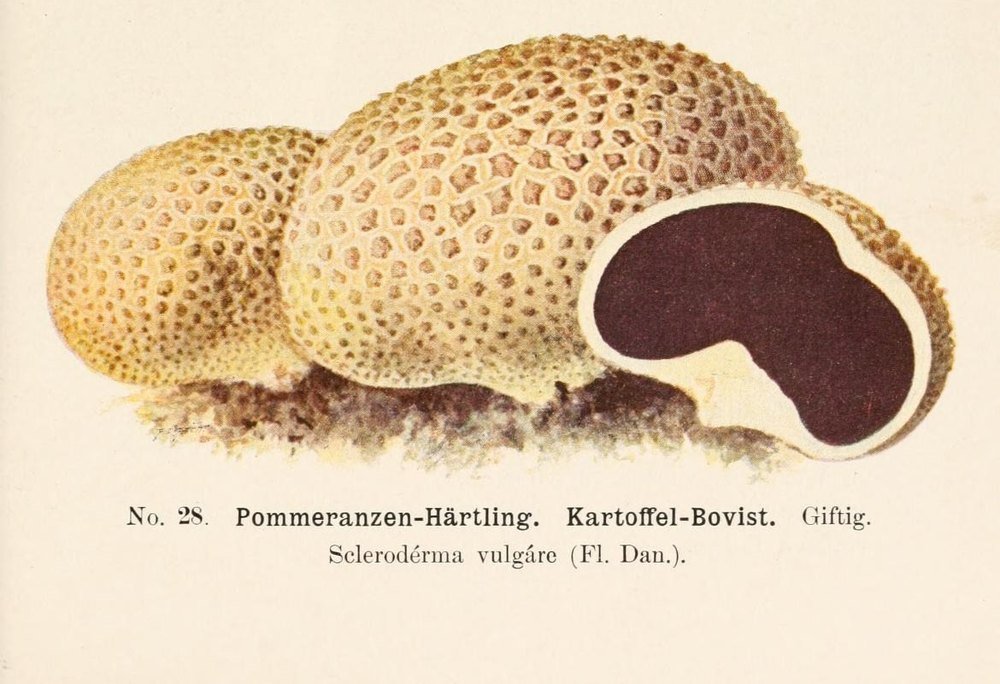
Common earthball (yellow-brown ball with a black interior, of acid woodland) · Concealed shoes · Comfrey (Symphytum officinale) · Coltsfoot (Tussilago farfara) · Confection of hyacinth (sapphire, emerald, and other stones, with coral, pearls, and gold) · Colocynth (The dried pulp of Citrullus colocynthis)
_(6358024203).jpg)
Historical description, not medical advice.