
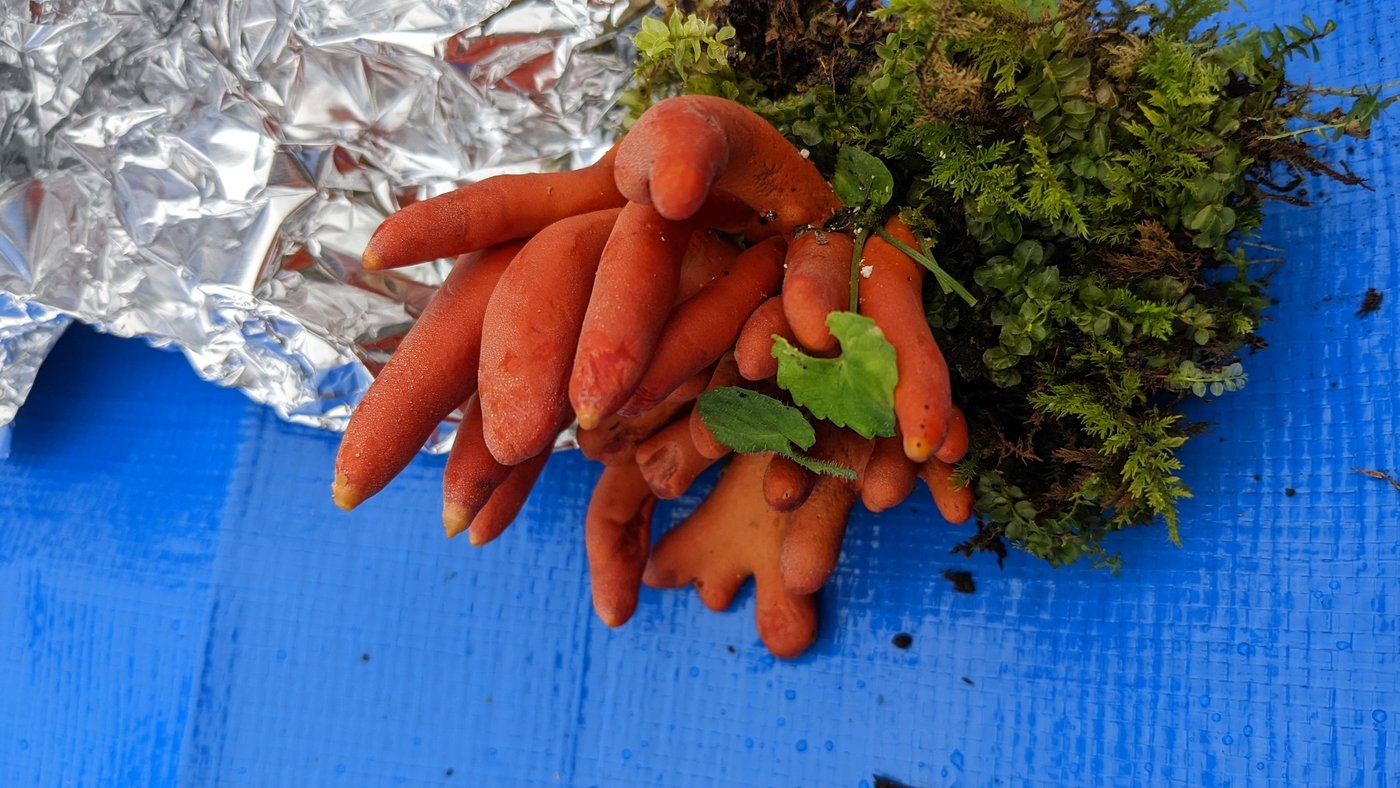
Poison fire coral
Trichoderma cornu-damae (formerly Podostroma)
- Known today as
- A red, finger-like fungus of Japan, Korea, and Southeast Asia.
- Kind
- Fungus
- Constituents
- satratoxin H, roridin E, verrucarin J
- Poisoning
- Mycotoxins of the moulds
- In other databases
- GBIF search · Wikidata search
Deadly. Deadly; the juice irritates the skin.
Poison fire coral: what was it used for?
None; mistaken for medicinal “caterpillar” fungi and steeped in liquor, with fatal results.
Poison fire coral: what does modern science say?
Its trichothecene toxins cause organ failure, hair loss, and shedding skin; deaths have been recorded in Japan and Korea.
Poison fire coral: is it poisonous?
Yes, and it can kill. Deadly; the juice irritates the skin. Its poisoning is mycotoxins of the moulds: Hours for an acute dose; years for the cancers. Historical description, not medical advice; in a poisoning, call a poison centre.
Pharmacognosy & Toxicology
- Constituents
- satratoxin Ha trichothecene
- roridin E ChEMBL
- verrucarin J ChEMBL
- Mechanism
- The trichothecenes block protein synthesis in every dividing cell: the marrow, the gut lining, and the skin, which it burns on touch.
- Toxic dose
- A piece the size of a fingertip has killed; it is the only fungus known to poison through the skin.
- Syndrome
- Mycotoxins of the moulds
- Standing
- None; found in Australia for the first time in 2019.
- Saikawa, Y., et al. (2001). “Toxic principles of a poisonous mushroom Podostroma cornu-damae.” Tetrahedron 57. Verified against its record · doi:10.1016/s0040-4020(01)00824-9
Constituent names open the compound’s record at PubChem, and “ChEMBL” beside a name opens its record at ChEMBL, the European Bioinformatics Institute’s database of bioactive molecules. Where a mechanism line was checked against ChEMBL (ChEMBL 37, read 1 October 2026), the check is shown with the measured value and its source paper, or says plainly that nothing has been measured. Doses are as the references give them, for description only; this is not medical advice. Each source carries the result of its check against Crossref, PubMed, or the authority’s page: see Verification.
Poison fire coral: what lore surrounds it?
One of the few fungi said to be dangerous even to handle.
Sources
- Benjamin, D. R. (1995). Mushrooms: Poisons and Panaceas. Verified against its record · doi:10.1016/0165-6147(96)81595-1
- Japanese public-health warnings on kaentake. Book, not indexed
Verification
- Checked
- October 1, 2026
- Passes
- Every sentence read against its sources, in the pass over the remaining 343 entries
- The Standing line checked against the authority it names (EMA, WHO, FDA, CITES, Commission E)
- Every dated or regulatory claim checked by category across the database
- Sources
- 3 cited: 2 verified against its record, 1 book, not indexed.
- Corrections
- None were needed.
What was checked, how, and what was found is set out on the Verification page. A checked source is one whose record was found; it does not make the entry medical advice.
Cite This Entry
Version 1 · first published September 25, 2026
- Chicago
“Poison fire coral.” In Materia Medica, edited by B. C. P. Statema. Version 1. The Thinking Press, 2026–. Last modified September 25, 2026. https://thethinkingpress.org/materia-medica/poison-fire-coral.
- MLA
“Poison fire coral.” Materia Medica, edited by B. C. P. Statema, version 1, The Thinking Press, 25 Sept. 2026, thethinkingpress.org/materia-medica/poison-fire-coral. Accessed 8 Oct. 2026.
- APA
Poison fire coral. (2026, September 25). In B. C. P. Statema (Ed.), Materia medica (Version 1). The Thinking Press. Retrieved October 8, 2026, from https://thethinkingpress.org/materia-medica/poison-fire-coral
Club members keep entries on a shelf with private notes, print the plates as cards, and receive an entry by email each week. Create a free account before January 1, 2027 and all of it is yours for good. About the Club
See Also
Poisoned alike: mycotoxins of the moulds
Winter-grain mould · Aflatoxin mould · the syndrome, with all of them →
Drawing on the same sources: Benjamin
Nearby in the alphabet
Pokeweed (the American pokeweed) · Plantain (Plantago major) · Polypody of mercurialis, syrup of · Pilgrim badges and ampullae · Pomander (of ambergris, musk, civet, and spices, carried in a pierced case) · Pilewort · Pomegranate (Punica granatum) · Periwinkle (the lesser periwinkle, a trailing evergreen with blue flowers)

Historical description, not medical advice.