
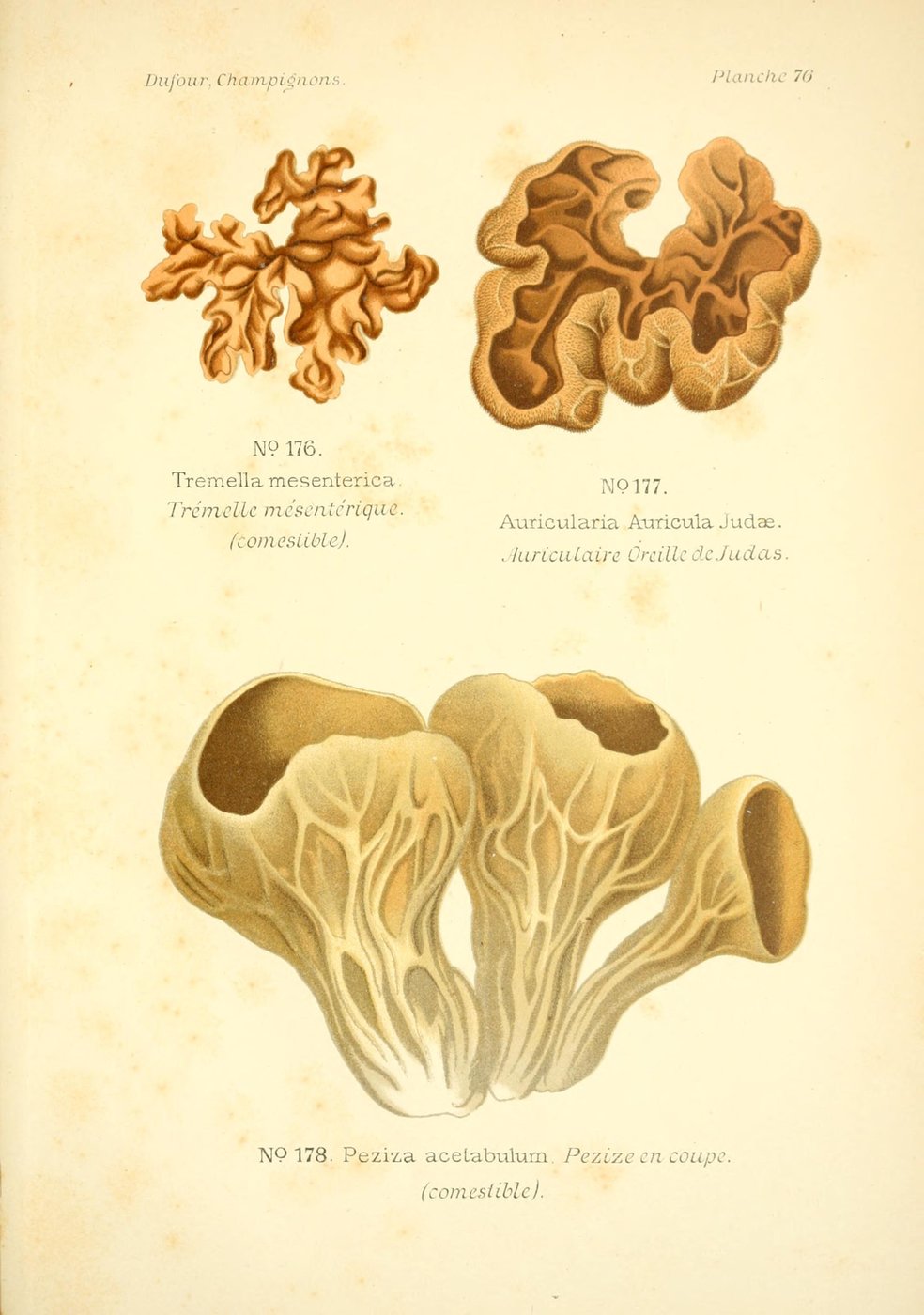
Jelly ear
Auricularia auricula-judae; Judas’s ear, wood ear
- Known today as
- A brown, rubbery, ear-shaped fungus, chiefly on elder.
- Kind
- Fungus
- Constituents
- polysaccharides, an anticoagulant polysaccharide
- In other databases
- GBIF search · Wikidata search
Revised October 3, 2026: Checked against its sources, each read in full, in part, or in its abstract. Version 1, first published September 25, 2026.
Jelly ear: what was it used for?
Seventeenth-century English herbalists boiled it in milk against sore throats; a related wood ear is a common food in East Asia.
Jelly ear: what does modern science say?
Its polysaccharides delay clotting and platelet aggregation in laboratory tests.
Pharmacognosy & Toxicology
- Constituents
- polysaccharidesincluding beta-glucans
- an anticoagulant polysaccharide
- Mechanism
- A food in East Asia and a sore-throat remedy in old England. In 1980 Hammerschmidt reported, as “Szechwan purpura,” an Oriental tonic food that briefly stopped the platelets from clumping and caused a mild bleeding tendency; polysaccharides of Auricularia delay clotting and platelet aggregation in laboratory tests.
- Hammerschmidt, D. E. (1980). “Szechwan purpura.” New England Journal of Medicine 302. Abstract read · the text read
The abstract of each source, beneath its citation. For Club members. About the Club or sign in.
Constituent names open the compound’s record at PubChem, and “ChEMBL” beside a name opens its record at ChEMBL, the European Bioinformatics Institute’s database of bioactive molecules. Where a mechanism line was checked against ChEMBL (ChEMBL 37, read 1 October 2026), the check is shown with the measured value and its source paper, or says plainly that nothing has been measured. Doses are as the references give them, for description only; this is not medical advice. Each source carries the result of its check against Crossref, PubMed, or the authority’s page: see Verification.
Jelly ear: what lore surrounds it?
Legend says Judas hanged himself on an elder tree, and the ears that grow on its branches are his.
In Their Own Words
Culpeper says Jew's-ears boiled in milk and drunk help sore throats.
“Jew’s-ears boiled in milk and drank, helps sore throats. Moss is cold, dry, and binding, therefore good for fluxes of all sorts.”
Nicholas Culpeper, The Complete Herbal, The College's simples, things bred of plants. London: Thomas Kelly, 17, Paternoster Row, MDCCCL (Project Gutenberg eBook #49513). The text, read in part
Cooke says that the Jew's ear was formerly supposed to possess great virtues, which were by his time discredited.
“In former times the Jew's ear (Hirneola auricula Judæ, Fr.) was supposed to possess great virtues, which are now discredited.”
M. C. Cooke, M.A., LL.D.; edited by the Rev. M. J. Berkeley, Fungi: Their Nature and Uses, Chapter IV, Uses. New York: D. Appleton and Company, 1875 (The International Scientific Series, vol. XV; Project Gutenberg eBook #30181). The text, read in part
McIlvaine says it is used extensively in China, where it is brought dried from Tahiti in great quantities and made into soup.
“Extensively used in China, where eating it probably antedates all European records by several thousand years. It is brought there dried from Tahiti in great quantities and made into soup.”
Charles McIlvaine and Robert K. Macadam, Toadstools, Mushrooms, Fungi, Edible and Poisonous; One Thousand American Fungi, Hirneola auricula-Judæ, species entry. Revised edition; Indianapolis: The Bowen-Merrill Company, copyright 1900, 1902 (Project Gutenberg eBook #51393). The text, read in part
Each passage is quoted from the text named, which the press fetched and read, and was checked word for word against a fresh copy of it; the link opens that copy. Passages are given as printed, without the editors’ footnote numbers, and with words broken across lines joined.
Sources
- Grieve, M. (1931). A Modern Herbal. Read in part · the text read
- Culpeper, N. (1653). Pharmacopoeia Londinensis: or the London Dispensatory. London: Peter Cole. Text Creation Partnership edition A35381. Read in part · the text read
- Liu, M., et al. (2025). Sustainable cultivation and functional bioactive compounds of Auricularia mushrooms: advances, challenges, and future prospects. Biology (Basel) 14: 1555. Read in full · the text read
Verification
- Checked
- October 1, 2026, and October 3, 2026
- Passes
- Every sentence read against its sources, in the pass over the remaining 343 entries
- Every dated or regulatory claim checked by category across the database
- Every source read, in full, in part, or in its abstract, and every sentence checked against what was read (October 3, 2026)
- Sources
- 4 cited: 1 read in full, 2 read in part, 1 abstract read. 1 with the abstract on file.
- Corrections
- None were needed.
What was checked, how, and what was found is set out on the Verification page. A checked source is one whose record was found; it does not make the entry medical advice.
Cite This Entry
Version 1 · first published September 25, 2026 · last revised October 3, 2026
- Chicago
“Jelly ear.” In Materia Medica, edited by B. C. P. Statema. Version 1. The Thinking Press, 2026–. Last modified October 3, 2026. https://thethinkingpress.org/materia-medica/jelly-ear.
- MLA
“Jelly ear.” Materia Medica, edited by B. C. P. Statema, version 1, The Thinking Press, 3 Oct. 2026, thethinkingpress.org/materia-medica/jelly-ear. Accessed 8 Oct. 2026.
- APA
Jelly ear. (2026, October 3). In B. C. P. Statema (Ed.), Materia medica (Version 1). The Thinking Press. Retrieved October 8, 2026, from https://thethinkingpress.org/materia-medica/jelly-ear
Club members keep entries on a shelf with private notes, print the plates as cards, and receive an entry by email each week. Create a free account before January 1, 2027 and all of it is yours for good. About the Club
See Also
Sharing polysaccharides
Drawing on the same sources: Grieve, Culpeper, Liu
Juniper · Jalap · Lady’s mantle · Indian and Arabian pills · Orpiment and realgar · Cinnabar · the bibliography →
Nearby in the alphabet
Jet, oil of (a dense variety of lignite) · James’s powder (secret in its making) · Jewelweed · Juneberry · Jack-o’-lantern · Iva (Ajuga iva)
_BHL3270624.jpg)
Historical description, not medical advice.