
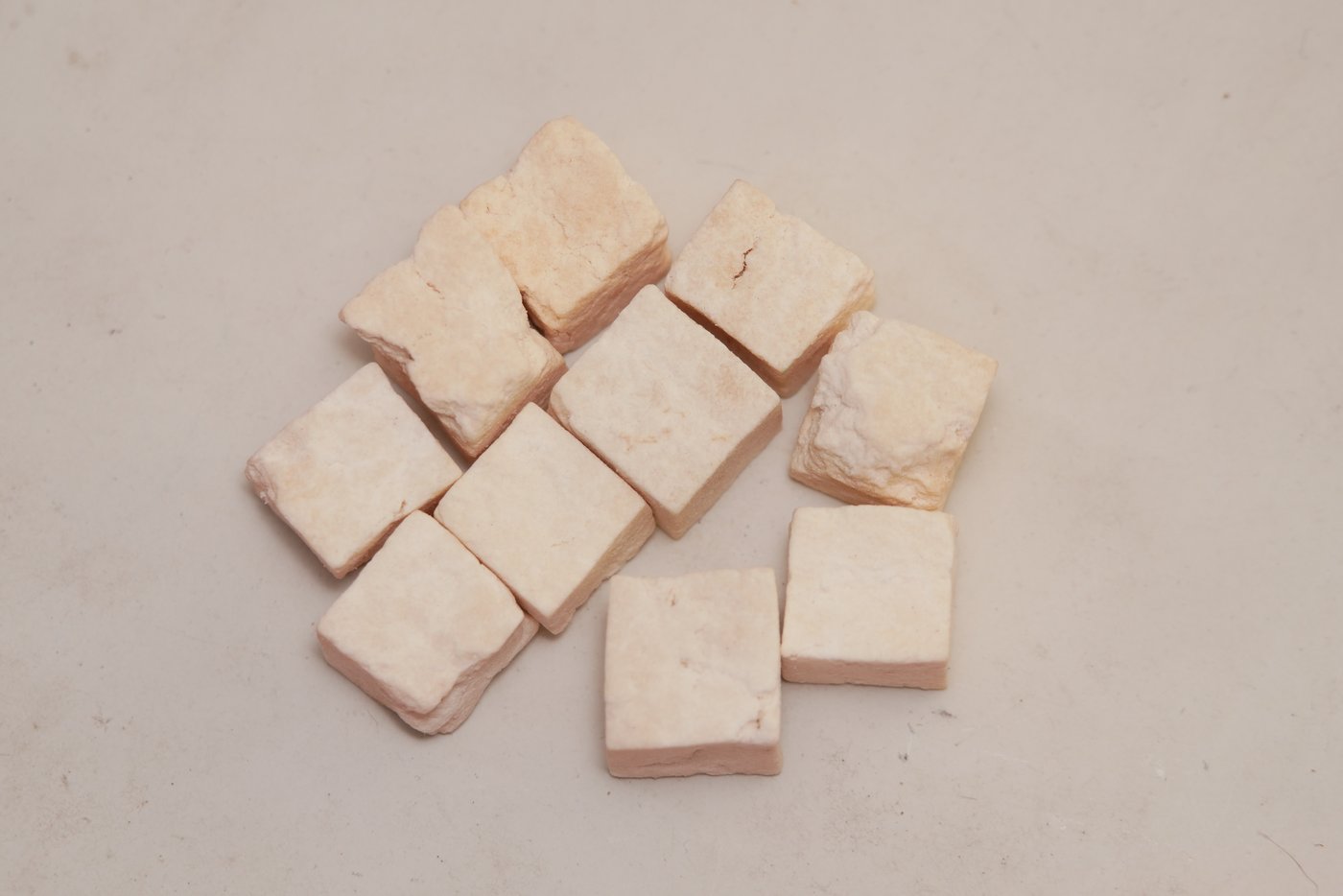
Fu ling
Wolfiporia extensa (Poria cocos); poria, hoelen
- Known today as
- A large underground mass like a small coconut, the sclerotium of a fungus that grows on pines.
- Kind
- Fungus
- Constituents
- pachymic acid, polysaccharides, 3-epidehydrotumulosic acid
- In other databases
- GBIF search · Wikidata search
Revised October 3, 2026: Checked against its sources, each read in full, in part, or in its abstract. Version 1, first published September 25, 2026.
Fu ling: what was it used for?
Used extensively in Chinese medicine, to promote urination, strengthen the spleen, and calm the mind.
Fu ling: what does modern science say?
Little clinical evidence.
Pharmacognosy & Toxicology
- Constituents
- pachymic acid ChEMBLa triterpenoid
- polysaccharideswhich potentiate the immune response in the laboratory
- 3-epidehydrotumulosic acid
- Mechanism
- The sclerotium of a fungus of pines: its triterpenes are anti-inflammatory in experimental models and inhibit phospholipase A2, and its polysaccharides potentiate the immune response in the laboratory; it is used as a diuretic, sedative and tonic, but there are too few clinical studies to establish its efficacy and safety.
- Toxic dose
- Its safety has not been established by clinical studies.
- Standing
- A traditional medicine of China and Japan; no use established by clinical trials.
- Ríos, J.-L. (2011). “Chemical constituents and pharmacological properties of Poria cocos.” Planta Medica 77. Abstract read · the text read
The abstract of each source, beneath its citation. For Club members. About the Club or sign in.
Constituent names open the compound’s record at PubChem, and “ChEMBL” beside a name opens its record at ChEMBL, the European Bioinformatics Institute’s database of bioactive molecules. Where a mechanism line was checked against ChEMBL (ChEMBL 37, read 1 October 2026), the check is shown with the measured value and its source paper, or says plainly that nothing has been measured. Doses are as the references give them, for description only; this is not medical advice. Each source carries the result of its check against Crossref, PubMed, or the authority’s page: see Verification.
Fu ling: what lore surrounds it?
Listed among the superior drugs of the Divine Farmer’s Classic.
In Their Own Words
Stuart records that the Chinese considered fu-ling peptic, nutrient, diuretic and quieting, especially in children's nervous disorders, and prescribed it in wasting diseases.
“Medicinally, it is considered to be peptic, nutrient, diuretic, and quieting, especially in the nervous disorders of children. It is prescribed in wasting diseases.”
G. A. Stuart, Chinese Materia Medica: Vegetable Kingdom, Pachyma cocos (Fu-ling), p. 298. Internet Archive OCR text of the University of Toronto copy (catalogue date 1911). The text, read in part
Stuart says it was ground, mixed with rice flour and made into small square cakes sold hot by street hawkers in the cities of the central provinces.
“In China it is ground up, mixed with rice flour, and made into small square cakes, which are sold hot by hawkers on the streets of most cities in the Central provinces.”
G. A. Stuart, Chinese Materia Medica: Vegetable Kingdom, Pachyma cocos (Fu-ling), p. 298. Internet Archive OCR text of the University of Toronto copy (catalogue date 1911). The text, read in part
McIlvaine describes the American Tuckahoe (Pachyma cocos) as attached to tree roots several feet underground, growing to the size of a man's head, with a coarse brown covering like a coconut.
“It is usually found attached to the roots of trees, in low marshy places. It grows several feet below the surface, and to the size of a man’s head. It varies in shape, being oblong or round, having a coarse brown covering, looking like a cocoanut.”
Charles McIlvaine and Robert K. Macadam, Toadstools, Mushrooms, Fungi, Edible and Poisonous; One Thousand American Fungi, Pachyma cocos (Tuckahoe), Plate CLV. Revised edition; Indianapolis: The Bowen-Merrill Company, copyright 1900, 1902 (Project Gutenberg eBook #51393). The text, read in part
Each passage is quoted from the text named, which the press fetched and read, and was checked word for word against a fresh copy of it; the link opens that copy. Passages are given as printed, without the editors’ footnote numbers, and with words broken across lines joined.
Sources
- Shennong bencao jing (Han dynasty). Read in part · the text read
- Wikipedia contributors. “Wolfiporia cocos.” Wikipedia, The Free Encyclopedia. en.wikipedia.org/wiki/Wolfiporia_cocos (read 2 October 2026). Read in full · the text read
Verification
- Checked
- October 1, 2026, and October 3, 2026
- Passes
- Every sentence read against its sources, in the pass over the remaining 343 entries
- The Standing line checked against the authority it names (EMA, WHO, FDA, CITES, Commission E)
- Every dated or regulatory claim checked by category across the database
- Every source read, in full, in part, or in its abstract, and every sentence checked against what was read (October 3, 2026)
- Sources
- 3 cited: 1 read in full, 1 read in part, 1 abstract read. 1 with the abstract on file.
- Corrections
- None were needed.
What was checked, how, and what was found is set out on the Verification page. A checked source is one whose record was found; it does not make the entry medical advice.
Cite This Entry
Version 1 · first published September 25, 2026 · last revised October 3, 2026
- Chicago
“Fu ling.” In Materia Medica, edited by B. C. P. Statema. Version 1. The Thinking Press, 2026–. Last modified October 3, 2026. https://thethinkingpress.org/materia-medica/fu-ling.
- MLA
“Fu ling.” Materia Medica, edited by B. C. P. Statema, version 1, The Thinking Press, 3 Oct. 2026, thethinkingpress.org/materia-medica/fu-ling. Accessed 8 Oct. 2026.
- APA
Fu ling. (2026, October 3). In B. C. P. Statema (Ed.), Materia medica (Version 1). The Thinking Press. Retrieved October 8, 2026, from https://thethinkingpress.org/materia-medica/fu-ling
Club members keep entries on a shelf with private notes, print the plates as cards, and receive an entry by email each week. Create a free account before January 1, 2027 and all of it is yours for good. About the Club
See Also
Sharing polysaccharides
Nearby in the alphabet
Funeral bell (A small brown mushroom of rotting wood) · Friar’s balsam (storax, balsam of tolu, and aloes, in spirit) · Galangal (Alpinia officinarum) · Frankincense (The resin of Boswellia sacra and related trees) · Galbanum (Gum resin of Ferula gummosa) · Fox’s heart (The dried heart of a fox) · Gallia moschata (made into troches of aloeswood, ambergris, and musk) · Foxglove (Digitalis purpurea)

Historical description, not medical advice.