
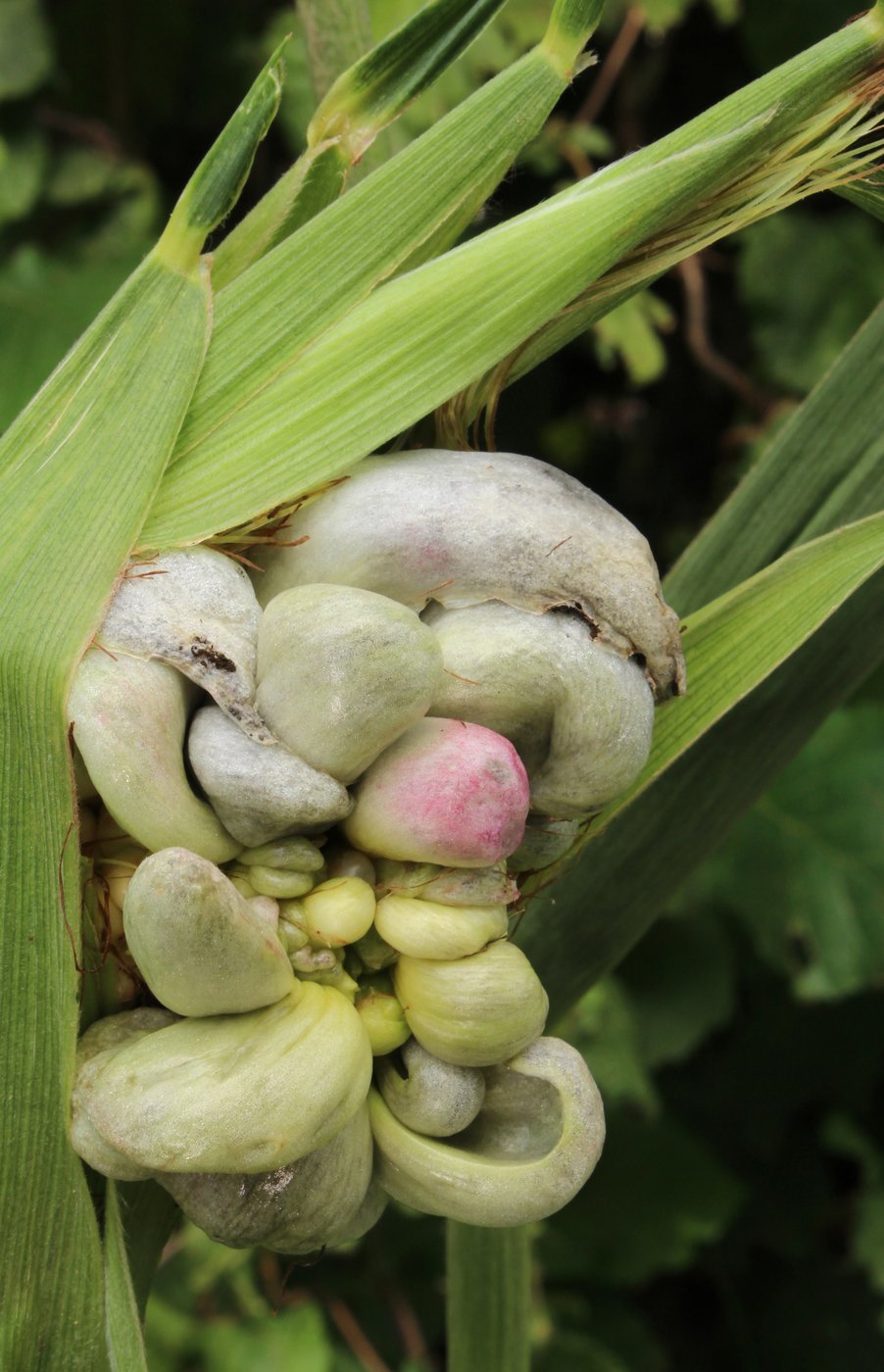
Corn smut
Ustilago maydis; Mexican huitlacoche, from Nahuatl
- Known today as
- A fungus that swells the kernels of maize into galls filled with blue-black spores.
- Kind
- Fungus
- Constituents
- ustilagic acid, lysine, beta-glucans
- In other databases
- GBIF search · Wikidata search
Revised October 17, 2026: Checked against its sources, each read in full, in part, or in its abstract. Version 1, first published September 25, 2026.
Corn smut: what was it used for?
A delicacy in Mexico since Aztec times.
Corn smut: what does modern science say?
Edible and nutritious.
The toxic dose and the poisoning
- Toxic dose
- A food.
The references for these lines are listed under Pharmacognosy, in Science. Doses are as the references give them, for description only; this is not medical advice. In a poisoning, call a poison centre.
Corn smut: what lore surrounds it?
What farmers elsewhere destroy as a blight, Mexico sells as a delicacy.
In Their Own Words
Cooke's Handbook describes maize smut as produced on the stems and germens, bursting the epidermis, with minute, spherical, brownish-black, warted spores.
“Produced on the stems, germens, &c.; epidermis at length bursting; spores spherical, minute, brownish-black, surface covered with echinulate warts.”
M. C. Cooke, M.A., Handbook of British Fungi, with full descriptions of all the species, and illustrations of the genera, no. 1525, Ustilago maydis, 'Maize Smut'. London and New York: Macmillan and Co., 1871 (Internet Archive OCR text). The text, read in part
Each passage is quoted from the text named, which the press fetched and read, and was checked word for word against a fresh copy of it; the link opens that copy. Passages are given as printed, without the editors’ footnote numbers, and with words broken across lines joined.
Pharmacognosy
- Constituents
- ustilagic acid
- lysine ChEMBLhigh, in the galls
- beta-glucans
- Mechanism
- The galls on maize, eaten young as huitlacoche, are a food rich in lysine, which maize itself has little of. Peoples of the American Southwest, the Zuni among them, used it to bring on labour, and it is said to act like ergot, but more weakly.
- Standing
- A delicacy of Mexican cooking; a research organism in fungal genetics.
- Valverde, M. E., et al. (1995). “Huitlacoche (Ustilago maydis) as a food source: biology, composition, and production.” Critical Reviews in Food Science and Nutrition 35. Abstract read · the text read
The abstract of each source, beneath its citation. For Club members. About the Club or sign in.
Constituent names open the compound’s record at PubChem, and “ChEMBL” beside a name opens its record at ChEMBL, the European Bioinformatics Institute’s database of bioactive molecules. Where a mechanism line was checked against ChEMBL (ChEMBL 37, read 1 October 2026), the check is shown with the measured value and its source paper, or says plainly that nothing has been measured. Doses are as the references give them, for description only; this is not medical advice. Each source carries the result of its check against Crossref, PubMed, or the authority’s page: see Verification.
Sources
- Wikipedia, “Corn smut,” en.wikipedia.org (read 2 October 2026). Read in full · the text read
Verification
- Checked
- October 1, 2026, October 17, 2026
- Passes
- Read against its sources in the pass over the remaining 343 entries
- Every dated or regulatory claim checked by category across the database
- Every source read, in full, in part, or in its abstract, and every sentence checked against what was read (October 17, 2026)
- Sources
- 2 cited: 1 read in full, 1 abstract read. 1 with the abstract on file.
- Corrections
- None recorded.
What was checked, how, and what was found is set out on the Verification page. A checked source is one whose record was found; it does not make the entry medical advice.
Club members can point at a technical term in this entry, such as a constituent, an action, or a word of Jung’s, to read its definition from the source. The Club.
Cite This Entry
Version 1 · first published September 25, 2026 · last revised October 17, 2026
- Chicago
“Corn smut.” In Materia Medica, edited by B. C. P. Statema. Version 1. The Thinking Press, 2026–. Last modified October 17, 2026. https://thethinkingpress.org/materia-medica/corn-smut.
- MLA
“Corn smut.” Materia Medica, edited by B. C. P. Statema, version 1, The Thinking Press, 17 Oct. 2026, thethinkingpress.org/materia-medica/corn-smut. Accessed 22 Nov. 2026.
- APA
Corn smut. (2026, October 17). In B. C. P. Statema (Ed.), Materia medica (Version 1). The Thinking Press. Retrieved November 22, 2026, from https://thethinkingpress.org/materia-medica/corn-smut
See Also
Sharing beta-glucans
Drawing on the same sources: Wikipedia
Cyclosporin fungus · Confection of hyacinth · Cyprus powder · the bibliography →
Nearby in the alphabet
Cornicello · Corn silk (The silk of the maize ear) · Couch grass · Coriander (seed and leaf) · Cowslip (Primula veris) · Cordial flowers and fruits · Crabs’ eyes (Chalky stones from the stomachs of crayfish) · Coral, red (Corallium rubrum, of the western Mediterranean, prepared as powder)
Historical description, not medical advice.

