
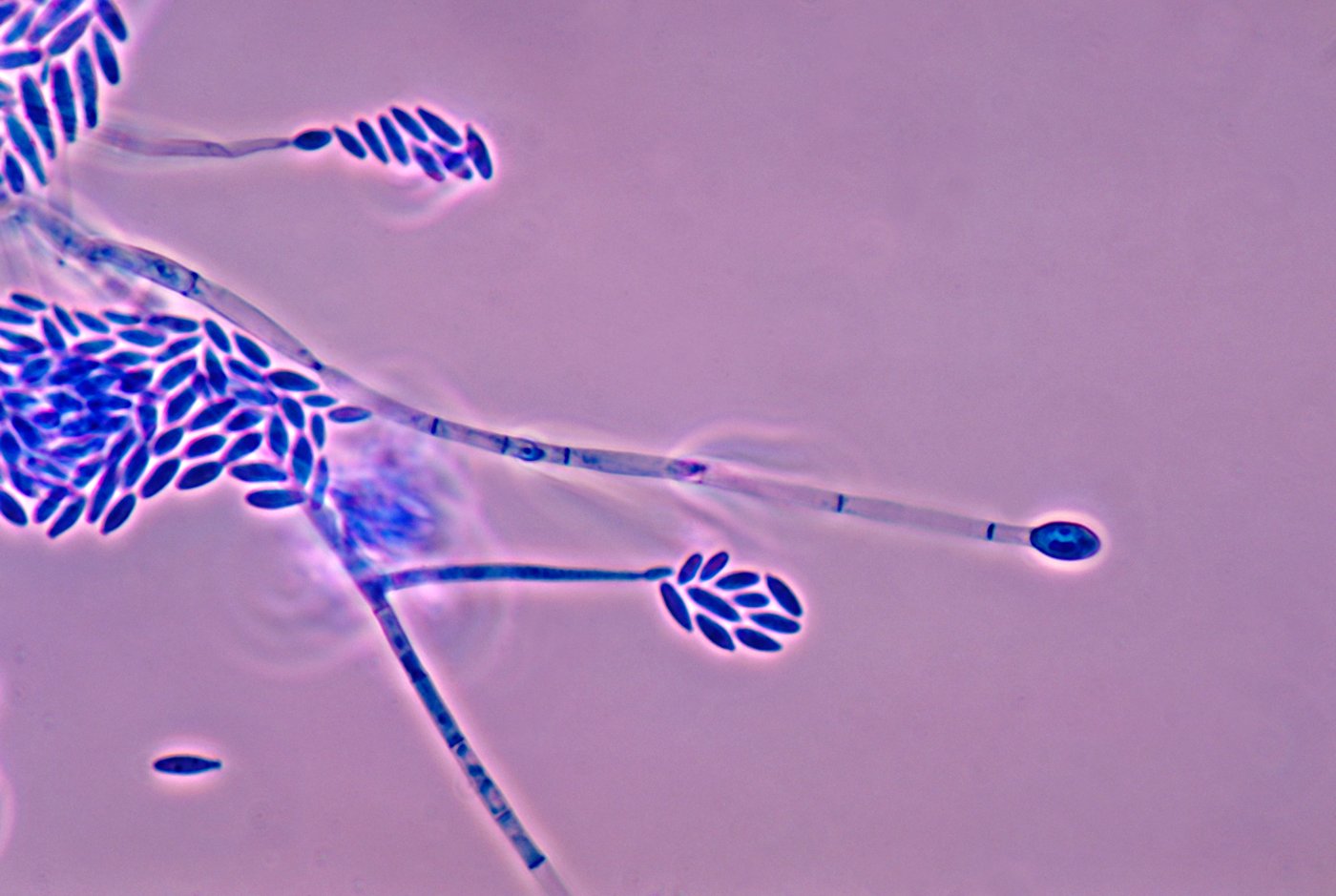
Winter-grain mould
Fusarium sporotrichioides and relatives
- Known today as
- Pink and white moulds of grain left in the field over winter.
- Kind
- Fungus
- Constituents
- T-2 toxin, deoxynivalenol, fumonisin B1, and 1 more
- Poisoning
- Mycotoxins of the moulds
- In other databases
- GBIF search · Wikidata search
Revised October 3, 2026: Checked against its sources, each read in full, in part, or in its abstract. Version 1, first published September 25, 2026.
Deadly. Historical description only.
Winter-grain mould: what was it used for?
None.
Winter-grain mould: what does modern science say?
Its T-2 toxin destroys the bone marrow and the lining of the gut.
Winter-grain mould: is it poisonous?
Yes, and it can kill. Its poisoning is mycotoxins of the moulds: Hours for an acute dose; years for the cancers. Historical description, not medical advice; in a poisoning, call a poison centre.
Pharmacognosy & Toxicology
- Constituents
- T-2 toxin ChEMBLa trichothecene
- deoxynivalenol ChEMBLvomitoxin
- fumonisin B1
- zearalenone ChEMBLan oestrogen mimic
- Mechanism
- The trichothecenes block protein synthesis; fumonisins disrupt sphingolipid metabolism, and the fungus that makes them was the commonest in the home-grown maize of a South African region with much oesophageal cancer.
- Toxic dose
- Overwintered grain in Orenburg in the 1940s killed, by one report, a tenth of the population of the area.
- Syndrome
- Mycotoxins of the moulds
- Standing
- The US Food and Drug Administration restricts deoxynivalenol to 1 part per million; the WHO and the European Commission’s Scientific Committee on Food have set a tolerable daily intake for the fumonisins.
- Marasas, W. F. O. (2001). “Discovery and occurrence of the fumonisins: a historical perspective.” Environmental Health Perspectives 109. Abstract read · the text read
The abstract of each source, beneath its citation. For Club members. About the Club or sign in.
Constituent names open the compound’s record at PubChem, and “ChEMBL” beside a name opens its record at ChEMBL, the European Bioinformatics Institute’s database of bioactive molecules. Where a mechanism line was checked against ChEMBL (ChEMBL 37, read 1 October 2026), the check is shown with the measured value and its source paper, or says plainly that nothing has been measured. Doses are as the references give them, for description only; this is not medical advice. Each source carries the result of its check against Crossref, PubMed, or the authority’s page: see Verification.
Winter-grain mould: what lore surrounds it?
In the hunger of the Second World War, when the harvest was delayed, people in the Orenburg region of the Soviet Union ate grain that had lain in the fields over winter; many thousands died of alimentary toxic aleukia.
Sources
- Wikipedia contributors. “Fusarium sporotrichioides.” Wikipedia, The Free Encyclopedia. en.wikipedia.org/wiki/Fusarium_sporotrichioides (read 2 October 2026). Read in full · the text read
- Wikipedia contributors. “Alimentary toxic aleukia.” Wikipedia, The Free Encyclopedia. en.wikipedia.org/wiki/Alimentary_toxic_aleukia (read 2 October 2026). Read in full · the text read
- Wikipedia contributors. “T-2 mycotoxin.” Wikipedia, The Free Encyclopedia. en.wikipedia.org/wiki/T-2_mycotoxin (read 2 October 2026). Read in full · the text read
- Wikipedia contributors. “Vomitoxin.” Wikipedia, The Free Encyclopedia. en.wikipedia.org/wiki/Vomitoxin (read 2 October 2026). Read in full · the text read
Verification
- Checked
- October 1, 2026, and October 3, 2026
- Passes
- Every sentence read against its sources, in the fifty-entry sample
- The Standing line checked against the authority it names (EMA, WHO, FDA, CITES, Commission E)
- Every dated or regulatory claim checked by category across the database
- Every source read, in full, in part, or in its abstract, and every sentence checked against what was read (October 3, 2026)
- Sources
- 5 cited: 4 read in full, 1 abstract read. 1 with the abstract on file.
- Corrections
- "killed a tenth of the population of some districts" checked and kept (reported as 10 per cent of the population in some localities).
What was checked, how, and what was found is set out on the Verification page. A checked source is one whose record was found; it does not make the entry medical advice.
Cite This Entry
Version 1 · first published September 25, 2026 · last revised October 3, 2026
- Chicago
“Winter-grain mould.” In Materia Medica, edited by B. C. P. Statema. Version 1. The Thinking Press, 2026–. Last modified October 3, 2026. https://thethinkingpress.org/materia-medica/fusarium.
- MLA
“Winter-grain mould.” Materia Medica, edited by B. C. P. Statema, version 1, The Thinking Press, 3 Oct. 2026, thethinkingpress.org/materia-medica/fusarium. Accessed 8 Oct. 2026.
- APA
Winter-grain mould. (2026, October 3). In B. C. P. Statema (Ed.), Materia medica (Version 1). The Thinking Press. Retrieved October 8, 2026, from https://thethinkingpress.org/materia-medica/fusarium
Club members keep entries on a shelf with private notes, print the plates as cards, and receive an entry by email each week. Create a free account before January 1, 2027 and all of it is yours for good. About the Club
See Also
Poisoned alike: mycotoxins of the moulds
Aflatoxin mould · Poison fire coral · the syndrome, with all of them →
Nearby in the alphabet
Witch ball (often silvered or colored, hung in the window) · Wild rue (Peganum harmala) · Witch bottle · Wild ginger · Witch marks (Symbols scratched or burned near doors and fireplaces) · Wild garlic (Allium ursinum) · Witches’ butter (Black or yellow jelly fungi that swell on dead branches after rain) · Wild carrot, seed of (Queen Anne’s lace)

Historical description, not medical advice.