
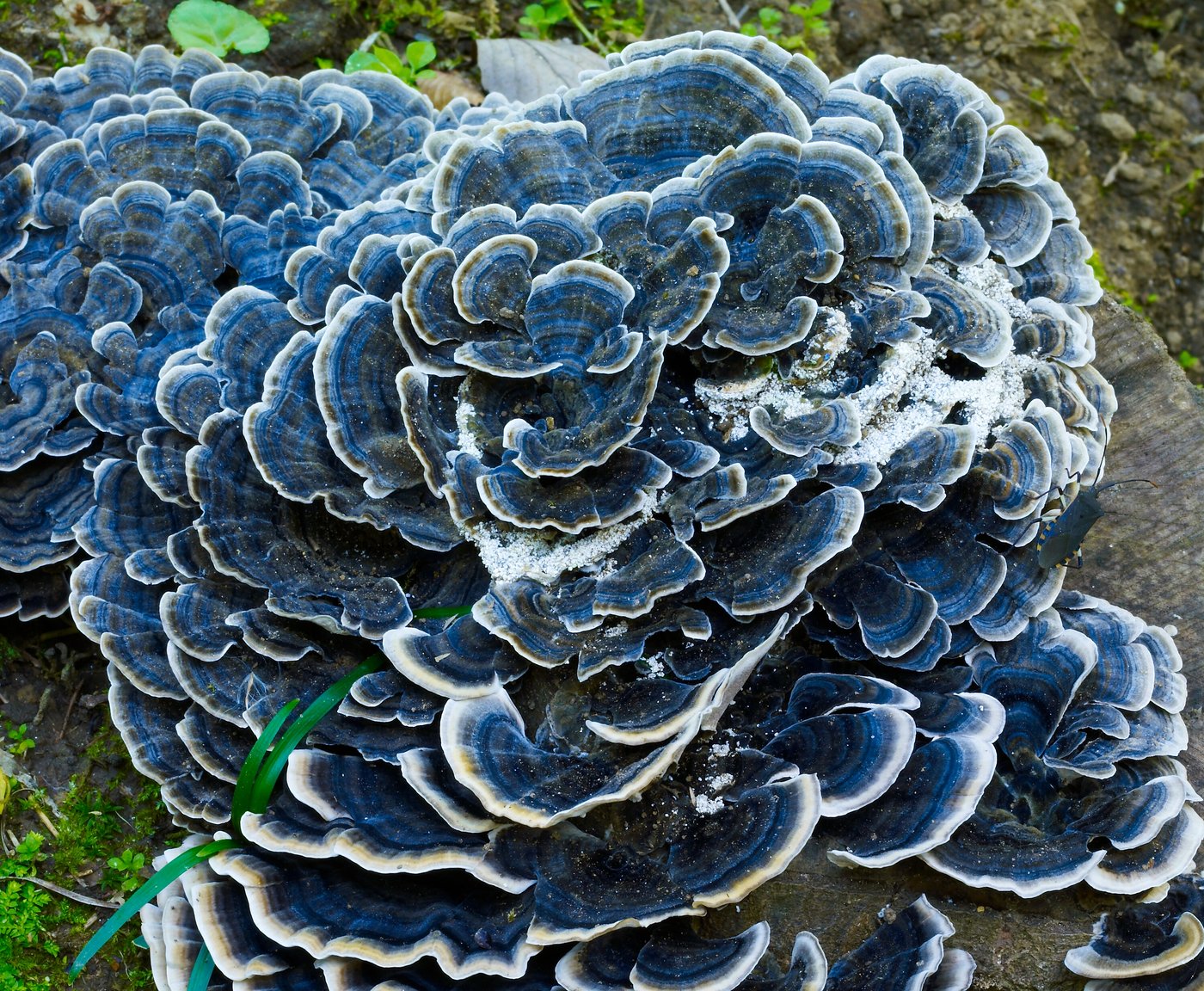
Turkey tail
Trametes versicolor
- Known today as
- A thin, banded bracket of dead wood, common worldwide.
- Kind
- Fungus
- Constituents
- polysaccharide-K, polysaccharopeptide
- In other databases
- GBIF search · Wikidata search
Turkey tail: what was it used for?
A tea in Chinese and Japanese traditional medicine.
Turkey tail: what does modern science say?
A protein-bound polysaccharide extracted from it, PSK, has been used in Japan since the 1970s alongside chemotherapy for some cancers.
Pharmacognosy & Toxicology
- Constituents
- polysaccharide-KPSK, Krestin
- polysaccharopeptidePSP
- Mechanism
- The protein-bound polysaccharides stimulate immune cells in the dish and in mice.
- Toxic dose
- No toxicity reported.
- Standing
- PSK has been approved in Japan since the 1970s as an adjuvant in gastric and colorectal cancer, with trials showing a modest survival benefit beside chemotherapy; not approved elsewhere.
- Oba, K., et al. (2007). “Efficacy of adjuvant immunochemotherapy with polysaccharide K for patients with curative resections of gastric cancer.” Cancer Immunology, Immunotherapy 56. Verified against its record · doi:10.1007/s00262-006-0248-1
Constituent names open the compound’s record at PubChem, and “ChEMBL” beside a name opens its record at ChEMBL, the European Bioinformatics Institute’s database of bioactive molecules. Where a mechanism line was checked against ChEMBL (ChEMBL 37, read 1 October 2026), the check is shown with the measured value and its source paper, or says plainly that nothing has been measured. Doses are as the references give them, for description only; this is not medical advice. Each source carries the result of its check against Crossref, PubMed, or the authority’s page: see Verification.
Turkey tail: what lore surrounds it?
The humblest of brackets, and one of the most studied.
In Their Own Words
Mrs Grieve calls the Striped Stump Flap (Polystictus versicolor) one of the commonest and most beautiful British fungi, a stalkless bracket growing in layers from trunks and stumps, and says it is poisonous.
“The STRIPED STUMP FLAP (Polystictus versicolor), one of our commonest and most beautiful Fungi, is also poisonous. It has no stalk, but grows out horizontally in a bracketlike way, layer upon layer, from trunks and tree-stumps and branches.”
Mrs. M. Grieve, A Modern Herbal: “Fungi”, “Fungi”: the Polypores. The text of A Modern Herbal as published on botanical.com. The text, read in part
Each passage is quoted from the text named, which the press fetched and read, and was checked word for word against a fresh copy of it; the link opens that copy. Passages are given as printed, without the editors’ footnote numbers, and with words broken across lines joined.
Sources
- National Cancer Institute, PDQ: Medicinal Mushrooms. Book, not indexed
Verification
- Checked
- October 1, 2026
- Passes
- Every sentence read against its sources, in the pass over the remaining 343 entries
- The Standing line checked against the authority it names (EMA, WHO, FDA, CITES, Commission E)
- Every dated or regulatory claim checked by category across the database
- Sources
- 2 cited: 1 verified against its record, 1 book, not indexed.
- Corrections
- None were needed.
What was checked, how, and what was found is set out on the Verification page. A checked source is one whose record was found; it does not make the entry medical advice.
Cite This Entry
Version 1 · first published September 25, 2026
- Chicago
“Turkey tail.” In Materia Medica, edited by B. C. P. Statema. Version 1. The Thinking Press, 2026–. Last modified September 25, 2026. https://thethinkingpress.org/materia-medica/turkey-tail.
- MLA
“Turkey tail.” Materia Medica, edited by B. C. P. Statema, version 1, The Thinking Press, 25 Sept. 2026, thethinkingpress.org/materia-medica/turkey-tail. Accessed 8 Oct. 2026.
- APA
Turkey tail. (2026, September 25). In B. C. P. Statema (Ed.), Materia medica (Version 1). The Thinking Press. Retrieved October 8, 2026, from https://thethinkingpress.org/materia-medica/turkey-tail
Club members keep entries on a shelf with private notes, print the plates as cards, and receive an entry by email each week. Create a free account before January 1, 2027 and all of it is yours for good. About the Club
See Also
Nearby in the alphabet
Turmeric (of the ginger family, whose root is deep yellow within) · Truffle · Turpentine · Troche of agaric (Laricifomes officinalis (syn) · Unicorn’s horn (Monodon monoceros) · Touch-pieces · Valerian (Valeriana officinalis) · Tormentil

Historical description, not medical advice.