Panther cap
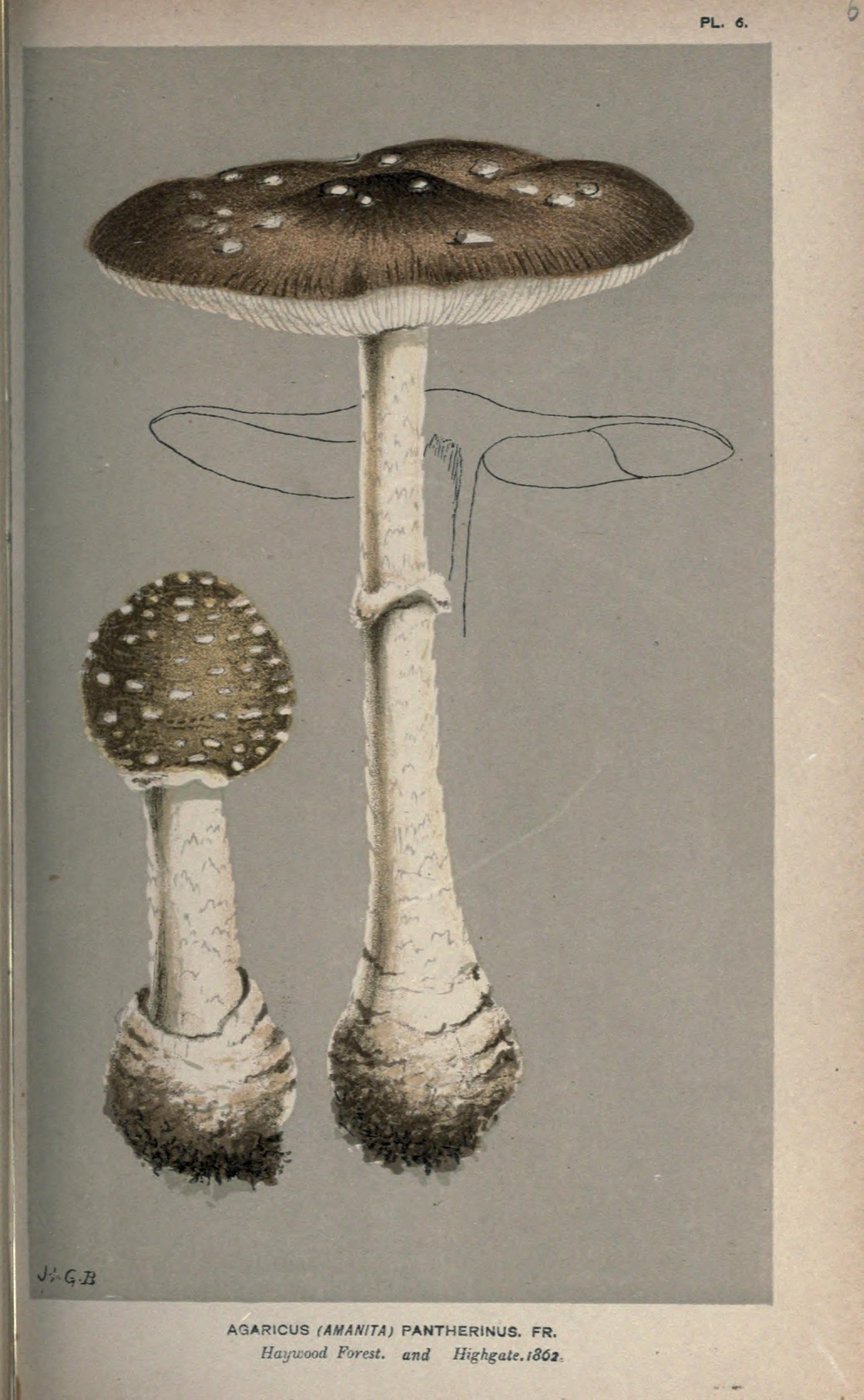
Amanita pantherina
- Known today as
- An umber to greyish-olive amanita flecked with white, of woods, heaths, and pastures.
- Kind
- Fungus
- Constituents
- ibotenic acid, muscimol
- In other databases
- GBIF search · Wikidata search
Revised October 17, 2026: Checked against its sources, each read in full, in part, or in its abstract. Version 1, first published September 25, 2026.
Caution. Poisonous; can bring coma and seizures.
Panther cap: what was it used for?
None.
Panther cap: what does modern science say?
Carries less ibotenic acid and more muscimol than the fly agaric, and its poisoning more often ends in coma.
Panther cap: is it poisonous?
Yes, in some form or dose. Poisonous; can bring coma and seizures. Its poisoning is ibotenic acid and muscimol (pantherine syndrome): Thirty minutes to two hours. Historical description, not medical advice; in a poisoning, call a poison centre.
The toxic dose and the poisoning
- Toxic dose
- Coma more often than with the fly agaric, and sometimes seizures.
- Syndrome
- Ibotenic acid and muscimol (pantherine syndrome)
The references for these lines are listed under Pharmacognosy, in Science. Doses are as the references give them, for description only; this is not medical advice. In a poisoning, call a poison centre.
Panther cap: what lore surrounds it?
The fly agaric’s partner in the ‘pantherina’ poisoning syndrome.
In Their Own Words
Mrs Grieve, after saying that the Fly Agaric is used to make people drunk in Kamchatka, adds that Amanita pantherina is used in Japan for the same purpose.
“Although justly considered injurious, it is used as a means of intoxication by the natives of Kamschatka. A. pantherina is used in Japan for like purposes.”
Mrs. M. Grieve, A Modern Herbal: “Fungi”, “Fungi”: the Amanitas (A. muscaria). The text of A Modern Herbal as published on botanical.com. The text, read in part
George Massee describes Amanita pantherina as having a viscid, striate cap, yellow-brown, grey or whitish, with flat mealy warts and white gills.
“=pantherina=, Fr. P. 7-10 cm. soon plane, viscid, striate, yellow-brown, grey, or whitish, with flat mealy warts; g. free but close to stem, white”
George Massee, F.L.S., European Fungus Flora: Agaricaceae, Amanita, A. pantherina. London: Duckworth & Co., 3 Henrietta Street, W.C., 1902 (Project Gutenberg eBook #33013). The text, read in part
Each passage is quoted from the text named, which the press fetched and read, and was checked word for word against a fresh copy of it; the link opens that copy. Passages are given as printed, without the editors’ footnote numbers, and with words broken across lines joined.
Pharmacognosy
- Constituents
- ibotenic acid ChEMBLless than in the fly agaric
- muscimol ChEMBL
- Mechanism
- As the fly agaric.
- Standing
- None.
- Michelot, D., and Melendez-Howell, L. M. (2003). Mycological Research 107. Abstract read · the text read
The abstract of each source, beneath its citation. For Club members. About the Club or sign in.
Constituent names open the compound’s record at PubChem, and “ChEMBL” beside a name opens its record at ChEMBL, the European Bioinformatics Institute’s database of bioactive molecules. Where a mechanism line was checked against ChEMBL (ChEMBL 37, read 1 October 2026), the check is shown with the measured value and its source paper, or says plainly that nothing has been measured. Doses are as the references give them, for description only; this is not medical advice. Each source carries the result of its check against Crossref, PubMed, or the authority’s page: see Verification.
Sources
- Vendramin, A., and Brvar, M. (2014). Amanita muscaria and Amanita pantherina poisoning: two syndromes. Toxicon. Abstract read · the text read
- Cirronis, M., et al. (2025). Coma and confirmed epileptiform activity induced by Amanita pantherina poisoning. Toxicon. Abstract read · the text read
- Rea, C. (1922). British Basidiomycetae: A Handbook to the Larger British Fungi. Cambridge: Cambridge University Press. Read in part · the text read
Verification
- Checked
- October 1, 2026, October 17, 2026
- Passes
- Read against its sources in the pass over the remaining 343 entries
- Every dated or regulatory claim checked by category across the database
- Every source read, in full, in part, or in its abstract, and every sentence checked against what was read (October 17, 2026)
- Sources
- 4 cited: 1 read in part, 3 abstract read. 3 with the abstract on file.
- Corrections
- None recorded.
What was checked, how, and what was found is set out on the Verification page. A checked source is one whose record was found; it does not make the entry medical advice.
Club members can point at a technical term in this entry, such as a constituent, an action, or a word of Jung’s, to read its definition from the source. The Club.
Cite This Entry
Version 1 · first published September 25, 2026 · last revised October 17, 2026
- Chicago
“Panther cap.” In Materia Medica, edited by B. C. P. Statema. Version 1. The Thinking Press, 2026–. Last modified October 17, 2026. https://thethinkingpress.org/materia-medica/panther-cap.
- MLA
“Panther cap.” Materia Medica, edited by B. C. P. Statema, version 1, The Thinking Press, 17 Oct. 2026, thethinkingpress.org/materia-medica/panther-cap. Accessed 22 Nov. 2026.
- APA
Panther cap. (2026, October 17). In B. C. P. Statema (Ed.), Materia medica (Version 1). The Thinking Press. Retrieved November 22, 2026, from https://thethinkingpress.org/materia-medica/panther-cap
See Also
Poisoned alike: ibotenic acid and muscimol (pantherine syndrome)
Drawing on the same sources: Rea, Michelot
Saffron milk cap · Stinkhorn · The sickener · False morel · the bibliography →
Nearby in the alphabet
Paregoric (camphor, benzoic acid, and anise oil in spirit) · Palm of Christ (Ricinus communis (note XLII)) · Parsley (Petroselinum crispum) · Palm and olive branches (Branches blessed on Palm Sunday) · Paschal candle · Oyster mushroom (A shell-shaped mushroom of dead hardwood) · Pasque flower · Oxymel, and oxymel of squill (Honey boiled with vinegar)
Historical description, not medical advice.

