
Bloodroot
Red puccoon, puccoon, tetterwort, redroot, pauson, turmeric, Indian paint; Sanguinaria canadensis of Linnaeus; the Ojibwe meskwadjibikûk and the Potawatomi mackwadjibikûkûk, red root
- Known today as
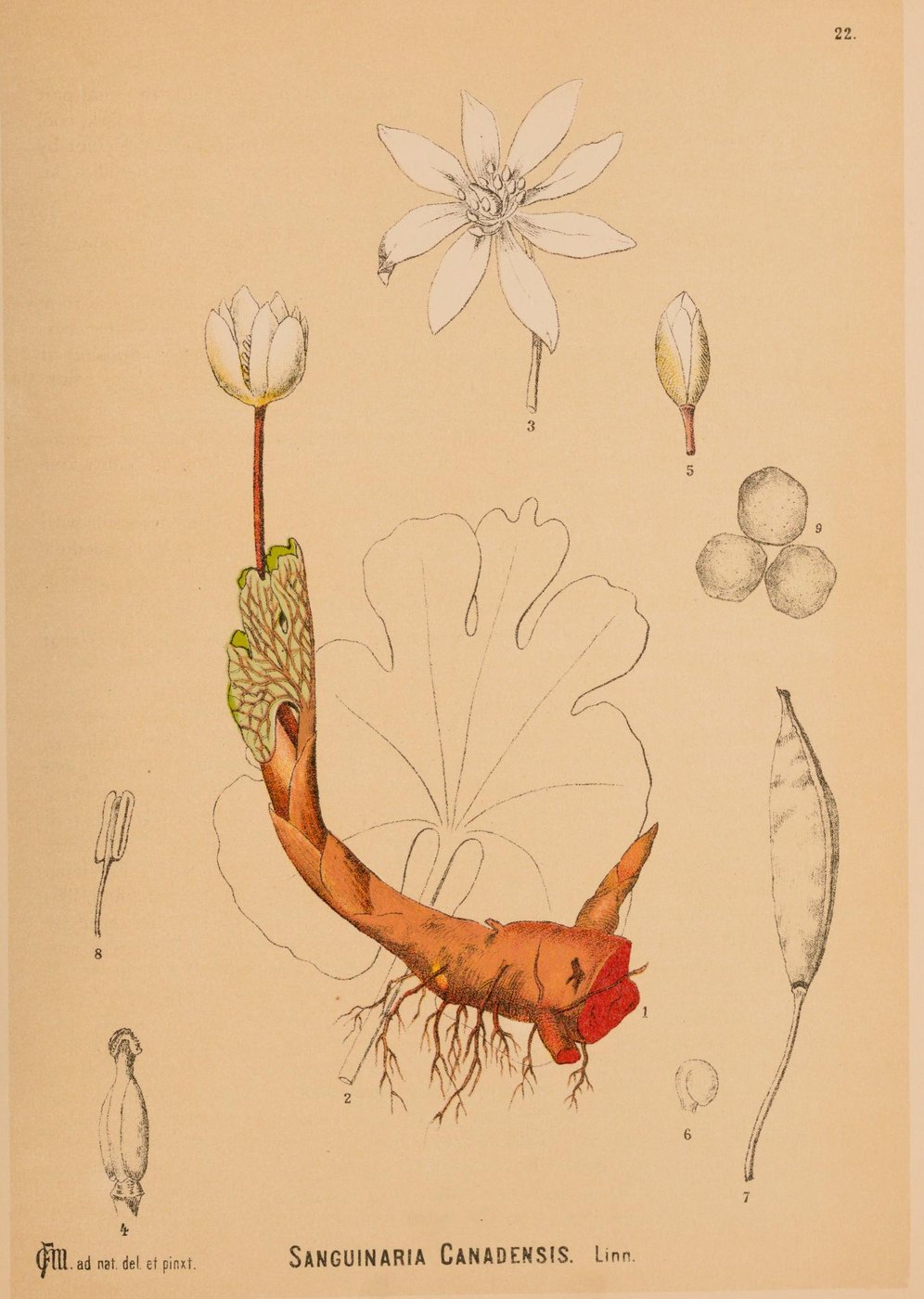
- Sanguinaria canadensis, the first flower of the spring woods from Canada to the South: a single creamy-white flower of eight petals on a naked scape three to six inches high, wrapped as it rises in its one lobed leaf, from a short horizontal root that bleeds a bright orange-red juice wherever it is cut. It grows in rich open woods and on bottom-lands along shaded streams, flowering from March to May and fruiting in June.
- Kind
- Plant, in 4 older authorities
- Constituents
- sanguinarine, chelerythrine, protopine, and γ-homochelidonine, an orange-red resin
- Earliest authority here
- Jacob Bigelow
- In other databases
- Plants of the World Online search · GBIF search · Wikidata search
Deadly. Deadly in overdose: the root and its alkaloids are acrid poisons that have killed by vomiting, burning, and heart failure. The black salves made from it eat the skin, including skin that was not cancerous, and the alkaloid in them is suspected of causing cancer; mouthwashes containing it caused white patches in the mouth. A touch of the juice on sugar was the old dose.
Bloodroot: what was it used for?
The Pillager Ojibwe, Smith records, squeezed the orange juice onto a lump of maple sugar and held it in the mouth until it melted, for sore throat; the Forest Potawatomi did the same for mild sore throats and steeped the root for diphtheria; both painted their faces with it for the medicine lodge and for clan marks, and used it alone or in combinations for a dark yellow or orange dye. Bigelow found it an acrid narcotic: eight to twenty grains of the fresh powdered root irritated the throat, brought on heartburn, nausea, faintness, and vertigo, and at last vomited; in smaller repeated doses it slowed the pulse like digitalis, and Professors Smith and Ives gave it in incipient consumption and typhoid pneumonia, Smith also curing soft polypi with the powder. Rafinesque had it as the base of Rawson’s bitters and a prophylactic against marsh fevers. Densmore: expectorant in small doses, nauseant and emetic in large, in the ninth United States Pharmacopoeia.
Bloodroot: foraging it in the Midwest
- Part
- Root
- When
- Autumn, after the leaves die down
Rich open woods and shaded bottom-lands, flowering in March and April; the root is dug in autumn, by Grieve, or when the seeds are ripe, by Millspaugh, and quickly spoils if not kept dry. A poison and a dye, never a food.
After Grieve; Millspaugh. All the foragables of the Midwest. Historical record, not a field guide: identify before you gather, and read the whole entry.
Bloodroot: what does modern science say?
The root’s benzophenanthridine and protopine alkaloids, sanguinarine first among them, have never become medicines; a 2016 review found them instead associated with toxicities “ranging from mouthwash induced leukoplakia to cancer salve necrosis and treatment failure,” and suggested that the natural variation in the alkaloids explains the inconsistent results. Sanguinarine, the active ingredient of the black salves still sold for skin cancers, intercalates DNA, generates oxidative stress, and has given contradictory genotoxicity results; mouthwashes containing it have been linked to oral leukoplakia, and a 2017 review judged the question of its carcinogenicity of urgent clinical relevance because patients keep applying the salve to sun-damaged and cancerous skin.
Bloodroot: is it poisonous?
Yes, and it can kill. Deadly in overdose: the root and its alkaloids are acrid poisons that have killed by vomiting, burning, and heart failure. The black salves made from it eat the skin, including skin that was not cancerous, and the alkaloid in them is suspected of causing cancer; mouthwashes containing it caused white patches in the mouth. A touch of the juice on sugar was the old dose. Historical description, not medical advice; in a poisoning, call a poison centre.
Pharmacognosy & Toxicology
- Constituents
- sanguinarine ChEMBLthe chief benzophenanthridine alkaloid, red-salted, a DNA intercalator; the agent of the black salves and of the old mouthwashes
- chelerythrine, protopine, and γ-homochelidoninethe other alkaloids of the root, by Densmore’s list; Millspaugh identified sanguinarine with chelerythrine
- an orange-red resinthe colour, which Bigelow found held in the resin more than the water, to the dyers’ disappointment
- Mechanism
- The alkaloids are acrid irritants and escharotics that kill tissue they touch, which is how the salve works and how it harms; sanguinarine generates oxidative and endoplasmic reticulum stress and 8-hydroxyguanine lesions in DNA, and its genotoxicity tests have contradicted one another. Bigelow saw it slow the pulse in sub-emetic doses after a first quickening.
- Toxic dose
- Eight to twenty grains of the fresh powdered root to vomit, by Bigelow; a scruple to half a drachm infused, a teaspoonful or two every half hour, by Ives; thirty to eighty drops of the tincture in wine, by Rafinesque. The juice on a lump of maple sugar, by the Ojibwe.
- Standing
- No approved medicine; a 2016 review found the alkaloids tied to toxicities from mouthwash leukoplakia to salve necrosis, and a 2017 review called the carcinogenic question urgent because the salve is still applied to cancerous skin.
- Croaker, A., King, G. J., Pyne, J. H., Anoopkumar-Dukie, S., & Liu, L. (2016). Sanguinaria canadensis: traditional medicine, phytochemical composition, biological activities and current uses. International Journal of Molecular Sciences 17: 1414. doi:10.3390/ijms17091414 Verified against its record · PMID 27618894
- Croaker, A., et al. (2017). Carcinogenic potential of sanguinarine, a phytochemical used in ‘therapeutic’ black salve and mouthwash. Mutation Research: Reviews in Mutation Research 774: 46–56. doi:10.1016/j.mrrev.2017.09.001 Verified against its record · PMID 29173498
The abstract of each source, beneath its citation. For Club members. About the Club or sign in.
Constituent names open the compound’s record at PubChem, and “ChEMBL” beside a name opens its record at ChEMBL, the European Bioinformatics Institute’s database of bioactive molecules. Where a mechanism line was checked against ChEMBL (ChEMBL 37, read 1 October 2026), the check is shown with the measured value and its source paper, or says plainly that nothing has been measured. Doses are as the references give them, for description only; this is not medical advice. Each source carries the result of its check against Crossref, PubMed, or the authority’s page: see Verification.
Bloodroot: what lore surrounds it?
The paint of the Midwest: the red of the medicine lodge and the warpath, of the clan marks the Potawatomi still drew, and of the dyers who could never make it hold. Puccoon is its old English name from the Algonquian, and tetterwort tells what the juice was put on. The salve that Millspaugh called an escharotic is the black salve of the present day, and the one use of the plant the physicians most want stopped.
Bloodroot: what did the older authorities say?
- Jacob Bigelow
- “Among the earliest visiters of spring the botanist will find in almost any part of the United States the Sanguinaria Canadensis.” Its medical properties “are those of an acrid narcotic”; a large dose irritates the fauces, occasions heartburn, nausea, faintness, vertigo, and diminished vision, and at length vomits. Papers dipped in the tincture take a bright salmon colour, but the aqueous infusion dyes faintly, “an impediment to the use of this article in dyeing.”
- Huron H. Smith
- “The Pillager Ojibwe use the orange-red juice of the Bloodroot to cure sore throat. The juice is squeezed out on a lump of maple sugar, and this is retained in the mouth until it has melted away. They also use the juice to paint the face for the medicine lodge ceremony or when on the warpath.” In dyeing it needs no mordant and gives a dark yellow or orange.
- Charles F. Millspaugh
- “The most beautiful harbinger of its season,” used for many years by the aborigines to paint their faces, clothing, and implements of war, and by the laity as a domestic remedy in gastric troubles with podophyllum. In toxic doses it causes burning of every mucous membrane it touches, faintness, and insensibility; “death has occurred from overdoses,” after violent vomiting, terrible thirst, dilated pupils, and the coldness that shows the heart failing.
- Mrs. M. Grieve
- Emetic, cathartic, expectorant, and emmenagogue; chiefly used as an expectorant in chronic bronchitis and locally in chronic eczema, “applied to fungoid growths, ulcers fleshy excrescences, cancerous affections and as an escharotic.” The root is collected in the autumn after the leaves die down, and the powder causes sneezing.
Sources
- Bigelow, J. (1817). American Medical Botany, vol. 1, “Sanguinaria canadensis. Blood root,” pp. 75–83 and Plate VII. Internet Archive, mobot31753000788213. Primary text
- Millspaugh, C. F. (1887). American Medicinal Plants, vol. 1, no. 22, “Sanguinaria canadensis,” and Plate 22. Internet Archive, americanmedicina01mill_0. Primary text
- Smith, H. H. (1932). Ethnobotany of the Ojibwe Indians, Bulletin of the Public Museum of the City of Milwaukee 4(3), “Bloodroot,” under medicines and dyes. Project Gutenberg, 49527. Primary text
- Smith, H. H. (1933). Ethnobotany of the Forest Potawatomi Indians, Bulletin of the Public Museum of the City of Milwaukee 7(1), “Bloodroot.” Internet Archive, ethnobotany-of-the-forest-potawatomi-indians-by-huron-h.-smith-1933. Primary text
- Densmore, F. (1928). Uses of Plants by the Chippewa Indians, Forty-fourth Annual Report of the Bureau of American Ethnology, “Sanguinaria canadensis.” Internet Archive, usesofplantsbych00dens. Primary text
- Rafinesque, C. S. (1830). Medical Flora, or Manual of the Medical Botany of the United States of North America, vol. 2, no. 83, “Sanguinaria.” Internet Archive, b21468710_0002. Primary text
- Grieve, M. A Modern Herbal, “Bloodroot.” As published on botanical.com. Standard reference work
Verification
- Checked
- October 1, 2026
- Passes
- Every sentence read against its sources, in the pass over the remaining 343 entries
- The Standing line checked against the authority it names (EMA, WHO, FDA, CITES, Commission E)
- Every dated or regulatory claim checked by category across the database
- Sources
- 9 cited: 2 verified against its record, 6 primary text, 1 standard reference work. 2 with the abstract on file.
- Corrections
- None were needed.
What was checked, how, and what was found is set out on the Verification page. A checked source is one whose record was found; it does not make the entry medical advice.
Cite This Entry
Version 1 · first published October 4, 2026
- Chicago
“Bloodroot.” In Materia Medica, edited by B. C. P. Statema. Version 1. The Thinking Press, 2026–. Last modified October 4, 2026. https://thethinkingpress.org/materia-medica/bloodroot.
- MLA
“Bloodroot.” Materia Medica, edited by B. C. P. Statema, version 1, The Thinking Press, 4 Oct. 2026, thethinkingpress.org/materia-medica/bloodroot. Accessed 8 Oct. 2026.
- APA
Bloodroot. (2026, October 4). In B. C. P. Statema (Ed.), Materia medica (Version 1). The Thinking Press. Retrieved October 8, 2026, from https://thethinkingpress.org/materia-medica/bloodroot
Club members keep entries on a shelf with private notes, print the plates as cards, and receive an entry by email each week. Create a free account before January 1, 2027 and all of it is yours for good. About the Club
See Also
Sharing sanguinarine
Also in M. Grieve
Burdock in M. Grieve · Sumac in M. Grieve · Clove in M. Grieve · Rosemary rice water in M. Grieve · everything M. Grieve names →
Drawing on the same sources: Bigelow, Millspaugh, Smith, Densmore
Ginseng · Wild ginger · Mayapple · Ghost pipe · Black walnut · Cattail · the bibliography →
Nearby in the alphabet
Bloodstone (iron oxide, which streaks blood-red) · Blessed paper (Paper blessed so that what is written on it may take effect) · Bogbean · Blessed oil · Borage (Borago officinalis) · Blessed herbs (especially on the feast of the Assumption (15 August)) · Borax (brought as the crude salt tincal from the lakes of Tibet) · Blessed candles (and the Paschal candle)
Historical description, not medical advice.