
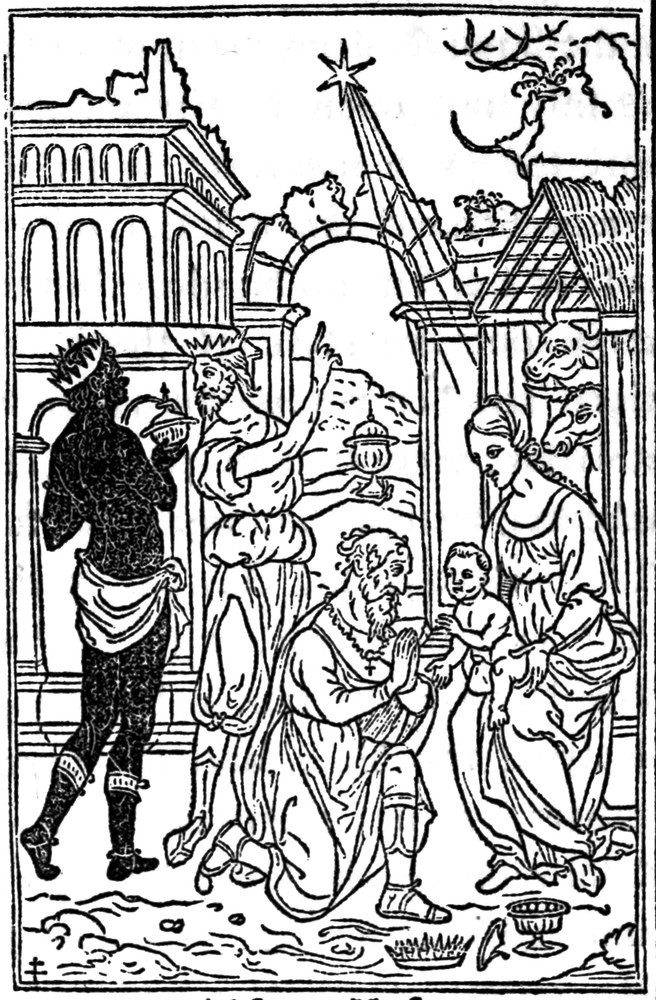
Gold, frankincense, and myrrh
Oro, incenso, mirra
- Known today as
- The gifts of the Magi.
- Kind
- Sacramental, in 1 older authority
- Earliest authority here
- The Catholic Encyclopedia (New York, 1907–1914)
- In the Canale glossary
- On the Manner of Discerning and Healing the Bewitched, Appendix A: Treatise Two: Blessed Objects and Materials
Revised October 1, 2026: An authority added from a text read in full. Version 1, first published September 25, 2026.
Gold, frankincense, and myrrh: what did Canale use it for?
Blessed especially at Epiphany; fumigated or carried against “bonds, incantations, hexes”; placed in the four corners of the bed (Treatise Two).
Gold, frankincense, and myrrh: what does modern science say?
The older Roman Ritual gives blessings of these gifts, and of chalk for marking the door, at Epiphany; the blessing of chalk is still widely practiced.
Gold, frankincense, and myrrh: what did the older authorities say?
- The Catholic Encyclopedia
- The Catholic Encyclopedia's article on the Magi is sober about the gifts: “The Magi adored (prosekynesan) the Child as God, and offered Him gold, frankincense, and myrrh. The giving of gifts was in keeping with Oriental custom. The purpose of the gold is clear; the Child was poor. We do not know the purpose of the other gifts. The Magi probably meant no symbolism.” It adds that “no Father of the Church holds the Magi to have been kings,” that “some Fathers speak of three Magi; they are very likely influenced by the number of gifts,” while “in the Orient, tradition favours twelve,” and that the names Gaspar, Melchior and Balthasar appear among the Latins only “from the seventh century.”
Sources
- [53] Grasska, D. (2026). Unpacking faith: gifts of Epiphany. The Southern Cross, 1 January 2026. Book, not indexed
- [120] Weller, P. T. (trans.) (1964). The Roman Ritual, Part XI: Blessings and Other Sacramentals. EWTN Library, ewtn.com. Primary text
- The Catholic Encyclopedia (New York, 1907–1914), “Kings.” newadvent.org/cathen/09527a.htm Standard reference work
- The Catholic Encyclopedia (New York, 1907–1914), “Exorcism.” newadvent.org/cathen/05709a.htm Standard reference work
Verification
- Checked
- October 1, 2026
- Passes
- Every dated or regulatory claim checked by category across the database
- Each quotation from the older authorities checked word for word against the text, read in full
- Sources
- 4 cited: 1 primary text, 2 standard reference work, 1 book, not indexed.
- Corrections
- None were needed.
What was checked, how, and what was found is set out on the Verification page. A checked source is one whose record was found; it does not make the entry medical advice.
Cite This Entry
Version 1 · first published September 25, 2026 · last revised October 1, 2026
- Chicago
“Gold, frankincense, and myrrh.” In Materia Medica, edited by B. C. P. Statema. Version 1. The Thinking Press, 2026–. Last modified October 1, 2026. https://thethinkingpress.org/materia-medica/gold-frankincense-and-myrrh.
- MLA
“Gold, frankincense, and myrrh.” Materia Medica, edited by B. C. P. Statema, version 1, The Thinking Press, 1 Oct. 2026, thethinkingpress.org/materia-medica/gold-frankincense-and-myrrh. Accessed 8 Oct. 2026.
- APA
Gold, frankincense, and myrrh. (2026, October 1). In B. C. P. Statema (Ed.), Materia medica (Version 1). The Thinking Press. Retrieved October 8, 2026, from https://thethinkingpress.org/materia-medica/gold-frankincense-and-myrrh
Club members keep entries on a shelf with private notes, print the plates as cards, and receive an entry by email each week. Create a free account before January 1, 2027 and all of it is yours for good. About the Club
See Also
Also in The Catholic Encyclopedia
Hagstone in The Catholic Encyclopedia · The fig hand in The Catholic Encyclopedia · The Hand of Glory in The Catholic Encyclopedia · The eye bead in The Catholic Encyclopedia · everything The Catholic Encyclopedia names →
Nearby in the alphabet
Golden pills (a standard compound of aloes, scammony, and colocynth) · Gold leaf (Beaten gold) · Gorse (Ulex europaeus) · Goji berry · Greater celandine (Chelidonium majus) · Goat’s rue (French lilac) · Ground cherry (the ground cherries) · Glauber’s salt


Historical description, not medical advice.