
Ergot and the Witch Trials
The 1976 hypothesis, and why most historians reject it.
In the Texts
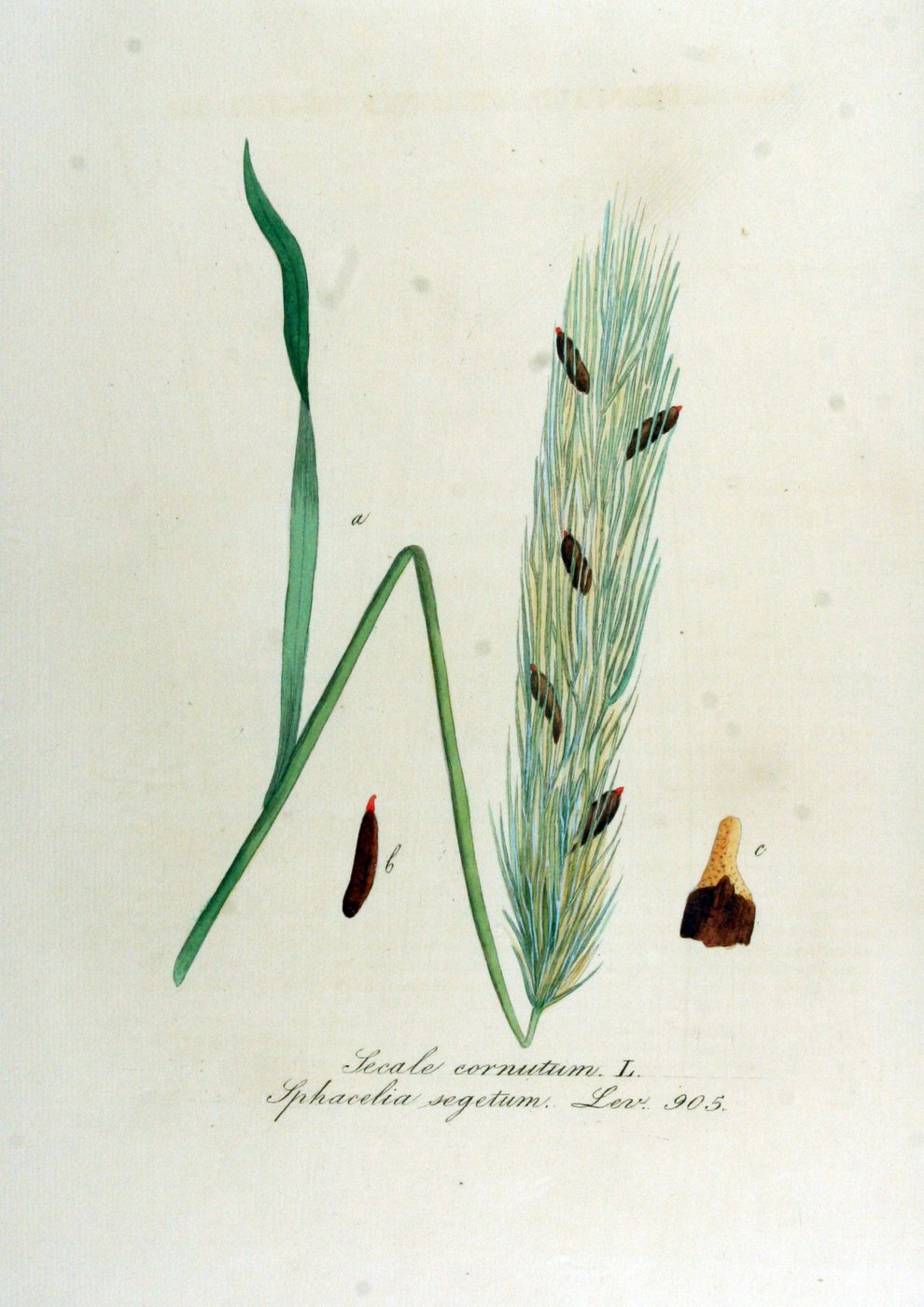
The afflictions of the bewitched in the manuals, convulsions, the sense of being pricked and bitten, visions, and gangrene of the limbs, overlap with the ignis sacer that the monks of Saint Anthony treated: the fire that blackened the limbs and the madness that went with it. Canale’s purges and his diet of clean food would, by accident, have removed the cause of that disease.
What Medicine Makes of It
In 1976 Linnda Caporael argued in Science that the Salem accusers of 1692 were suffering convulsive ergotism from a damp rye harvest, and the idea has been applied since to Strasbourg and to the European trials. Spanos and Gottlieb replied in the same journal within the year: the symptoms came and went with the court sessions, affected the accusers and not their households, and lacked the vomiting, diarrhoea, and gangrene of ergotism; no epidemic was reported in the town. Mary Matossian’s Poisons of the Past (1989) revived the claim statistically for Europe, with weather and rye prices, and most historians of witchcraft remain unpersuaded, for the trials followed the courts and the sermons, not the harvests.
The Evidence
- Caporael (1976) argued from a wet spring, a rye-growing district, and the symptoms of the Salem girls; Spanos and Gottlieb (1976) replied that the symptoms were not those of ergotism, that no one else in the households fell ill, and that the accusers’ fits were elicited in court and ceased outside it.
- Matossian (1989) correlated witch-trial frequency across Europe with cold wet summers and rye prices, and found an association; Woolf (2000) found the same for Essex, and both admit the association is weak and the mechanism unproven.
- Convulsive ergotism is well described in the Continental epidemics of 1690–1770 (Barger, 1931): the Salem symptoms lack its gangrene, its hunger, and its deaths.
- Pont-Saint-Esprit in 1951, the last European outbreak, caused hallucinations and seven deaths in 250 cases from one baker’s flour (Gabbai et al., 1951); no one was accused of witchcraft.
- The historians’ consensus (Levack, 2016) is that the trials follow the law, the courts, and the preaching, with weather as at most a background stress; the demonological manuals are themselves the better explanation of what the accusers saw.
Where They Part
Ergotism was real, and in the bewitched of some villages the manuals were surely treating it; but the fit between the alkaloid and the accusation is loose, and the trials are better explained by what the manuals themselves show: a theory of affliction that made neighbours into suspects. See the reading on the mechanism of the rite for what the manuals did achieve.
In the Materia Medica
Sources
- Caporael, L. R. (1976). “Ergotism: the Satan loosed in Salem?” Science 192.
- Spanos, N. P., and Gottlieb, J. (1976). “Ergotism and the Salem Village witch trials.” Science 194.
- Matossian, M. K. (1989). Poisons of the Past. Yale University Press.
Historical and interpretive; not medical advice.