
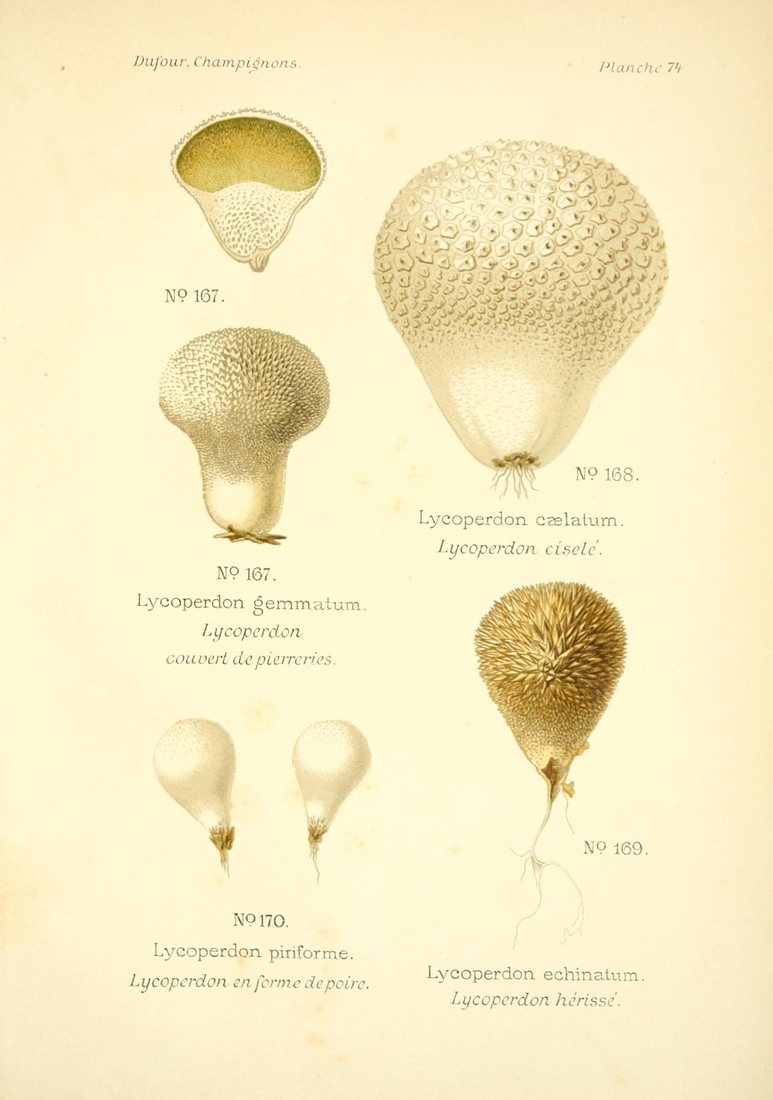
Puffball
Calvatia gigantea, Lycoperdon species; devil’s snuffbox
- Known today as
- White balls that ripen into a cloud of brown spores.
- Kind
- Fungus
- Constituents
- calvacin, spores, ergosterol
- In other databases
- GBIF search · Wikidata search
Puffball: what was it used for?
The spore mass was packed into wounds to stop bleeding; beekeepers burned it to stupefy their bees.
Puffball: foraging it in the Midwest
- Part
- The mature ball
- When
- Late summer and autumn
The Ojibwe kept the giant puffball on hand in its mature stage and snuffed the inner mass up the nose to stop a nosebleed; the Potawatomi used the spores of a pinkish puffball as a headache powder and to soothe a chafed infant, and counted every other fungus a poison.
After Smith. All the foragables of the Midwest. Historical record, not a field guide: identify before you gather, and read the whole entry.
Puffball: what does modern science say?
Edible when young and white throughout; the spores, breathed in large amounts, can inflame the lungs.
Pharmacognosy & Toxicology
- Constituents
- calvacina protein with antitumour activity in mice (1960s)
- sporeswhich cause lycoperdonosis
- ergosterol ChEMBL
- Mechanism
- The spore mass packed in a wound is a dry, absorbent, mildly haemostatic dressing, and the smoke stupefies bees; the spores inhaled in quantity, as by teenagers who snorted them in 1994, cause lycoperdonosis, a pneumonitis that needed steroids and ventilation. Calvacin from the giant puffball slowed tumours in mice in 1960 and went no further.
- Toxic dose
- Young, white, and cooked, a food; the spores are not to be inhaled.
- Standing
- An edible when young; a documented inhalation hazard.
- Centers for Disease Control (1994). “Respiratory illness associated with inhalation of mushroom spores: Wisconsin, 1994.” MMWR 43. Verified against its record · doi:10.1001/jama.1994.03520070020011
- Lucas, E. H., et al. (1957). “Production of oncostatic principles in vivo and in vitro by species of the genus Calvatia.” Antibiotics Annual. Matched to its record and reviewed
Constituent names open the compound’s record at PubChem, and “ChEMBL” beside a name opens its record at ChEMBL, the European Bioinformatics Institute’s database of bioactive molecules. Where a mechanism line was checked against ChEMBL (ChEMBL 37, read 1 October 2026), the check is shown with the measured value and its source paper, or says plainly that nothing has been measured. Doses are as the references give them, for description only; this is not medical advice. Each source carries the result of its check against Crossref, PubMed, or the authority’s page: see Verification.
Puffball: what lore surrounds it?
“Devil’s snuffbox” for the smoke of spores that puffs out when it is trodden on.
In Their Own Words
Mrs Grieve records that cottagers once kept the woolly, spore-filled inside of the puff-ball to bind over wounds to stop bleeding, keeping pieces year after year for emergencies.
“In former times, it was not unusual among cottagers to find the woolly interior mass, with its profusion of minute, snuff-coloured spores, considered an excellent remedy to apply for the staunching of blood in wounds, pieces of Puff-ball being kept year after year for use in case of emergency”
Mrs. M. Grieve, A Modern Herbal: “Fungi”, “Fungi”: the Puff-balls. The text of A Modern Herbal as published on botanical.com. The text, read in part
The 1911 Britannica says the puff-ball is edible while white and fleshy, and that the fibrous mass left after the spores escape has been used as tinder and as a styptic for wounds.
“When white and fleshy the fungus is edible. The fibrous mass which remains after the spores have escaped has been used for tinder or as a styptic for wounds.”
Encyclopædia Britannica, eleventh edition: Puff-ball, “Puff-ball”, vol. 22, p. 635. The 1911 Encyclopædia Britannica, as transcribed on Wikisource. The text, read in full
Each passage is quoted from the text named, which the press fetched and read, and was checked word for word against a fresh copy of it; the link opens that copy. Passages are given as printed, without the editors’ footnote numbers, and with words broken across lines joined.
Sources
- Grieve, M. (1931). A Modern Herbal. Read in part · the text read
Verification
- Checked
- October 1, 2026
- Passes
- Every sentence read against its sources, in the pass over the remaining 343 entries
- The Standing line checked against the authority it names (EMA, WHO, FDA, CITES, Commission E)
- Every dated or regulatory claim checked by category across the database
- Sources
- 3 cited: 1 read in part, 1 verified against its record, 1 matched to its record and reviewed.
- Corrections
- None were needed.
What was checked, how, and what was found is set out on the Verification page. A checked source is one whose record was found; it does not make the entry medical advice.
Cite This Entry
Version 1 · first published September 25, 2026
- Chicago
“Puffball.” In Materia Medica, edited by B. C. P. Statema. Version 1. The Thinking Press, 2026–. Last modified September 25, 2026. https://thethinkingpress.org/materia-medica/puffball.
- MLA
“Puffball.” Materia Medica, edited by B. C. P. Statema, version 1, The Thinking Press, 25 Sept. 2026, thethinkingpress.org/materia-medica/puffball. Accessed 8 Oct. 2026.
- APA
Puffball. (2026, September 25). In B. C. P. Statema (Ed.), Materia medica (Version 1). The Thinking Press. Retrieved October 8, 2026, from https://thethinkingpress.org/materia-medica/puffball
Club members keep entries on a shelf with private notes, print the plates as cards, and receive an entry by email each week. Create a free account before January 1, 2027 and all of it is yours for good. About the Club
See Also
Sharing spores, ergosterol
Drawing on the same sources: Grieve, Lucas
Radish · Pokeweed · Rosemary · Armenian stone, pills of · the bibliography →
Nearby in the alphabet
Purslane (a succulent, creeping herb of warm gardens) · The prologue of John · Quicksilver (and its salts such as calomel and corrosive sublimate) · The precious stones (emerald, jacinth, garnet, and topaz, as they were used in medicine) · Quince (Cydonia oblonga) · Pomegranate (Punica granatum) · Pomander (of ambergris, musk, civet, and spices, carried in a pierced case)
Historical description, not medical advice.