
Jewelweed
Spotted touch-me-not, wild celandine, slippers, quick-in-the-hand, weathercocks; Impatiens biflora of Walter, Impatiens capensis of Meerburgh, Impatiens fulva; the Ojibwe wesa’wûs ga’skonêk, yellow light; the Potawatomi wasawa’shiak, yellow slippery
- Known today as
- Impatiens capensis, the orange-flowered touch-me-not of wet shady ground across the eastern and midwestern United States and Canada, a succulent annual whose spurred flowers hang like slippers and whose ripe pods burst at a touch: the plant the tribes rubbed on nettle stings and poison ivy, and the one plant of the Midwestern folk pharmacy that has been put to a controlled test.
- Kind
- Plant, in 3 older authorities
- Constituents
- saponins, lawsone
- Earliest authority here
- Huron H. Smith
- In other databases
- Plants of the World Online search · GBIF search · Wikidata search
Caution. Nothing read for this entry describes harm from the plant used on the skin. Against poison ivy a fresh mash or a saponin wash applied at once is what the trials supported; a bottled extract did nothing.
Jewelweed: what was it used for?
“This is accounted a valuable medicine among the Forest Potawatomi who use the fresh juice of the plant to wash nettle stings or poison ivy infections,” Smith writes, and adds that he knows himself “that it instantly alleviates the sting of the Stinging Nettle” and had it from the Indians that it cures the itch of poison ivy. The Flambeau medicine man Bearskin told him the fresh juice rubbed on the head cured a headache, and the leaves were steeped for a tea. Both the Ojibwe and the Potawatomi boiled the whole plant for an orange or deep yellow dye, deepened with rusty nails. Rafinesque has the two touch-me-nots “in common use for jaundice and asthma, as a tea,” emetic and diuretic in large doses, the leaves for piles and a wash for wounds, and dyeing wool saffron and yellow.
Jewelweed: foraging it in the Midwest
- Part
- Fresh juice and leaves
- When
- Summer, when the plant stands
Wet shady ground beside the nettles and the poison ivy it is used against; the fresh plant is crushed and the juice rubbed on at once. A dried or bottled extract is not the remedy the tribes used, and did nothing in the one trial of it.
After Smith. All the foragables of the Midwest. Historical record, not a field guide: identify before you gather, and read the whole entry.
Jewelweed: what does modern science say?
Tested three times against poison ivy. In 1997 an extract of the fresh stems, patched on urushiol sites in ten volunteers, did no better than distilled water. In 2012 the fresh plant mash, rubbed on the forearms of volunteers after poison ivy had been brushed on, did reduce the rash, while extracts did not and soaps did best of all; the lawsone content varied with the season and made no difference. In 2015 a saponin-rich extract of the leaves also reduced the rash, as did every soap tested, so that the saponins, the plant’s own soap, appear to be the agent, and the old use holds up as a wash applied at once.
Pharmacognosy & Toxicology
- Constituents
- Mechanism
- A wash: the saponins, like soap, remove or disperse the urushiol before it binds, which is why the fresh mash and the saponin extract worked when applied at once and a bottled extract patched on an established reaction did not.
- Toxic dose
- The fresh juice or mash rubbed on the skin at once, by the Potawatomi and the trials.
- Standing
- A folk remedy that survived a controlled test, on the condition that it is used as the tribes used it, fresh and immediately.
- Abrams Motz, V., Bowers, C. P., Mull Young, L., & Kinder, D. H. (2012). The effectiveness of jewelweed, Impatiens capensis, the related cultivar I. balsamina and the component, lawsone in preventing post poison ivy exposure contact dermatitis. Journal of Ethnopharmacology 143: 314–318. doi:10.1016/j.jep.2012.06.038 Verified against its record · PMID 22766473
- Motz, V. A., et al. (2015). Efficacy of the saponin component of Impatiens capensis Meerb. in preventing urushiol-induced contact dermatitis. Journal of Ethnopharmacology 162: 163–167. doi:10.1016/j.jep.2014.12.024 Verified against its record · PMID 25543019
- Long, D., Ballentine, N. H., & Marks, J. G. (1997). Treatment of poison ivy/oak allergic contact dermatitis with an extract of jewelweed. American Journal of Contact Dermatitis 8: 150–153. doi:10.1016/s1046-199x(97)90095-6 Verified against its record · PMID 9249283
The abstract of each source, beneath its citation. For Club members. About the Club or sign in.
Constituent names open the compound’s record at PubChem, and “ChEMBL” beside a name opens its record at ChEMBL, the European Bioinformatics Institute’s database of bioactive molecules. Where a mechanism line was checked against ChEMBL (ChEMBL 37, read 1 October 2026), the check is shown with the measured value and its source paper, or says plainly that nothing has been measured. Doses are as the references give them, for description only; this is not medical advice. Each source carries the result of its check against Crossref, PubMed, or the authority’s page: see Verification.
Jewelweed: what lore surrounds it?
Weathercocks, slippers, quick-in-the-hand: the names are all about the pod that leaps apart when touched, and the jewel is the water that beads on the leaf. Smith, a museum botanist who did not often vouch for his informants’ remedies, vouched for this one from his own stung hands.
Jewelweed: what did the older authorities say?
- Huron H. Smith
- Among the Forest Potawatomi the fresh juice washes nettle stings and poison ivy, and “the writer knows that it instantly alleviates the sting of the Stinging Nettle.” Among the Ojibwe, Bearskin of Flambeau “said that the fresh juice of this plant rubbed on the head would cure a headache,” and the Pillager Ojibwe boiled the whole plant with a few rusty nails for a yellow dye. The chemical constituents, he notes, were not known.
- C. S. Rafinesque
- “Touchmenot, Jewel weed. Slippers, Celandine, Quickinthehand, Weathercocks. Two sp. I. fulva and pallida, both in common use for jaundice and asthma, as a tea. In large doses emetic, eccoprotic and diuretic. Leaves used for piles and wash for wounds: they dye wool saffron color and yellow.”
- Britton and Brown
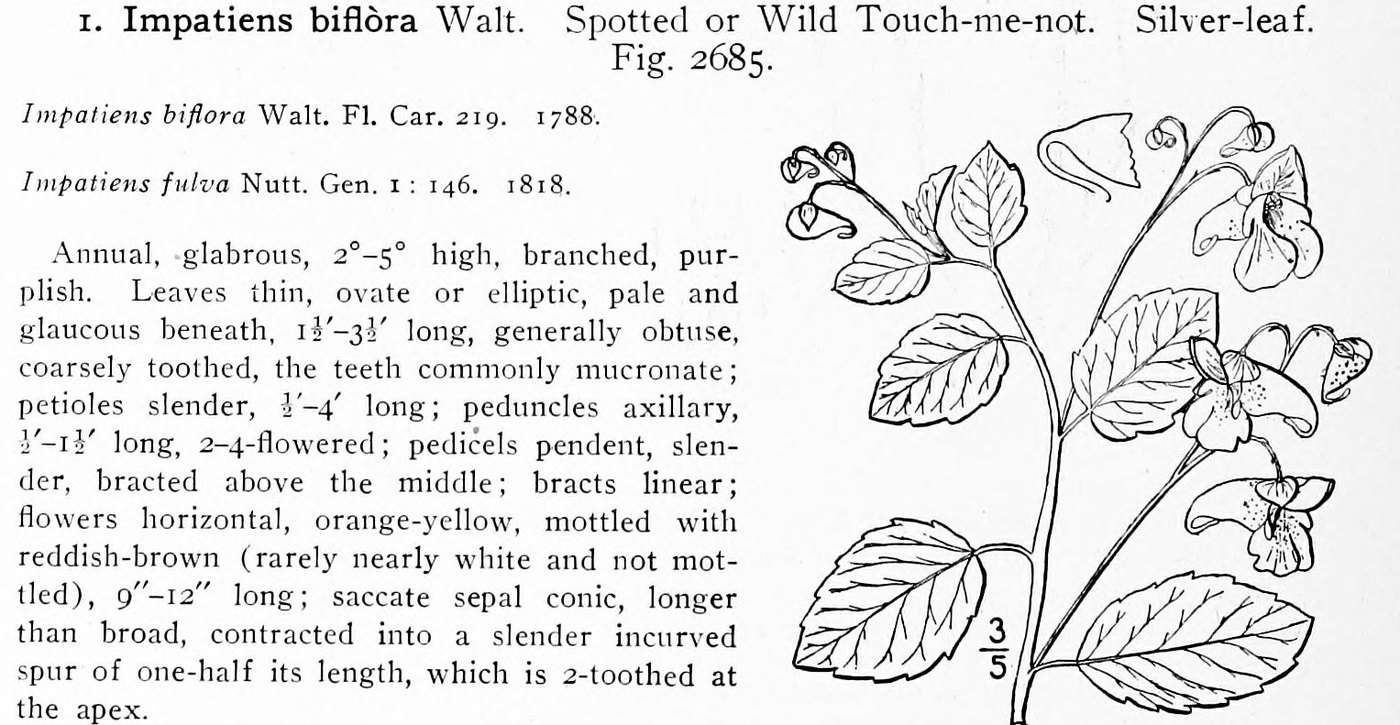
- In the Illustrated Flora of 1913: an annual, glabrous, two to five feet high, branched, purplish; leaves thin, ovate or elliptic, pale and glaucous beneath, coarsely toothed; the flowers horizontal, orange-yellow, mottled with reddish-brown, rarely nearly white, on slender pendent pedicels, two to four to a peduncle. Impatiens biflora of Walter’s Flora of Carolina, 1788.
Sources
- Smith, H. H. (1932). Ethnobotany of the Ojibwe Indians, Bulletin of the Public Museum of the City of Milwaukee 4(3), “Spotted Touch-me-not,” under medicines and dyes. Project Gutenberg, 49527. Primary text
- Smith, H. H. (1933). Ethnobotany of the Forest Potawatomi Indians, Bulletin of the Public Museum of the City of Milwaukee 7(1), “Touch-me-not,” under medicines and dyes. Internet Archive, ethnobotany-of-the-forest-potawatomi-indians-by-huron-h.-smith-1933. Primary text
- Rafinesque, C. S. (1830). Medical Flora, or Manual of the Medical Botany of the United States of North America, vol. 2, “Impatiens,” p. 229. Internet Archive, b21468710_0002. Primary text
- Britton, N. L., & Brown, A. (1913). An Illustrated Flora of the Northern United States, Canada and the British Possessions, 2nd ed., vol. 2, “Impatiens biflora. Spotted Touch-me-not.” Internet Archive, cu31924024548525. Standard reference work
Verification
- Checked
- October 1, 2026
- Passes
- Every sentence read against its sources, in the pass over the remaining 343 entries
- The Standing line checked against the authority it names (EMA, WHO, FDA, CITES, Commission E)
- Every dated or regulatory claim checked by category across the database
- Sources
- 7 cited: 3 verified against its record, 3 primary text, 1 standard reference work. 3 with the abstract on file.
- Corrections
- None were needed.
What was checked, how, and what was found is set out on the Verification page. A checked source is one whose record was found; it does not make the entry medical advice.
Cite This Entry
Version 1 · first published October 4, 2026
- Chicago
“Jewelweed.” In Materia Medica, edited by B. C. P. Statema. Version 1. The Thinking Press, 2026–. Last modified October 4, 2026. https://thethinkingpress.org/materia-medica/jewelweed.
- MLA
“Jewelweed.” Materia Medica, edited by B. C. P. Statema, version 1, The Thinking Press, 4 Oct. 2026, thethinkingpress.org/materia-medica/jewelweed. Accessed 8 Oct. 2026.
- APA
Jewelweed. (2026, October 4). In B. C. P. Statema (Ed.), Materia medica (Version 1). The Thinking Press. Retrieved October 8, 2026, from https://thethinkingpress.org/materia-medica/jewelweed
Club members keep entries on a shelf with private notes, print the plates as cards, and receive an entry by email each week. Create a free account before January 1, 2027 and all of it is yours for good. About the Club
See Also
Sharing saponins
Verbascum thapsus · Eryngium maritimum · Atriplex hortensis · Succisa pratensis
Drawing on the same sources: Smith, Rafinesque
Juneberry · Cattail · Milkweed · Pawpaw · Ground cherry · Pokeweed · the bibliography →
Nearby in the alphabet
Jet, oil of (a dense variety of lignite) · Juniper (The berries and wood of Juniperus communis) · Jelly ear (rubbery, ear-shaped fungus, chiefly on elder) · Kermes (which yield a red dye used since antiquity) · James’s powder (secret in its making) · Koji mould (The mould grown on steamed rice or soybeans) · Jalap
Historical description, not medical advice.