
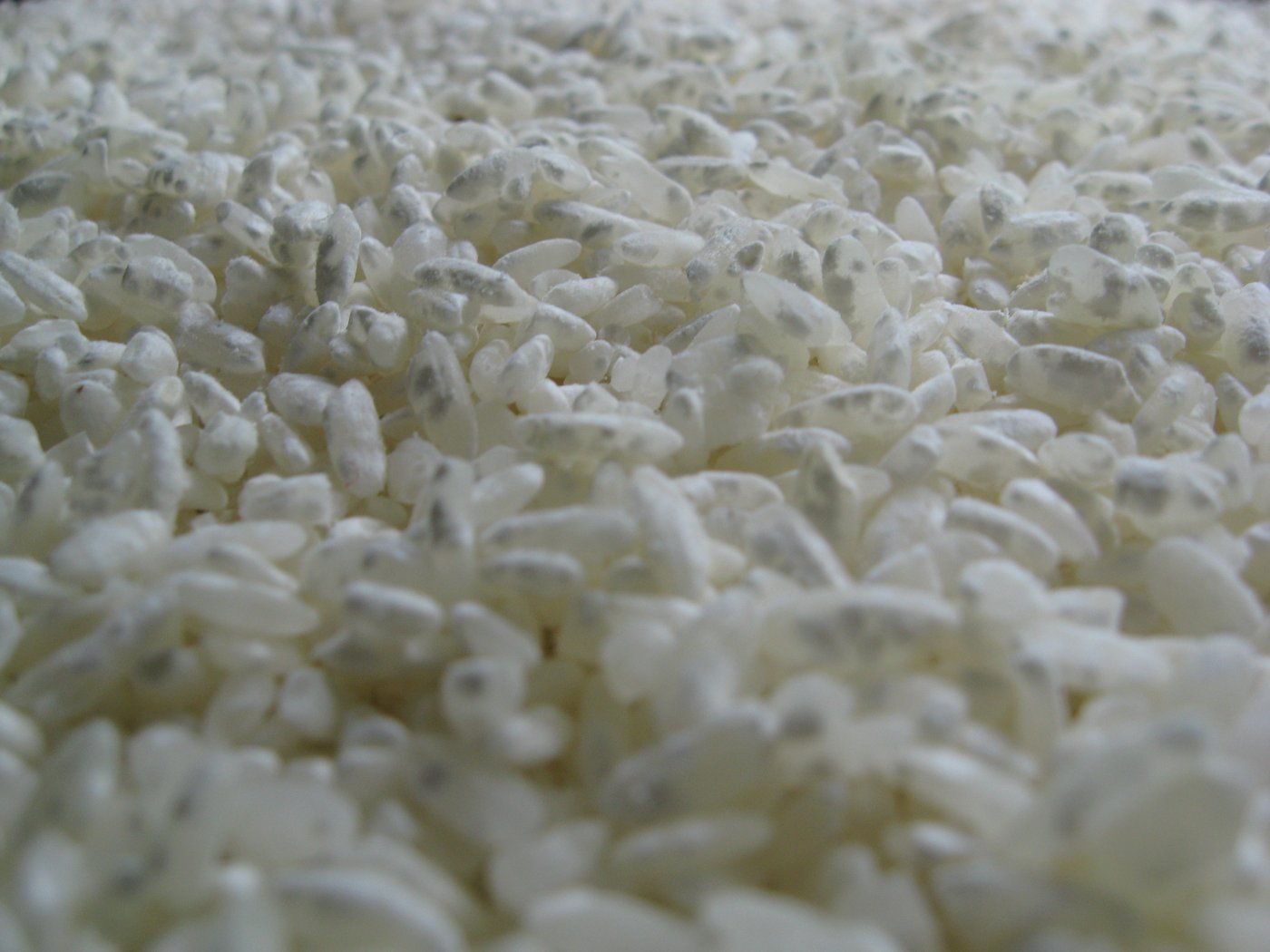
Koji mould
Aspergillus oryzae
- Known today as
- The mould grown on steamed rice or soybeans.
- Kind
- Fungus
- Constituents
- amylase, protease, kojic acid
- In other databases
- GBIF search · Wikidata search
Revised October 3, 2026: Checked against its sources, each read in full, in part, or in its abstract. Version 1, first published September 25, 2026.
Koji mould: what was it used for?
The starter of sake, soy sauce, and miso.
Koji mould: what does modern science say?
A domesticated relative of the aflatoxin mould, which does not make the toxin.
Pharmacognosy & Toxicology
- Constituents
- Mechanism
- The enzymes of Aspergillus oryzae break down the starch of rice for sake and the protein of soy for miso and soy sauce; the domesticated mould carries the aflatoxin gene cluster of its wild relative A. flavus in a broken, silent form.
- Toxic dose
- None; kojic acid, used in cosmetics to lighten skin, is restricted in cosmetics in the European Union.
- Standing
- Named the national fungus of Japan by the Brewing Society of Japan in 2006; listed as generally recognised as safe by the US Food and Drug Administration.
- Machida, M., et al. (2005). “Genome sequencing and analysis of Aspergillus oryzae.” Nature 438. Abstract read · the text read
The abstract of each source, beneath its citation. For Club members. About the Club or sign in.
Constituent names open the compound’s record at PubChem, and “ChEMBL” beside a name opens its record at ChEMBL, the European Bioinformatics Institute’s database of bioactive molecules. Where a mechanism line was checked against ChEMBL (ChEMBL 37, read 1 October 2026), the check is shown with the measured value and its source paper, or says plainly that nothing has been measured. Doses are as the references give them, for description only; this is not medical advice. Each source carries the result of its check against Crossref, PubMed, or the authority’s page: see Verification.
Koji mould: what lore surrounds it?
The Brewing Society of Japan named it the national fungus in 2006.
In Their Own Words
He describes the foreman adding three salt-spoonfuls of the spores of a fungus, which Ahlburg had described as Eurotium, to every two bushels of rice.
“To every two bushels the foreman adds three salt spoonfuls of the spores of a fungus, described by the late Mr. Ahlburg as Eurotium”
R. W. Atkinson, On the Diastase of Koji, Section I, Preparation of the Koji. Proceedings of the Royal Society of London; received March 3, read March 10, 1881 (Internet Archive OCR text). The text, read in part
Each passage is quoted from the text named, which the press fetched and read, and was checked word for word against a fresh copy of it; the link opens that copy. Passages are given as printed, without the editors’ footnote numbers, and with words broken across lines joined.
Sources
- Machida, M., et al. (2008). Genomics of Aspergillus oryzae. DNA Research 15: 173–183. Abstract read · the text read
- Wikipedia contributors. “Aspergillus oryzae.” Wikipedia, The Free Encyclopedia. en.wikipedia.org/wiki/Aspergillus_oryzae (read 2 October 2026). Read in full · the text read
- Wikipedia contributors. “Kojic acid.” Wikipedia, The Free Encyclopedia. en.wikipedia.org/wiki/Kojic_acid (read 2 October 2026). Read in full · the text read
Verification
- Checked
- October 1, 2026, and October 3, 2026
- Passes
- Every sentence read against its sources, in the pass over the remaining 343 entries
- The Standing line checked against the authority it names (EMA, WHO, FDA, CITES, Commission E)
- Every dated or regulatory claim checked by category across the database
- Every source read, in full, in part, or in its abstract, and every sentence checked against what was read (October 3, 2026)
- Sources
- 4 cited: 2 read in full, 2 abstract read. 2 with the abstract on file.
- Corrections
- said the domesticated mould had lost the aflatoxin genes; the genome paper shows the cluster present but non-functional. Corrected.
- a dangling fragment from an earlier edit restored to a full sentence.
What was checked, how, and what was found is set out on the Verification page. A checked source is one whose record was found; it does not make the entry medical advice.
Cite This Entry
Version 1 · first published September 25, 2026 · last revised October 3, 2026
- Chicago
“Koji mould.” In Materia Medica, edited by B. C. P. Statema. Version 1. The Thinking Press, 2026–. Last modified October 3, 2026. https://thethinkingpress.org/materia-medica/koji-mould.
- MLA
“Koji mould.” Materia Medica, edited by B. C. P. Statema, version 1, The Thinking Press, 3 Oct. 2026, thethinkingpress.org/materia-medica/koji-mould. Accessed 8 Oct. 2026.
- APA
Koji mould. (2026, October 3). In B. C. P. Statema (Ed.), Materia medica (Version 1). The Thinking Press. Retrieved October 8, 2026, from https://thethinkingpress.org/materia-medica/koji-mould
Club members keep entries on a shelf with private notes, print the plates as cards, and receive an entry by email each week. Create a free account before January 1, 2027 and all of it is yours for good. About the Club
See Also
Nearby in the alphabet
Labdanum (Cistus ladanifer and C) · Kermes (which yield a red dye used since antiquity) · Lady’s mantle · Juniper (The berries and wood of Juniperus communis) · Lapis lazuli, pills of · Juneberry · Laudanum (with saffron, cinnamon, and cloves) · Jewelweed
.jpg)
Historical description, not medical advice.