
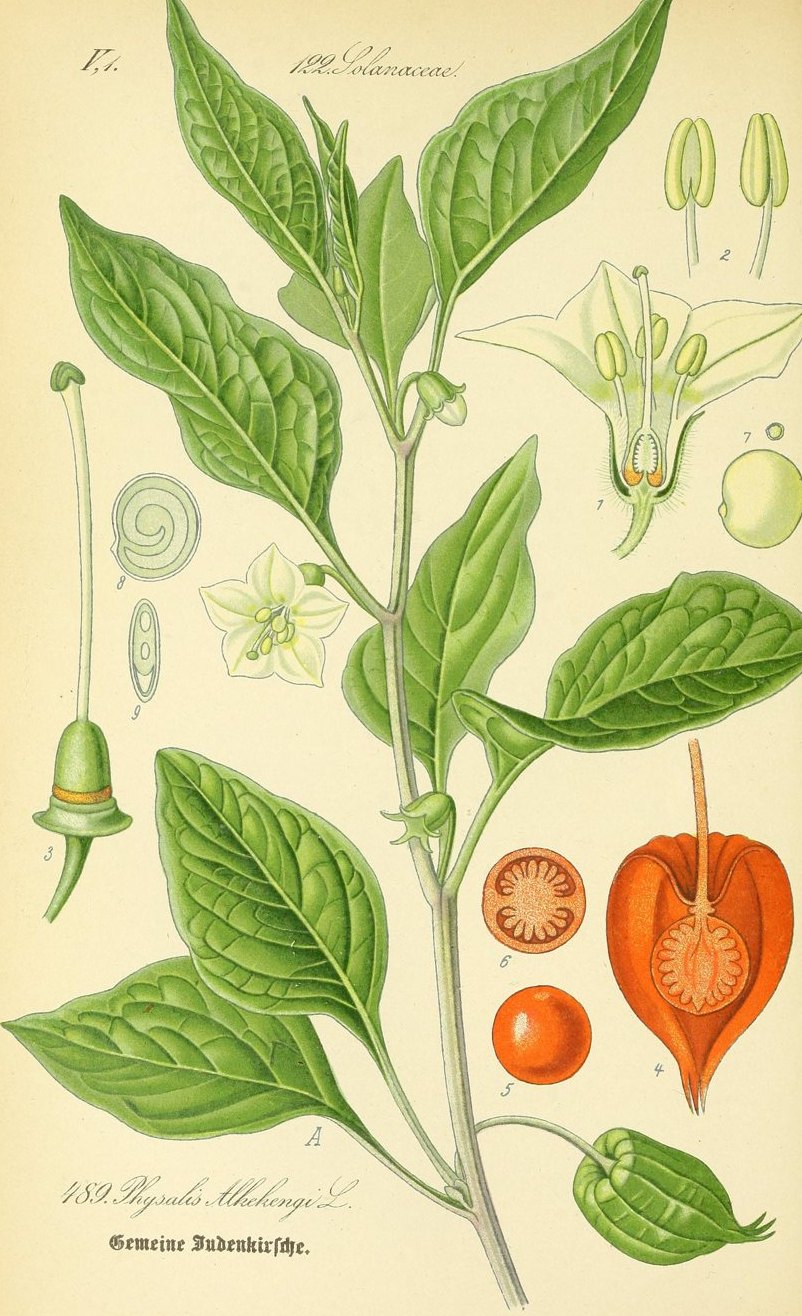
Ground cherry
Winter cherry, strawberry tomato, Cape gooseberry, goldenberry, Poha; yellow henbane; Alkekengi of the old shops; Judenkirsche and Schlutte in German; Physalis alkekengi, Physalis viscosa, Physalis peruviana
- Known today as
- Physalis, the ground cherries: nightshades whose five-cleft calyx swells after the flower falls into a papery bladder, the Greek phusa, that encloses a round berry, red in the European winter cherry and yellow or orange in the American ground cherry.
- Kind
- Plant, in 5 older authorities
- Constituents
- physalin, withanolides, citric acid, and 1 more
- Earliest authority here
- Nicholas Culpeper (1616–1654)
- In other databases
- Plants of the World Online search · GBIF search · Wikidata search
Caution. The fruit is eaten, but a strong dose of the leaves and stems causes heaviness and constipation; the winter cherry’s fruit extract harmed zebrafish embryos; and it is among the plants most often reported to a German poison centre, nearly always without symptoms.
Ground cherry: what was it used for?
The berries, slightly acid and bitter, as a diuretic and aperient for gravel, suppression of urine, and gout, six to twelve berries or half an ounce of the juice; in America the juice of the ground cherry, one or two fluid ounces, for gravel, difficult urination, and fevers with scanty urine; the leaves boiled for poultices; and the bitter principle physalin against intermittent fever.
Ground cherry: what does modern science say?
The genus is a chemist’s, for its withanolides and physalins. From the goldenberry, Physalis peruviana, a 2025 study isolated a new withanolide, physaperuvin K, from the edible fruit; it inhibited NF-κB signalling in cells at 10 nanomolar without killing them. The fruit is a source of fibre, ascorbic acid, and potassium, and its extract checked colorectal and lung cancer cells in the dish. The winter cherry is not harmless: its fruit extract was more toxic than its calyx to zebrafish embryos, and in Germany it was among the fruit plants most often reported to the Erfurt poison centre over ten years, though poisoning by fruit plants there was rare and 82 percent of exposures were without symptoms.
Pharmacognosy & Toxicology
- Constituents
- physalinthe bitter principle, obtained from the winter cherry by Dessaignes and Chautard in 1852; five physalin derivatives were found in the goldenberry fruit
- withanolidesphysaperuvin K from the edible goldenberry fruit, and seven more from the aerial parts, among them the chlorinated physalolactone
- citric acidwith sugar in the fruit
- glycidyl stearatethe key cardiotoxic component of the winter cherry’s fruit extract in the zebrafish study
- Mechanism
- The goldenberry’s withanolides inhibited NF-κB activity at 10 to 60 nanomolar and the production of nitric oxide in activated macrophages at low micromolar concentrations, without overt cytotoxicity. The toxicity of the winter cherry’s fruit extract to zebrafish embryos lay in a 5 to 10 kilodalton fraction that was not polysaccharide, and removing it made the extract safer.
- Toxic dose
- Six to twelve berries, or half an ounce of the expressed juice, by Grieve; one or two fluid ounces of the juice of the American ground cherry, by King’s.
- Standing
- Food more than medicine: a 2025 analysis of the goldenberry’s nutrients and phytochemicals supports its name of “superfruit,” while the winter cherry’s toxicological profile, the zebrafish study says, “has not been comprehensively assessed.”
- Sang-Ngern, M., et al. (2025). Biologically active withanolides from Physalis peruviana. Pharmaceutical Biology 63: 334–343. doi:10.1080/13880209.2025.2488136 Verified against its record · PMID 40285658
- Añibarro-Ortega, M., et al. (2025). Nutrients, phytochemicals, and in vitro biological activities of goldenberry (Physalis peruviana L.) fruit and calyx. Plants 14: 327. doi:10.3390/plants14030327 Verified against its record · PMID 39942889
- Zhou, Z., et al. (2026). Acute developmental toxicity and cardiotoxicity of Physalis alkekengi L. fruit and calyx extracts based on zebrafish (Danio rerio) model. Journal of Ethnopharmacology 364: 121534. doi:10.1016/j.jep.2026.121534 Verified against its record · PMID 41839299
- Wendt, S., Prasa, D., Lübbert, C., Begemann, K., & Franke, H. (2023). Exposures to fruit plants in Germany from 2010–2019: analysis of the Erfurt joint poison information center database. Bundesgesundheitsblatt 66: 1423–1433. doi:10.1007/s00103-023-03780-7 Verified against its record · PMID 37828294
The abstract of each source, beneath its citation. For Club members. About the Club or sign in.
Constituent names open the compound’s record at PubChem, and “ChEMBL” beside a name opens its record at ChEMBL, the European Bioinformatics Institute’s database of bioactive molecules. Where a mechanism line was checked against ChEMBL (ChEMBL 37, read 1 October 2026), the check is shown with the measured value and its source paper, or says plainly that nothing has been measured. Doses are as the references give them, for description only; this is not medical advice. Each source carries the result of its check against Crossref, PubMed, or the authority’s page: see Verification.
Ground cherry: what lore surrounds it?
The bladder names the plant: Greek phusa, for the calyx that swells into a lantern round the fruit, which Thomé’s Flora paints mennigrot, the red of red lead, calyx and berry alike. The Germans call it Judenkirsche, the Jews’ cherry, and Schlutte. Ray’s gouty patient took eight berries at every change of the moon; Culpeper had the berries bruised into the ale as it was tunned; the yellow colouring of the skin and calyx was once used for butter; and a preparation called Lithal, an extract of the berries with a lithium salt, was sold. The Dioscorides whom Millspaugh and Grieve invoke is known here only through them.
Ground cherry: what did the older authorities say?
- Nicholas Culpeper
- Winter-cherries are “a plant of Venus,” not native to England but cherished in gardens for their virtues: the leaves cooling, for inflammations; the berries opening, provoking urine plentifully when it is stopped or hot and painful, and expelling the stone and gravel of the reins, kidneys, and bladder. Three or four handfuls of the bruised berries put into as many gallons of new beer or ale make a drink which, “taken daily, has been found to do much good to many, both to ease the pains, and expel urine and the stone, and to cause the stone not to engender.”
- C. S. Rafinesque
- Holds all the species equal to Solanum virginicum, “but berries acid bitterish, liked by children, good diuretic and sedative.”
- Charles F. Millspaugh
- Notes among the nightshades that many species of Physalis are valuable, and that the winter cherry “has been considered an excellent diuretic from the days of Dioscorides; Ray considered it also anti-podagric.”
- King’s American Dispensatory
- Gives the berries of Physalis viscosa, the ground cherry or yellow henbane of dry fields and roadsides, as tonic, laxative, and diuretic, said also to be sedative, their juice reputed very beneficial in gravel and difficult urination, one or two fluid ounces; and reports that Dessaignes and Chautard in 1852 obtained from the European winter cherry its bitter principle, physalin, “which has been employed with success in intermittent fever.”
- Mrs. M. Grieve
- Records that in Germany, Spain, and Switzerland the berries are eaten freely; that Ray told of a gouty patient who kept off the disorder by taking eight berries at each change of the moon, and that Dioscorides claimed they would cure epilepsy; that country people use them for their beasts and for themselves, especially after scarlet fever; and that the plant sold in pots as winter cherry is Solanum pseudo-capsicum, no Physalis at all.
Sources
- Culpeper, N. The Complete Herbal, “Winter-Cherries.” Project Gutenberg, 49513. Primary text
- Rafinesque, C. S. (1828). Medical Flora, or Manual of the Medical Botany of the United States of North America, vol. 2, “Physalis,” p. 250. Internet Archive, b21468710_0002. Primary text
- Millspaugh, C. F. (1887). American Medicinal Plants, vol. 2, the note on the Solanaceae at no. 125. Internet Archive, americanmedicina02mill_0. Primary text
- Felter, H. W., & Lloyd, J. U. (1898). King’s American Dispensatory, “Physalis.—Ground Cherry.” As transcribed at Henriette’s Herbal Homepage, henriettes-herb.com. Standard reference work
- Grieve, M. A Modern Herbal, “Cherry, Winter.” As published on botanical.com. Standard reference work
- Thomé, O. W. (1889). Flora von Deutschland, Österreich und der Schweiz, Bd. 4, “Gattung 639: Physalis,” and Tafel 489. Internet Archive, profdrthomesflor41889thom. Primary text
Verification
- Checked
- October 1, 2026
- Passes
- Every sentence read against its sources, in the pass over the remaining 343 entries
- The Standing line checked against the authority it names (EMA, WHO, FDA, CITES, Commission E)
- Every dated or regulatory claim checked by category across the database
- Sources
- 10 cited: 4 verified against its record, 4 primary text, 2 standard reference work. 4 with the abstract on file.
- Corrections
- None were needed.
What was checked, how, and what was found is set out on the Verification page. A checked source is one whose record was found; it does not make the entry medical advice.
Cite This Entry
Version 1 · first published October 3, 2026
- Chicago
“Ground cherry.” In Materia Medica, edited by B. C. P. Statema. Version 1. The Thinking Press, 2026–. Last modified October 3, 2026. https://thethinkingpress.org/materia-medica/ground-cherry.
- MLA
“Ground cherry.” Materia Medica, edited by B. C. P. Statema, version 1, The Thinking Press, 3 Oct. 2026, thethinkingpress.org/materia-medica/ground-cherry. Accessed 8 Oct. 2026.
- APA
Ground cherry. (2026, October 3). In B. C. P. Statema (Ed.), Materia medica (Version 1). The Thinking Press. Retrieved October 8, 2026, from https://thethinkingpress.org/materia-medica/ground-cherry
Club members keep entries on a shelf with private notes, print the plates as cards, and receive an entry by email each week. Create a free account before January 1, 2027 and all of it is yours for good. About the Club
See Also
Also in Nicholas Culpeper
Ground ivy in Nicholas Culpeper · Feverfew in Nicholas Culpeper · Ground pine in Nicholas Culpeper · Eryngo in Nicholas Culpeper · everything Nicholas Culpeper names →
Also in M. Grieve
Mayapple in M. Grieve · Ginseng in M. Grieve · Pawpaw in M. Grieve · Clove in M. Grieve · everything M. Grieve names →
Drawing on the same sources: Culpeper, Rafinesque, Millspaugh, Felter
Golden pills · Jewelweed · Chokecherry · Ghost pipe · the bibliography →
Nearby in the alphabet
Greater celandine (Chelidonium majus) · Gorse (Ulex europaeus) · Guaiacum (The wood and resin of Guaiacum officinale and G) · Gum arabic (The dried sap of Senegalia senegal and related acacias) · Gold, frankincense, and myrrh (The gifts of the Magi)
Historical description, not medical advice.