
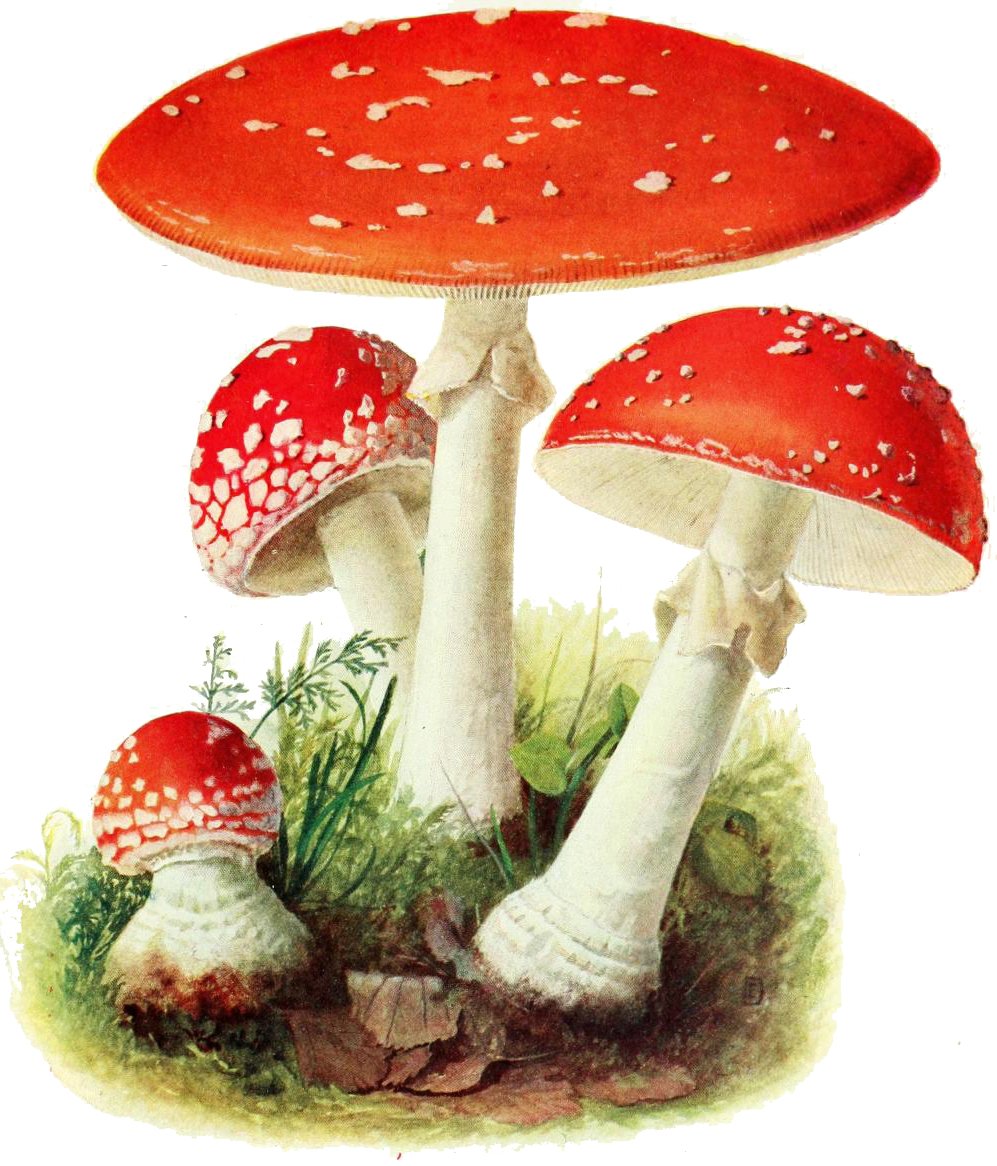
Fly agaric
Amanita muscaria
- Known today as
- The red, white-spotted toadstool of fairy tales, of birch and pine woods.
- Kind
- Fungus, in 3 older authorities
- Constituents
- ibotenic acid, muscimol, muscarine
- Earliest authority here
- Albertus Magnus (c. 1200–1280)
- In other databases
- GBIF search · Wikidata search
Revised October 3, 2026: Tradition, lore, modern assessment, and sources extended. Checked against its sources, each read in full, in part, or in its abstract. Version 1, first published September 25, 2026.
Caution. Poisonous.
Fly agaric: what was it used for?
Powdered in milk to kill flies, as Albertus Magnus recorded in the thirteenth century; eaten as an intoxicant by peoples of Siberia.
Fly agaric: what does modern science say?
Its ibotenic acid and muscimol cause delirium, drowsiness, and vivid dreams. Deaths are rare, but it is a poison. Muscimol, its chief drug, acts on the brain’s GABA receptors like a strong sedative, and ibotenic acid, which becomes muscimol on drying, is a nerve excitant; together they bring drowsiness, twitching, confusion, and sometimes vivid dreams, usually ending in recovery within a day. Muscarine, named from it, is present only in traces.
Fly agaric: is it poisonous?
Yes, in some form or dose. Poisonous. Its poisoning is ibotenic acid and muscimol (pantherine syndrome): Thirty minutes to two hours. Historical description, not medical advice; in a poisoning, call a poison centre.
Pharmacognosy & Toxicology
- Constituents
- Mechanism
- Muscimol is a GABA-A agonist; ibotenic acid a glutamate agonist.
- Checked against ChEMBL
- muscimol: Measured, as the entry says (“a GABA-A agonist”): GABA-A receptor; anion channel (human), IC50 2 nM, CHEMBL1125342; GABA-A receptor; anion channel (rat), IC50 3 nM, CHEMBL1122920.
- ibotenic acid: Measured, as the entry says (“a glutamate agonist”): Glutamate receptor ionotropic, kainate 3 (rat), Ki 1.7 µM, CHEMBL1629540; Glutamate receptor ionotropic, kainate 1 (rat), Ki 2.4 µM, CHEMBL1629540.
- Toxic dose
- The effect varies widely, and similar doses can act quite differently in different people; with modern treatment, deaths are extremely rare.
- Syndrome
- Ibotenic acid and muscimol (pantherine syndrome)
- Standing
- None; after an outbreak of poisonings from products containing it, the US Food and Drug Administration banned its use in food in December 2024.
- Michelot, D., and Melendez-Howell, L. M. (2003). Mycological Research 107. Book, not indexed
The abstract of each source, beneath its citation. For Club members. About the Club or sign in.
Constituent names open the compound’s record at PubChem, and “ChEMBL” beside a name opens its record at ChEMBL, the European Bioinformatics Institute’s database of bioactive molecules. Where a mechanism line was checked against ChEMBL (ChEMBL 37, read 1 October 2026), the check is shown with the measured value and its source paper, or says plainly that nothing has been measured. Doses are as the references give them, for description only; this is not medical advice. Each source carries the result of its check against Crossref, PubMed, or the authority’s page: see Verification.
Fly agaric: what lore surrounds it?
The toadstool of fairy tales and children’s books. Among the Koryak and other Siberian peoples it was taken by shamans and others, and its effects were said to pass into the urine of those who ate it. R. Gordon Wasson argued in 1968 that it was the Soma of the Rigveda.
Travellers’ reports of how it distorts the size of things are thought to lie behind the mushroom Alice eats in Alice’s Adventures in Wonderland (1865). Wasson’s identification of it with Soma is now doubted, and the theory that berserkers ate it before battle has no ancient source. Santa Claus’s flying reindeer have been read as a memory of its use by Sámi shamans, a reading the Sámi themselves reject.
Fly agaric: what did the older authorities say?
- Albertus Magnus
- Recorded, some time before 1256, that it was called the fly fungus because, powdered in milk, it kills flies; its name in many European languages is thought to come from this use.
- The Koryak and Chukchi
- Dried it in the sun or over the hearth and ate it, and many shamans took it before their seances, as Waldemar Jochelson recorded of the Koryak; the Chukchi tore it into pieces and chewed it. Those who could not afford it drank the urine of those who had eaten it and became as drunk, and Georg Steller wrote that when the Koryak met a reindeer intoxicated by the mushroom they tied its legs until the effect had passed.
- Linnaeus
- Named it Agaricus muscarius in 1753; Lamarck moved it to Amanita in 1783.
Sources
- Albertus Magnus, De vegetabilibus. Read in part · the text read
- Wasson, R. G. (1968). Soma: Divine Mushroom of Immortality. Read in part · the text read
- Michelot, D., and Melendez-Howell, L. M. (2003). “Amanita muscaria: chemistry, biology, toxicology, and ethnomycology.” Mycological Research 107. Abstract read · the text read
- Wikipedia contributors. “Amanita muscaria.” Wikipedia, The Free Encyclopedia. en.wikipedia.org/wiki/Amanita_muscaria (read 2 October 2026). Read in full · the text read
- Wikipedia contributors. “Muscimol.” Wikipedia, The Free Encyclopedia. en.wikipedia.org/wiki/Muscimol (read 2 October 2026). Read in full · the text read
- Wikipedia contributors. “Ibotenic acid.” Wikipedia, The Free Encyclopedia. en.wikipedia.org/wiki/Ibotenic_acid (read 2 October 2026). Read in full · the text read
Verification
- Checked
- October 1, 2026, and October 3, 2026
- Passes
- Every sentence read against its sources, in the pass over the remaining 343 entries
- The Standing line checked against the authority it names (EMA, WHO, FDA, CITES, Commission E)
- Every dated or regulatory claim checked by category across the database
- The mechanism read against ChEMBL (ChEMBL 37): curated mechanisms and measured activity
- Every source read, in full, in part, or in its abstract, and every sentence checked against what was read (October 3, 2026)
- Sources
- 7 cited: 3 read in full, 2 read in part, 1 abstract read, 1 book, not indexed. 2 with the abstract on file.
- Corrections
- None were needed.
What was checked, how, and what was found is set out on the Verification page. A checked source is one whose record was found; it does not make the entry medical advice.
Cite This Entry
Version 1 · first published September 25, 2026 · last revised October 3, 2026
- Chicago
“Fly agaric.” In Materia Medica, edited by B. C. P. Statema. Version 1. The Thinking Press, 2026–. Last modified October 3, 2026. https://thethinkingpress.org/materia-medica/fly-agaric.
- MLA
“Fly agaric.” Materia Medica, edited by B. C. P. Statema, version 1, The Thinking Press, 3 Oct. 2026, thethinkingpress.org/materia-medica/fly-agaric. Accessed 8 Oct. 2026.
- APA
Fly agaric. (2026, October 3). In B. C. P. Statema (Ed.), Materia medica (Version 1). The Thinking Press. Retrieved October 8, 2026, from https://thethinkingpress.org/materia-medica/fly-agaric
Club members keep entries on a shelf with private notes, print the plates as cards, and receive an entry by email each week. Create a free account before January 1, 2027 and all of it is yours for good. About the Club
See Also
Poisoned alike: ibotenic acid and muscimol (pantherine syndrome)
Sharing ibotenic acid, muscimol, muscarine
Also in Carl Linnaeus
Cinchona in Carl Linnaeus · Deadly nightshade in Carl Linnaeus · everything Carl Linnaeus names →
Drawing on the same sources: Michelot
Nearby in the alphabet
Foetid pills · The fig hand (made as a gesture or carved as a charm) · Fool’s webcap (A tawny webcap of European woods) · Fig (Ficus carica) · Foxglove (Digitalis purpurea) · Feverfew (Tanacetum parthenium) · Fox’s heart (The dried heart of a fox) · Fern seed (mistaken for seed)

Historical description, not medical advice.