
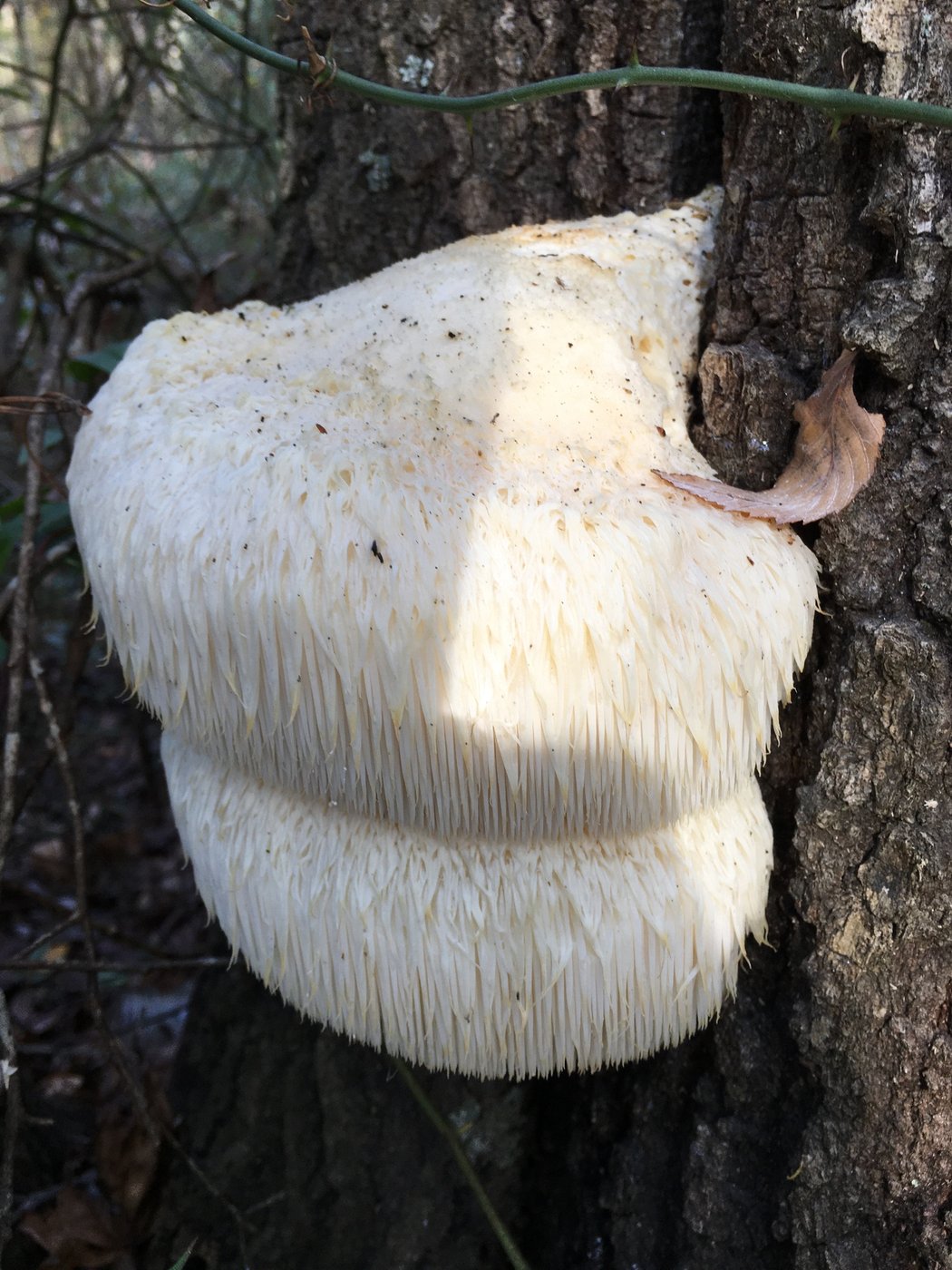
Lion’s mane
Hericium erinaceus
- Known today as
- A single clump of hanging spines on hardwood trees.
- Kind
- Fungus, in 2 older authorities
- Constituents
- hericenone B, erinacine A
- In other databases
- GBIF search · Wikidata search
Revised October 17, 2026: Tradition, lore, modern assessment, and sources extended. Checked against its sources, each read in full, in part, or in its abstract. Version 1, first published September 25, 2026.
Lion’s mane: what was it used for?
Food and tonic in Chinese and Japanese cooking and medicine.
Lion’s mane: what does modern science say?
Its hericenones and erinacines stimulate nerve growth factor in the laboratory, and a small Japanese trial suggested benefit in mild cognitive impairment; the evidence is early. Hericenones and erinacines raise nerve growth factor in cultured cells, which is the basis of the claims for the brain. The Japanese trial of 2009 in thirty people with mild cognitive impairment found a gain on a rating scale that faded within four weeks of stopping the tablets.
The toxic dose and the poisoning
- Toxic dose
- Generally safe as a food; the side effects reported with supplements include stomach discomfort, headache, and allergic reactions.
The references for these lines are listed under Pharmacognosy, in Science. Doses are as the references give them, for description only; this is not medical advice. In a poisoning, call a poison centre.
Lion’s mane: what did the older authorities say?
- Its names
- Hóutóugū, the monkey-head mushroom, in China; yamabushitake in Japan, after the yamabushi, the mountain ascetics of Shugendo.
- Chinese medicine
- Gives it for gastritis and ulcers, and, by one review’s account, to sharpen memory; it was also valued against fatigue.
Lion’s mane: what lore surrounds it?
It grows as one clump of hanging spines, and its Latin names both mean ‘hedgehog.’
Its meaty texture has led to trials of it as a stand-in for steak.
Pharmacognosy
- Constituents
- hericenone B
- erinacine A ChEMBLfrom the mycelium
- Mechanism
- Erinacines induce nerve growth factor in cultured cells.
- Standing
- No approved use; small trials.
- Mori, K., et al. (2009). Phytotherapy Research 23. Abstract read · the text read
The abstract of each source, beneath its citation. For Club members. About the Club or sign in.
Constituent names open the compound’s record at PubChem, and “ChEMBL” beside a name opens its record at ChEMBL, the European Bioinformatics Institute’s database of bioactive molecules. Where a mechanism line was checked against ChEMBL (ChEMBL 37, read 1 October 2026), the check is shown with the measured value and its source paper, or says plainly that nothing has been measured. Doses are as the references give them, for description only; this is not medical advice. Each source carries the result of its check against Crossref, PubMed, or the authority’s page: see Verification.
Sources
- Mori, K., et al. (2009). Improving effects of Hericium erinaceus on mild cognitive impairment. Phytotherapy Research 23: 367–372. Verified against its record · doi:10.1002/ptr.2634
- Mori, K., et al. (2009). Phytotherapy Research 23. Abstract read · the text read
- Friedman, M. (2015). “Chemistry, nutrition, and health-promoting properties of Hericium erinaceus.” Journal of Agricultural and Food Chemistry 63. Abstract read · the text read
- Wikipedia contributors. “Hericium erinaceus.” Wikipedia, The Free Encyclopedia. en.wikipedia.org/wiki/Hericium_erinaceus (read 2 October 2026). Read in full · the text read
- Wikipedia contributors. “Hericenone.” Wikipedia, The Free Encyclopedia. en.wikipedia.org/wiki/Hericenone (read 2 October 2026). Read in full · the text read
- Wikipedia contributors. “Erinacine.” Wikipedia, The Free Encyclopedia. en.wikipedia.org/wiki/Erinacine (read 2 October 2026). Read in full · the text read
- Menon, A., et al. (2025). Benefits, side effects, and uses of Hericium erinaceus as a supplement: a systematic review. Frontiers in Nutrition 12: 1641246. Read in full · the text read
- Ge, F., et al. (2025). Bioactive polysaccharides from Hericium erinaceus: extraction, structure, bioactivities, and applications. Molecules 30: 1850. Read in full · the text read
Verification
- Checked
- October 1, 2026, October 17, 2026
- Passes
- Read against its sources in the pass over the remaining 343 entries
- Every dated or regulatory claim checked by category across the database
- Every source read, in full, in part, or in its abstract, and every sentence checked against what was read (October 17, 2026)
- Sources
- 8 cited: 5 read in full, 2 abstract read, 1 verified against its record. 3 with the abstract on file.
- Corrections
- None recorded.
What was checked, how, and what was found is set out on the Verification page. A checked source is one whose record was found; it does not make the entry medical advice.
Club members can point at a technical term in this entry, such as a constituent, an action, or a word of Jung’s, to read its definition from the source. The Club.
Cite This Entry
Version 1 · first published September 25, 2026 · last revised October 17, 2026
- Chicago
“Lion’s mane.” In Materia Medica, edited by B. C. P. Statema. Version 1. The Thinking Press, 2026–. Last modified October 17, 2026. https://thethinkingpress.org/materia-medica/lions-mane.
- MLA
“Lion’s mane.” Materia Medica, edited by B. C. P. Statema, version 1, The Thinking Press, 17 Oct. 2026, thethinkingpress.org/materia-medica/lions-mane. Accessed 22 Nov. 2026.
- APA
Lion’s mane. (2026, October 17). In B. C. P. Statema (Ed.), Materia medica (Version 1). The Thinking Press. Retrieved November 22, 2026, from https://thethinkingpress.org/materia-medica/lions-mane
See Also
Nearby in the alphabet
Litharge (a byproduct of refining silver) · Linseed · Liverwort, or hepatica (Hepatica nobilis (syn) · Lime flower · Livid pinkgill (of broadleaf woods) · Licorice (The root of Glycyrrhiza glabra) · Lobelia · Letters from Heaven
Historical description, not medical advice.

