
Charming the Wart
The toad, the bean, and the natural history of warts.
In the Texts
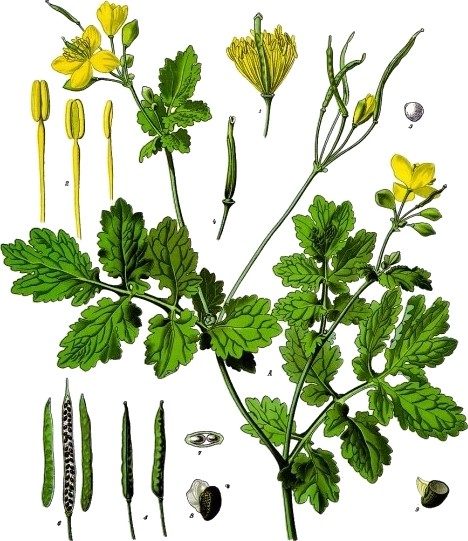
The wart charms are the commonest of all folk cures: rub it with a bean and bury the bean, with a snail and impale the snail, with meat and bury the meat, sell it for a pin, touch it with the toad; the greater celandine’s orange juice and the fig’s milk are the Materia Medica’s own. The charmers were the village’s respectable magicians, and Canale’s book is against them.
What Medicine Makes of It
Massing and Epstein (1963) watched 1,000 children for two years without treatment: two-thirds of the warts went on their own. Warts are papillomavirus and the immune system clears them in groups, which is why the charm seems to take them all at once. Surman (1973) and Spanos (1990) found hypnotic suggestion cleared warts in controlled trials, which is as near as medicine has come to the charm; the pooled trials (Kwok et al., 2011, 2012) put salicylic acid at about half cured against a quarter on placebo, and freezing no better than placebo unless aggressive.
The Evidence
- Massing and Epstein (1963) followed 1,000 institutionalised children for two years without treatment: two-thirds of the warts present at the start had gone by the end, and new ones appeared meanwhile; any charm applied to a wart has a two-in-three chance of apparent success within two years.
- Warts are caused by human papillomaviruses, identified in the 1970s; the immune system clears them, which is why they go in groups and why the charm that “sells” them seems to work on all at once.
- Surman, Gottlieb, Hackett, and Silverberg (1973) found hypnotic suggestion cleared warts on the treated side of the body in half of subjects against none of controls; Spanos, Williams, and Gwynn (1990) found suggestion matched salicylic acid and both beat no treatment at six weeks, and that the effect was on the children who imagined the warts shrinking.
- The charms, rubbing with a bean, a snail, a piece of meat buried, a cut potato, the toad, a stolen dishcloth, are gathered in Black (1883) and Radford (1961); the mechanism they share is the passage of time.
- Kwok et al. (2011, 2012), pooling 77 trials, found salicylic acid cured about 52 per cent of warts against 23 per cent on placebo, and cryotherapy no better than placebo unless aggressive, when it matched the acid; the toad and the charm are not far behind the dermatologist on the numbers, which is a fact about warts.
Where They Part
The charm works by time, and the dermatologist by a little more than time; the suggestion trials leave open a route by which the charmer’s confidence did something. The reading is about the base rate, and the base rate is two in three.
In the Materia Medica
Sources
- Massing, A. M., and Epstein, W. L. (1963). “Natural history of warts: a two-year study.” Archives of Dermatology 87.
- Spanos, N. P., Williams, V., and Gwynn, M. I. (1990). “Effects of hypnotic, placebo, and salicylic acid treatments on wart regression.” Psychosomatic Medicine 52.
- Kwok, C. S., et al. (2012). “Topical treatments for cutaneous warts.” Cochrane Database of Systematic Reviews 9.
- Black, W. G. (1883). Folk-Medicine. Folklore Society.
Historical and interpretive; not medical advice.